
Strategic Background
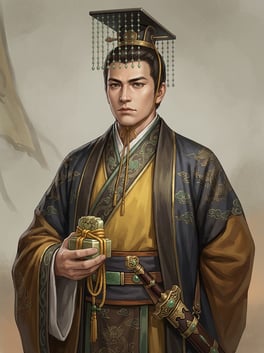
After Cao Pi became emperor, relations with Eastern Wu swung repeatedly from “submission” to “rupture.” Sun Quan had at one point acknowledged Wei as his suzerain, only to make peace with Shu Han again after Liu Bei's Eastern Campaign (Battle of Xiaoting) failed. For Cao Pi, emperor of the new dynasty, Eastern Wu’s vacillation was both a diplomatic embarrassment and an opportunity to prove his military prowess. The Records of the Three Kingdoms, “Annals of Emperor Wen,” records that in 224 (the fifth year of Huangchu), in the eighth month, Cao Pi assembled a navy and personally traveled by dragon boat along the Cai and Ying Rivers into the Huai River basin. He passed through Shouchun and reached Guangling in the ninth month. In 225 (the sixth year of Huangchu), he made another eastern inspection tour, arriving at the old city of Guangling in the tenth month to review his troops by the river. His forces were said to number more than a hundred thousand, with banners stretching for hundreds of li.
It should be noted that these two visits to Guangling were separate from the Wei campaign against Wu along three routes in the third year of Huangchu (Cao Xiu and Zhang Liao advanced from Dongkou, Cao Ren attacked Ruxu, and Cao Zhen besieged Jiangling). The Guangling expeditions were distinguished by the emperor’s personal presence and the water route that brought him directly to the north bank of the Yangtze. Their chief purpose was intimidation and reconnaissance, rather than a large-scale crossing of the river. Chapter 86 of Romance of the Three Kingdoms, however, turns the two inspections into a campaign with a complete victory and defeat.
The Two Sides’ Deployments
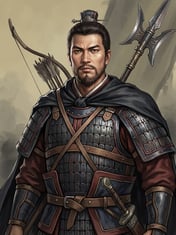
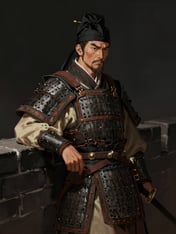
In the novel’s version, Cao Zhen led the Wei vanguard, first forming ranks north of the river. Cao Pi then arrived at Guangling aboard a great dragon boat adorned with multicolored banners bearing dragons and phoenixes, the sun and moon, accompanied by strategists including Liu Ye and Jiang Ji. On the Wu side, Xu Sheng oversaw the river defenses, while Sun Shao, Ding Feng, and other generals divided their troops and lay in ambush. At first, Cao Pi saw no one on the opposite bank and suspected a trap. Liu Ye advised him to wait several days, then send an advance force across the river to test the waters.
The historical accounts place greater emphasis on psychological warfare. The “Biography of Xu Sheng” records that when the Wei emperor came to Guangling in the fifth year of Huangchu, Xu Sheng, despite objections from the other generals, had fences and mock towers built along the river from Jianye, and boats set afloat on the water, the defenses extending for hundreds of li. Pei Songzhi’s annotation to the “Biography of the Wu Ruler,” quoting Gan Bao’s Jin Ji, also says that the people of Wu built a “phantom city” in a single night. On seeing it, Cao Pi sighed that the enemy held the opposite bank and could not be attacked, and then withdrew. On the campaign in the sixth year of Huangchu, more than a hundred thousand Wei troops reached the river, only to encounter bitter cold that froze the waterways and kept their ships from entering the river. Sun Shao also sent the general Gao Shou with five hundred picked volunteers to launch a night raid along a narrow path, capturing the emperor’s spare carriage and feathered parasol.
Key Decisions
The first decision point in this campaign was whether to cross the river. Neither in the novel nor in the historical accounts did Cao Pi actually order a crossing. The novel explains this through Liu Ye’s cautious advice, while the historical accounts show that Xu Sheng’s phantom city and the natural barrier of the Yangtze alone were enough to make Cao Pi hesitate. Cao Pi’s remark during the sixth year of Huangchu—that the Yangtze was a natural boundary dividing north from south—aptly conveys his understanding of the difficulty of crossing it.
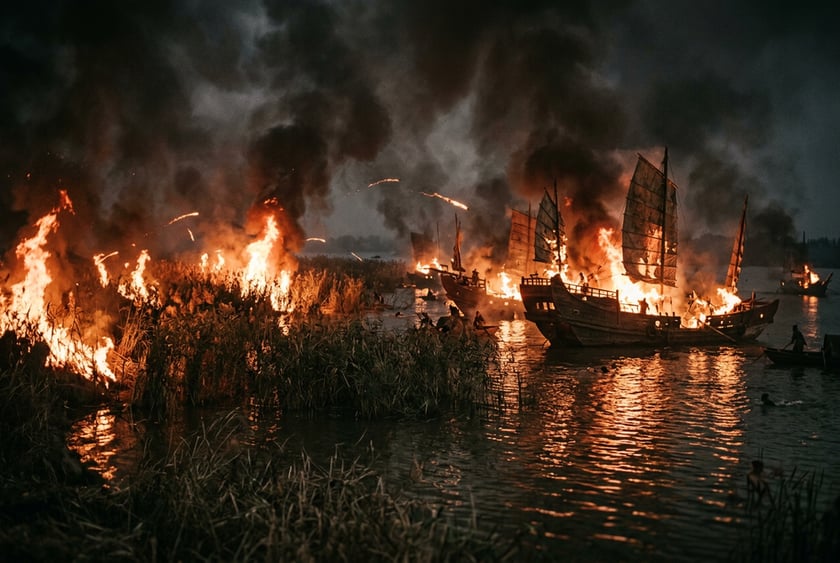
The second decision point was how to retreat. Here, the novel adds a great deal of dramatic material: as the Wei army retreated to the Huai River, the reeds had already been soaked with fish oil. The Wu army set them alight with the wind at their backs, the dragon boat caught fire, and Cao Pi hurriedly transferred to a small boat, then mounted a horse and fled. Ding Feng’s ambush sprang out; Zhang Liao was struck by an arrow; and Sun Shao and Ding Feng seized large quantities of carts, horses, ships, and weapons, routing the Wei army. This episode can be seen as an expansion of the historical account’s brief incident in which Sun Shao’s night raid captured the spare carriage and feathered parasol, with a fire attack motif added to it.
A third point deserves separate mention: the novel says that Zhang Liao was shot in the waist by Ding Feng during this campaign and died after his arrow wound burst open upon his return to Xu Chang. According to the “Biography of Zhang Liao” in the Records of the Three Kingdoms, however, Zhang Liao died of illness at Jiangdu in the third year of Huangchu while accompanying Cao Xiu on a campaign against Wu. His death had nothing to do with either of the two visits to Guangling. The novel moved his death to this episode to give him a “death on the battlefield.”
Outcome and Aftermath
The historical expeditions to Guangling achieved no decisive military result: the Wei army did not cross the river, and the Wu army did not attack north of it. Both sides suffered only limited losses. The real “victory” was that Eastern Wu, at relatively little cost, blunted the emperor of Wei’s eagerness to lead a campaign in person. Cao Pi died the following year, in the seventh year of Huangchu. After that, no Wei emperor ever again traveled in person to the Yangtze in an attempt to cross it, and the Wei-Wu confrontation on the eastern front settled into a prolonged stalemate centered on Hefei and Ruxu.
In the novel’s narrative, the campaign instead becomes a stage for the collective debut of Eastern Wu’s generals: Xu Sheng directs the overall effort, Ding Feng shoots a general, and Sun Shao captures equipment, while the King of Wu rewards Xu Sheng lavishly. The episode also echoes Deng Zhi’s mission to Wu and the restoration of the Wu-Shu alliance elsewhere in the same chapter, showing that Eastern Wu, with its alliance with Shu restored, was now capable of resisting Wei on its own.
Counterfactual Analysis
If Cao Pi had actually ordered a crossing in the fifth year of Huangchu, the Wei army would have faced numerous challenges: limited naval experience, a long supply line, and uncertainty about the strength and disposition of the defenses on the opposite bank. The lesson of the defeat at Chibi was still fresh. A forced crossing could well have led to heavy losses, dealing a severe blow to the prestige of the newly established Wei dynasty.
Would events have been different if the severe cold of the winter in the sixth year of Huangchu had not occurred and the Wei ships had been able to enter the river? Given that Eastern Wu had already established defenses in depth along the Jianye front, and that supplying an army of more than a hundred thousand over an extended period would have been difficult, Cao Pi would most likely still have withdrawn after reviewing his troops. The two expeditions to Guangling were more like a new emperor making a show of authority to consolidate his rule than genuine campaigns aimed at destroying Wu.