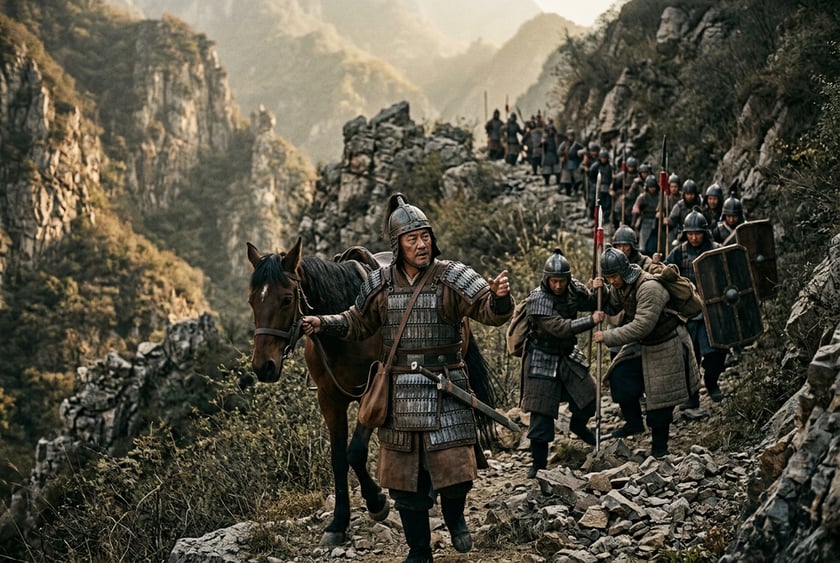
The fall of Shuhan came in the sixth year of Jingzhu (263), the culmination of a campaign against Shu conceived and directed by Sima Zhao. In the fifth month of that year the Wei emperor — acting on Sima Zhao's decisions — issued an edict dispatching a three-pronged invasion: General-Who-Pacifies-the-West Zhong Hui led the main force of more than one hundred thousand troops through the Xie and Luo valleys into Hanzhong; General-Who-Conquers-the-West Deng Ai commanded his forces from Gansong and Dazhong to pin down Jiang Wei; and Yongzhou Inspector Zhuge Xu moved from Wujie and Qiaotou to cut off Jiang Wei's line of retreat. The outlying Hanzhong strongholds of Lecheng, Hancheng, and Yangpingguan were successively neutralized by Zhong Hui's pressure; Fu Qian died in battle and Jiang Shu surrendered. Jiang Wei fought a fighting withdrawal from Dazhong, joined forces with Liao Hua, Zhang Yi, and Dong Jue, and fell back to hold Jianmen Pass against Zhong Hui's main army. In the tenth month, Deng Ai proposed a daring flanking route through the trackless Yinping corridor, led a picked force across seven hundred li of uninhabited terrain, drove straight to Jiangyou, and then at Mianzhu killed Zhuge Zhan and Zhuge Shang, father and son. Emperor Liu Chan convened a council of ministers and accepted the counsel of Grand Master of the Palace Qiao Zhou in favor of surrender; an envoy was dispatched to offer the imperial seals and ribbons to Deng Ai. Liu Chen, Prince of Beidì, wept before the ancestral shrine of the Illustrious Founding Emperor, killed his own wife and children, and then took his own life in loyal sacrifice. The following year, in the first month, Zhong Hui and Jiang Wei's planned coup in Chengdu miscarried and both were killed, and Shuhan's crown prince Liu Xuan also died in the chaos. Shuhan had been founded in the first year of Zhangwu under Emperor Zhaoplie (221), and it thus endured for forty-three years before its extinction.
The Records of the Three Kingdoms records that, in the final years of Jingyao, Huang Hao wielded power in the Shu Han court, trust between Jiang Wei and Liu Shan had broken down, and officials and commoners alike had lost the will to fight. When Deng Ai’s forces reached Chengdu, Liu Shan surrendered following Qiao Zhou’s advice; this was the majority conclusion of the ministers’ meeting at the time, not an isolated act of submission. It was a collapse in which the political system failed before the military did.
Romance
The novel dramatizes such tragic scenes as Liu Chen, King of Beidi, weeping at the ancestral temple and taking his own life; Zhuge Zhan and his son dying in battle at Mianzhu; and Jiang Wei feigning surrender to Zhong Hui while plotting to restore the kingdom. It concentrates responsibility for the kingdom’s fall heavily on Huang Hao and Liu Shan personally, reinforcing a moral narrative of “treacherous ministers ruining the state and loyal ministers dying for it.”
The fall of Shu Han was never simply a matter of victory or defeat in a single battle. It was the culmination of problems that had accumulated within the state over two decades. After Zhuge Liang died in the twelfth year of Jianxing (234), Shu Han had already passed its peak. During Jiang Wan and Fei Yi’s administrations, the state managed to maintain the status quo, but after Jiang Wei took over, he shifted to an active policy of northern campaigns. These eleven campaigns achieved limited results overall while steadily draining the state’s strength. In the final years of Yanxi and during Jingyao, the eunuch Huang Hao wielded power within the palace, allied himself with the Right General Yan Yu, and plotted to remove Jiang Wei. Forced to “evade danger in Dazhong”—that is, to remain away from Chengdu and farm for an extended period in the Long region—Jiang Wei put as much political distance as possible between himself and the throne. This was a solution to the threat to his personal safety, but it also left Shu Han’s highest military command entirely disconnected from the court’s decision-making apparatus. Sima Zhao’s assessment of Shu Han was remarkably precise: “Shu is a tiny state, with narrow territory and few people, yet Jiang Wei ruthlessly exploits its population”. He had identified not a military weakness but a political one: a small state whose supreme military commander had long been cut off from the court was the ideal target for an attack when its guard was down. From a broader perspective, Shu Han’s fall was also the inevitable result of structural imbalance within the Three Kingdoms system. Cao Wei controlled the nine provinces of the Central Plains and had more than sixty percent of the population of all three states. Shu Han and Eastern Wu had long faced the asymmetrical predicament of “resisting the Central Plains from a corner of the realm.” Once the Central Plains had completed its internal consolidation, as when the Sima clan displaced the Cao clan, neither peripheral regime could stand alone.
Main Figures
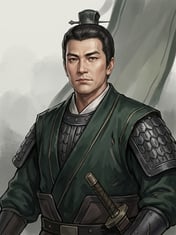
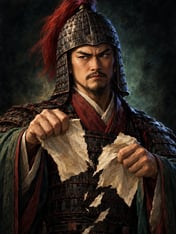
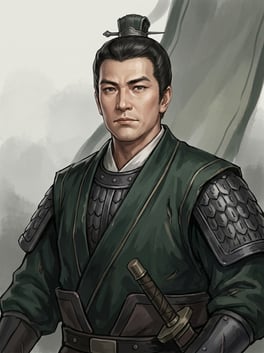
There were four key groups on the Shu Han side. The first comprised the Later Lord Liu Shan and the eunuch Huang Hao. Liu Shan reigned for forty-one years, the longest of any ruler during the Three Kingdoms period, but his actual involvement in governing was limited. Huang Hao’s rise to power was a product of this “political vacuum”. The second group was Jiang Wei and his subordinate generals: Liao Hua, Zhang Yi, and Dong Jue formed the core of the commanders around him. Together with Jiang Wei, they defended Jianmen Pass, faced Zhong Hui, and ultimately surrendered to him. The third group consisted of court officials, including Qiao Zhou, Zhang Tong, and Xi Zheng. Qiao Zhou’s proposal to “submit to the Song” determined Liu Shan’s final choice, while Zhang Tong and Xi Zheng later accompanied the Later Lord to Luoyang. The fourth group comprised those who died for their principles: Zhuge Liang’s son Zhuge Zhan and grandson Zhuge Shang fell in battle at Mianzhu; the Prince of Beidi, Liu Chen, wept at the ancestral temple and killed himself after first killing his wife; and the Crown Prince Liu Xuan was killed by rebel troops during Zhong Hui’s Rebellion. On the Cao Wei side, Sima Zhao directed the campaign, while the three commanders Zhong Hui, Deng Ai, and Zhuge Xu each had a distinct role: Zhong Hui led the main attack, Deng Ai the daring maneuver, and Zhuge Xu the interception. Of the three, Deng Ai was the most pivotal. He not only accomplished the extraordinary feat of crossing Yinping by stealth, but also demonstrated political skill after Shu Han’s surrender by “pacifying and welcoming those who submitted, and protecting the borders and settling the people.” Yet this also aroused Zhong Hui’s jealousy and led him to frame Deng Ai, ultimately igniting Zhong Hui’s Rebellion.
Core Issues
This episode raises three central issues. The first is the operational design of “feint and main force.” Sima Zhao’s three-pronged deployment already embodied a carefully coordinated division of roles: Zhong Hui’s main force of more than a hundred thousand drew all of Jiang Wei’s attention to Hanzhong and Jianmen Pass, freeing Deng Ai’s elite troops to carry out the high-risk, high-reward stealth crossing of Yinping. If any part of the plan had gone wrong—if Jiang Wei had abandoned Jianmen Pass and returned to reinforce the capital, if Zhuge Xu had cut off the Yinping route in time, or if Deng Ai’s army had been ambushed by Shu troops along the seven-hundred-li mountain road—the entire campaign might have failed. But Sima Zhao, Deng Ai, and Zhong Hui all accurately judged the limits of Shu Han’s capabilities: it was no longer able to execute strategic maneuvers of this scale. The second issue is the political choice between “surrender and resistance.” When Deng Ai’s forces reached Chengdu, three options were debated at court: flee to Wu, flee to Nanzhong, or surrender. Qiao Zhou rejected them one by one, reasoning that Nanzhong’s natural defenses could not be relied upon, that Eastern Wu would inevitably be conquered by Wei, and that surrender could preserve the ancestral temples. This ultimately persuaded Liu Shan to accept the proposal to surrender. Later generations criticized this choice on moral grounds, with the Prince of Beidi Liu Chen’s death for his principles serving as its foil. Politically, however, it was a rational calculation based on the balance of strength: continued resistance could only delay the state’s fall by a few months, at the cost of more lives and devastation. The third issue is the final attempt to “restore the state after its fall.” After surrendering to Zhong Hui, Jiang Wei plotted to exploit the conflict between Zhong Hui and Deng Ai, encouraging Zhong Hui to rebel against Wei and establish himself as ruler, in the hope of restoring Shu Han. The plot failed, and Jiang Wei died. This episode is highly romanticized in the Romance, but in essence it was Jiang Wei’s final stand for his political ideal of Shu Han; its chances of success were extremely slim.
Political Consequences
The fall of Shu Han had four layers of political consequences. First, in immediate terms, its ancestral temples were overturned, and Liu Shan and his family were moved east to Luoyang, where he was enfeoffed as the Duke of Anle. Shu Han’s bureaucracy was dismantled: some high-ranking figures, such as Zhuge Liang’s grandson Zhuge Jing, entered Jin service, while most lower- and middle-ranking officials returned to their hometowns. Eastern Wu, meanwhile, was left in strategic shock. Hua He memorialized Sun Xiu, lamenting the loss of “a land that had entrusted itself to us and a state that paid us tribute”. Wu’s own fall had effectively been sealed, though it would come seventeen years later. Second, at the level of the political system, Cao Wei—or, in reality, the Sima clan—had opened the way to unification by first taking Shu and then turning against Wu. In the second year of Xianxi (265), Sima Yan replaced Wei with Jin, ascended the throne in the first year of Taishi (265), and immediately began preparing for the campaign against Wu. The fall of Shu Han formally transformed the Three Kingdoms system from a “three-way balance” into a “confrontation between Wei and Wu.” Third, on the cultural level, Shu Han’s fall destroyed the political ideal of Zhuge Liang’s line—“to restore the Han house and return to the old capital”—but at the same time strengthened Zhuge Liang’s place in historical memory as a figure of “loyalty and righteousness.” It is rare in Chinese history for the founder of a failed regime to define its moral legacy. Fourth, in geopolitical terms, Yi Province changed from Shu Han’s sovereign territory into a remote commandery of Western Jin. Local gentry from Yi Province, such as Qiao Zhou, Zhang Yi, and Luo Xian, found new positions in the succeeding regime. Yet the province’s political center never again regained the stature it had held as a “founding base,” until Chengdu rose once more as a major southwestern metropolis in the Tang dynasty.
Counterfactual Analysis
Could Shu Han have lasted longer if Jiang Wei had not “evaded danger in Dazhong,” but had remained in Chengdu and maintained a normal relationship with Liu Shan? Militarily, if Jiang Wei had been in Chengdu, he could have returned more quickly once Zhong Hui’s main force entered Hanzhong. The cities of Lecheng and Yangping Pass might have held out for several more months. But if Deng Ai’s surprise attack through Yinping had been carried out successfully, it could still have broken through Shu Han’s defenses. In other words, Jiang Wei’s absence from Chengdu was not the fundamental cause of Shu Han’s fall; it was a consequence of Huang Hao’s abuse of power. A more fundamental counterfactual is this: if Shu Han had managed to reform its domestic administration during the Yanxi era, remove Huang Hao, and reorganize its civil and military leadership, Jiang Wei’s northern campaigns might have become sustained pressure on the frontier rather than costly expeditions. Shu Han might then have endured until internal divisions erupted in Cao Wei, creating an opportunity for a counteroffensive. But such reforms would have required a strong leader like Zhuge Liang, and after Zhuge Liang’s death Shu Han never produced another such figure. This was a structural weakness that no single decision could remedy. From a longer historical perspective, Shu Han’s fall was typical of the fate of a regime that “pitted a small force against a great one.” Its existence depended on a unique terrain, exceptional leaders, and a divided state among its rivals; it could not survive without all three. Once the Central Plains were unified and those special conditions disappeared, its fall was only a matter of time. Zhuge Liang’s greatest legacy may not have been how long he enabled Shu Han to endure, but the morally unimpeachable path it followed during its brief existence—a legacy that outlasted the state’s forty-three years.