Records
Wei's army won
- Commanders
- Wei's armyDeng Ai
- Shu armyZhuge Zhan
Vol. 35「遂戰,大敗,臨陣死,時年三十七」
263 CE (Jingyuan 4) · Mianzhu
In the winter of the sixth year of Jingzhao (263), Wei General Deng Ai infiltrated Shu by way of the Yinping-Jinggu road. The Shu Imperial Guard General Zhuge Zhan pulled back from Fucheng and drew up his battle line at Mianzhu Pass to make a stand. Deng Ai first sent his son Deng Zhong and the commander Sima Zuan to attack on the left and right flanks respectively; the initial assault went badly and they withdrew. Deng Ai angrily threatened to execute both of them, and the two men attacked again — this time breaking through Zhuge Zhan's line and killing Zhuge Zhan, his son Zhuge Shang, the Secretariat official Zhang Zun, and others. Earlier, Deng Ai had sent a letter proposing that Zhuge Zhan surrender, promising to memorialize for him the rank of Prince of Langxie; Zhuge Zhan had his fury answer the envoy's head, rejecting submission absolutely. After Mianzhu fell, the main Shu forces scattered, and Deng Ai drove straight to Chengdu, where Liu Chan, persuaded by Qiao Zhou and others, surrendered — and Shuhan was destroyed. The battle at Mianzhu was Shuhan's final large-scale engagement in the open field; Zhuge Zhan and his son both fell in the fighting, and later generations have held them up as exemplars of loyalty and righteousness.
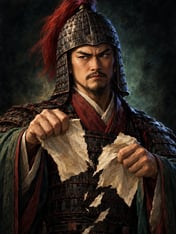 Zhuge ZhanKilled in actionTalk to me
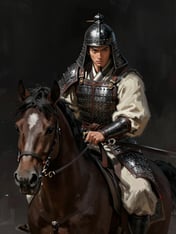 Zhuge ShangKilled in actionTalk to me
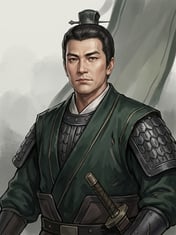 Deng AiCommanderTalk to me
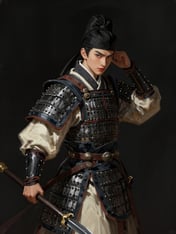 Deng ZhongWarriorTalk to me
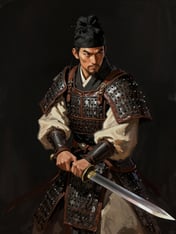 Huang ChongAdvisorTalk to me
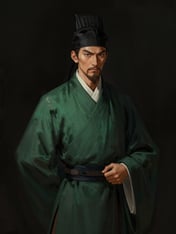 Zhang ZunKilled in actionTalk to me
Who won, as each book tells it; commanders as the text names them.
Records
Wei's army won
Vol. 35「遂戰,大敗,臨陣死,時年三十七」
Romance
Wei troops won
Ch. 117「蜀兵寡,魏兵眾,三人亦皆戰死,艾因此得了綿竹」
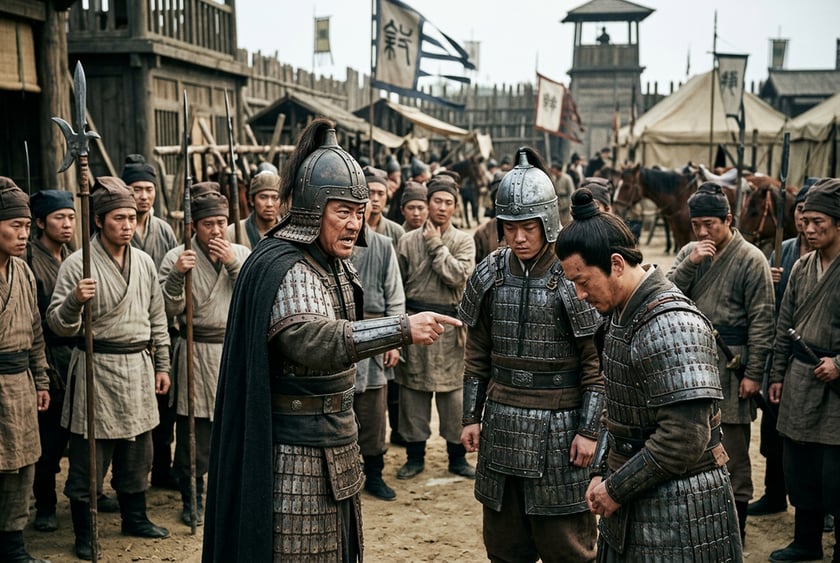
Scene
Deng Ai angrily rebukes his son Deng Zhong and Shi Zuan. The two generals look ashamed as the soldiers around them watch tensely.
Featured people: Deng Ai、Deng Zhong
The history and the novel give vastly different figures for the forces on both sides at Mianzhu, affecting how the reasons for the battle’s outcome are interpreted.
To dramatize Zhuge Zhan’s image as “a descendant of Zhuge Liang,” the novel substantially embellishes his emotional expressions when refusing to surrender and his deployments before battle.
Continue
Deng Ai was proud and robust, hasty and hot-tempered, and prone to flout convention and propriety, unable to get on smoothly with his colleagues; yet he was deep and resolute and full of stratagems. Though he stammered, he was quick-witted, from boyhood deeply versed in the art of war and skilled at reading terrain, gauging the enemy as if by divine insight, rich in miraculous calculation and strategy, and able to judge the lay of the land.
2642 people in common
2632 people in common
2641 person in common
2611 person in common
2581 person in common
2561 person in common
2551 person in common
2551 person in common
As a modern military historian, the Battle of Mianzhu must be read as the final move in Wei's 263 campaign to destroy Shuhan. In the eighth month of that year, Wei launched a three-pronged assault: Zhong Hui's main force out of Hanzhong, Zhuge Xu taking Wudou and Yinping, and Deng Ai pushing south from Longxi. Jiang Wei held the Jiange line against Zhong Hui's main force and Wei logistics were at one point under severe strain; but Deng Ai's flanking detachment chose a route that no one had imagined — through over seven hundred li of uninhabited terrain from Yinping, sliding down hillsides wrapped in felt, cutting roads through the mountains, bursting out at Jiangou, then driving south through Fucheng to Mianzhu, pushing the war from the Jiange front to Chengdu's doorstep. This was the exemplary case of "strategic maneuver defeating an opponent's fixed defense," cited repeatedly by historians such as Qian Mu and Lv Simian as a landmark in Chinese military history for "breaking a hold-and-defend strategy through operational mobility." On the Shuhan side, after receiving the news that Jiangou had fallen, Zhuge Zhan withdrew from Fucheng to defend Mianzhu and "arrayed his formation to await Deng Ai". This defensive line was already Chengdu's last barrier.
On the Wei side, after the extreme fatigue of crossing the mountains, Deng Ai's force numbered roughly fifteen to twenty thousand with seriously depleted equipment, but operating at peak concentration. He first dispatched his son Deng Zhong and his subordinate Shi Zuan to attack on the left and right. On the Shuhan side, the Sanguozhi-based estimate puts the force at no more than thirty thousand — rested and waiting, ostensibly holding a clear advantage. Zhuge Zhan's subordinate Huang Chong urged a rapid advance to seize the key terrain around Fucheng before Deng Ai could reach level ground; Zhuge Zhan refused. By insisting on keeping the decisive battle at Mianzhu Pass and "arraying his formation to await Deng Ai," the deployment itself surrendered the advantage of mountain terrain. This was the first layer of foreshadowing for the battle's outcome.
There were three key decision points. First, Deng Ai's surrender letter and Zhuge Zhan's furious execution of the envoy. Deng Ai offered to recommend Zhuge Zhan as King of Langxie if he surrendered; Zhuge Zhan executed the envoy in fury and resolved to fight. From a military standpoint Zhuge Zhan should have stalled or used the gesture to buy time; but from a political standpoint, as the "son of Chancellor Zhuge," he had almost no choice — he was bound by the political symbolism of the Zhuge family name. Second, the episode in which Deng Zhong and Shi Zuan suffered initial setbacks and Deng Ai furiously threatened to execute both generals if they did not immediately return to the attack. This passage captures Deng Ai's generalship: he knew that troops who had crossed the mountains had no option of turning back, and that only the extreme constraint of "a general who hesitates before the enemy will be executed" could draw out their full combat power — a kind of psychological mobilization Zhuge Zhan's side was incapable of. Third, Zhuge Zhan's refusal to hold the high ground, ceding the battlefield to a flat-formation set-piece engagement in the open. The Shuhan army could have used the hills around Mianzhu to slice the Wei force into small detachments and pick them apart; but once laid out in an open linear formation, the Wei troops — sharpened by seven hundred li of Yinping hardship — were able to run over them through discipline and will.
The battle ended in a crushing Shuhan defeat; Zhuge Zhan and his son Zhuge Shang both died in action, and Attendant Secretary Zhang Zun was also killed. Zhuge Shang's words before the battle — "My father and I have received great favor from the state; that we did not move earlier to execute Huang Hao and thus prevent the ruin of the dynasty — what reason is there to live?" — have been repeatedly quoted by historians and stand as the spiritual emblem of the last generation of Shuhan's educated elite. After the battle Deng Ai drove straight to Chengdu; Liu Chan surrendered on Qiao Zhou's advice, and Shuhanmiewang. The three echoes of Mianzhu were as follows. First, Shuhan's last major fighting force was destroyed and the will to resist across the whole of Yizhou collapsed with it; Liu Chan surrendered with almost no alternative left. Second, the "loyal death together, father and son" of Zhuge Zhan and Zhuge Shang became objects of posthumous veneration in both military and civilian temples; their defeat paradoxically elevated the Zhuge family name from "capable administrator of Yizhou" to a spiritual icon of "the Han dynasty's surviving aspirations." Third, Deng Ai's victory in this battle made him in one stroke the foremost contributor to Wei's destruction of Shuhan, surpassing Zhong Hui — but the height of his achievement immediately invited Zhong Hui and Wei Guan to conspire against him, and within two months he was dead at the hands of his own side. Mianzhu was the apex of Deng Ai's military career and the turning point of his fate.
The first counterfactual is that Huang Chong's strategy was adopted. Had Zhuge Zhan intercepted Deng Ai already at Fucheng and fixed the battle in mountainous terrain, the Wei elite troops arriving exhausted after crossing the mountains would have had no room to deploy; the Shuhan force rested and holding advantageous ground could at minimum have delayed the decisive engagement by several weeks. Any delay long enough for Jiang Wei to disengage from Jiange and come to the relief would likely have meant a counter-encirclement and annihilation of Deng Ai's isolated force — the process of Wei's destruction of Shuhan would have been delayed or might in 263–264 have produced an entirely different scenario of "Deng Ai's entire force lost, Zhong Hui and Jiang Wei locked in stalemate." The second counterfactual is Zhuge Zhan accepting Deng Ai's offer to surrender. This is almost impossible to imagine, but if assumed, then Shuhan under "peaceful submission" might have preserved a higher social standing for Liu Chan and the Zhuge Zhan family — yet the tragic grandeur of Shuhan as a political symbol would be entirely dissolved, and one of the beacons of the later "loyalty and righteousness" narrative would be extinguished. The third counterfactual is Deng Ai being ambushed during the Yinping crossing. Shuhan actually had this opportunity: had Jiang Shu and Ma Miao at Jiangou not opened the gate and surrendered, Deng Ai's already-starving force emerging from seven hundred li would have been annihilated on the spot. The Battle of Mianzhu happened in the first place only as the accumulated result of countless small collapses inside Shuhan. This is the exemplar of a regime's "silent disintegration at the end" — once the broader momentum is spent, no amount of heroism can reverse the outcome; it can only become an offering to the fallen state.