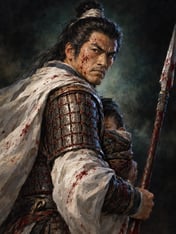
Final Days
In the seventh year of Jianxing (229), Zhao Yun was over seventy years old.
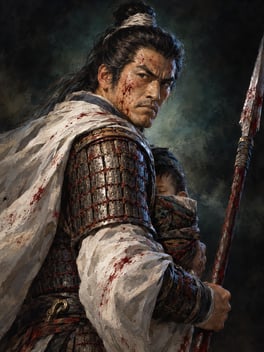
Since joining Liu Bei at Ye in the fifth year of Jian’an (200), he had followed him for nearly thirty years. From serving under Gongsun Zan to becoming Shu Han’s General Who Guards the South, he had taken part in almost every major turning point in Liu Bei’s rise: rescuing A Dou alone at Changban, driving back Cao’s forces with an empty camp at the Han River, pacifying the commanderies of Yi Province, remaining behind at Jiangzhou during the Battle of Xiaoting, and accompanying Zhuge Liang through the Xie Valley in the First Northern Expedition.
After the defeat at Jieting in the sixth year of Jianxing (228), Zhuge Liang demoted himself three grades. Zhao Yun, commander of the rear guard, also asked to be demoted to General Who Stabilizes the Army, citing his “gathering the troops and holding firm, without suffering a major defeat.” It was the last campaign of his life.
The following spring, Zhao Yun died of illness in Chengdu.
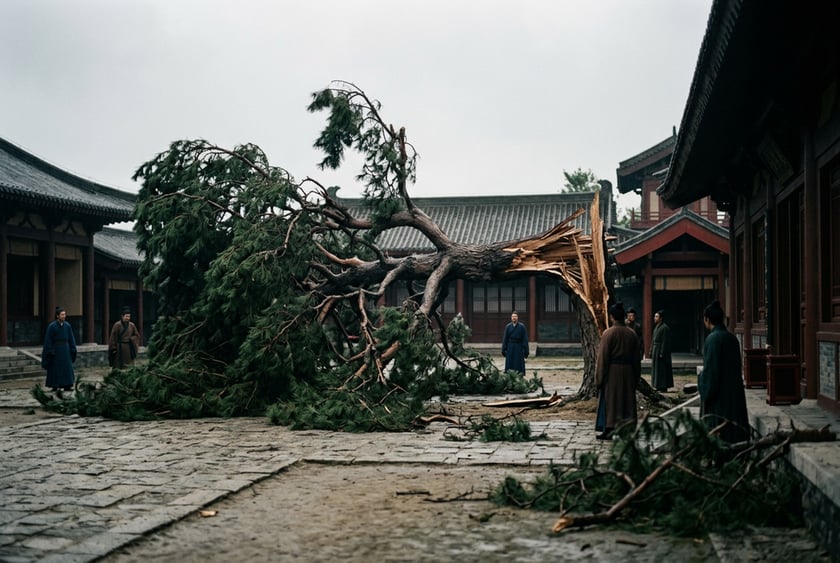
In chapter 97, the Romance of the Three Kingdoms gives his death a particularly dramatic treatment: the wind breaks a pine in the courtyard, Kongming casts the divination, his sons Zhao Tong and Zhao Guang rush in with the news, and Kongming throws down his cup and weeps bitterly. Nearly every detail signals to readers that “the age of a generation of Shu Han’s great generals has come to an end.”
The official histories record it more simply: he died in the seventh year of Jianxing and was posthumously enfeoffed as Marquis Shunping. Yet both history and fiction naturally portray this as the fate of the last elder among the “Five Tiger Generals”: Guan Yu, Zhang Fei, Ma Chao, and Huang Zhong had all died earlier, and Zhao Yun’s departure marked the passing of the last military figure from Liu Bei’s era.
Last Words or Final Charge
The Records of the Three Kingdoms contains no detailed account of Zhao Yun’s last words. Yet later historians and writers repeatedly cited several of his sayings from throughout his life, which may be regarded as his spiritual legacy.
The first was his remonstrance to the generals when land was being distributed after the entry into Yi Province: “Huo Qubing said that while the Xiongnu remained unconquered, there could be no home for him. Now the enemies of the state are not only the Xiongnu; it is too soon to seek ease.” He opposed Liu Bei’s granting of fields and estates in Yi Province to his generals after taking the province, and argued that they should be returned to the people. This was a key turning point in Shu Han’s early shift toward civilian administration and policies focused on the people’s livelihood.
The second was his private remonstrance to Liu Bei before the Battle of Xiaoting: “Cao Pi, not Sun Quan, is the enemy of the state. If we first destroy Wei, Wu will submit of its own accord.” He urged Liu Bei not to march east to avenge Guan Yu. This was a rare example among Shu Han’s generals of strategic judgment, but Liu Bei did not heed it.
The influence of these two “final charges” went far beyond that of ordinary deathbed words. They reflected Zhao Yun’s political restraint as a military man: he neither disturbed the people to win glory as a soldier nor let personal feelings dictate state policy. This character left him the least prominent in rank and the lowest in title among the Five Tigers, but the most highly regarded.
After His Death
After Zhao Yun died, the Later Lord Liu Shan posthumously awarded him the title of Grand General and the posthumous name Shunping Marquis. He was buried on the eastern side of Mount Jinping in Chengdu, and a shrine was erected where sacrifices were offered in each of the four seasons.
The posthumous name “Shunping” was exceptionally rare in Shu Han: “gentle, worthy, kind, and generous is called Shun; conducting affairs with due order is called Ping.” It was official recognition of the balance Zhao Yun had maintained between politics and military affairs throughout his life.
His eldest son, Zhao Tong, inherited his title and served as a Gate General, later rising to the posts of Gentleman of the Tiger Cavern and Supervising Commander of the Army. His second son, Zhao Guang, served as a Gate General and, during the Jingyao era, accompanied Jiang Wei on an expedition to Dazhong, where he died in battle, remaining loyal to the end. Zhao Guang’s death was significant not merely as a personal loss: across two generations, the Zhao family had fully embodied Shu Han’s ideal of “a military family serving the state from generation to generation.”
After Jiang Wei took charge of the government during the Yanxi era, Shu Han’s military establishment never again produced anyone like Zhao Yun, “able both to charge into battle and to carry weight at court.” In the thirty-four years between the Death of Zhao Yun and the Conquest of Shu by Wei, Shu Han’s military decisions grew increasingly aggressive, moving ever further from the spirit of “military restraint” that Zhao Yun represented.
Historical Assessment
Zhao Yun’s place in the Records of the Three Kingdoms is thought-provoking. Chen Shou included him alongside Guan Yu, Zhang Fei, Ma Chao, and Huang Zhong in the “Biographies of Guan, Zhang, Ma, Huang, and Zhao,” but devoted relatively little space to him. His assessment was concentrated in the words: “Huang Zhong and Zhao Yun were resolute and valiant, serving as claws and fangs. Were they not like Guan Ying and Xiahou Ying?” In other words, Chen Shou compared him to the Han dynasty generals Guan Ying and Xiahou Ying.
This designation as a supporting general differs considerably from the legendary image of him in the Romance of the Three Kingdoms as one of the “Five Tiger Generals.” The key point is that Shu Han had already fallen when Chen Shou wrote his biographies, and he drew on Shu Han’s old archives. Zhao Yun’s rank and achievements were indeed somewhat below those of Guan Yu and Zhang Fei. Yet Chen Shou’s concise account could not fully show Zhao Yun’s abilities in political restraint, communication with civil officials, and covering a retreat.
In the Romance of the Three Kingdoms, Zhao Yun was elevated from “supporting general” to one of the “Five Tigers.” Stories of his rescue at Changban, his empty-camp stratagem against Cao Cao, and the great battle at the Han River were repeatedly refined into the image of a military hero most familiar to the Chinese people. The contrast between the plainness of the official histories and the exaltation of the novel is itself a fascinating example of how Zhao Yun’s image evolved.
From any perspective, the Death of Zhao Yun was the final note in the story of the generation of military men who founded Shu Han. Never again would Shu Han produce a figure who combined martial courage, political restraint, and moral authority as he did.