Eastern Wu · General Who Assists Wu
Zhang Zhao
courtesy name 子布 · 156–236
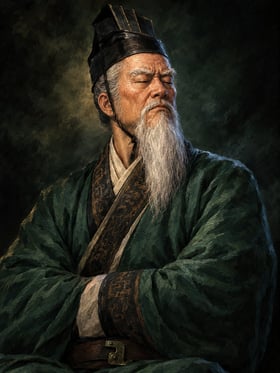
Zhang Zhao's countenance was grave and dignified, with an imposing air.

Life
In the novel: 24 chapters · In the Records: 13 volumes
Life156–236
195 CE (Xingping 2)
200 CE (Jian'an 5)
202 CE (Jian'an 7)
7 more events
208 CE (Jian'an 13)
215 CE (Jian'an 20)
220 CE (Huangchu 1)
223 CE (Huangchu 4)
233 CE (Qinglong 1)
- Sun Quan's Faction
- Eastern Wu
- Hatched: dated by chapter
- Life event
List all 6 stops
- Wu County200–202Sun Quan Succeeds to Power+1 more
- Chaisang208Sun Quan's Decision to Resist Cao Cao+2 more
- Yiyang215Guan Yu Attends the Meeting Armed with a Single Blade
- Jiao Province220Yu Fan Exiled to Jiao Province
- Wuchang221–223Sun Quan Invested as King of Wu+1 more
- Xiangping233Gongsun Yuan Executes Sun Quan's Envoys
On the boards
Compare with someone →Where this person ranks on each board.
Who they were
Character profile
- Appearance
- Zhang Zhao's countenance was grave and dignified, with an imposing air.
- Character
- Zhang Zhao was loyal and upright, fierce and unbending in temper; when his counsel went unadopted he often nursed resentment. He was known for his sternness, and for this reason was kept at a distance. Learned and erudite, he advocated a pragmatic surrender to Cao Cao, but at times he could be swayed and won over by Zhuge Liang's rhetoric.
- Manner of speech
- In debating affairs Zhang Zhao drew upon the classics, his words forceful and stern, his sense of duty showing in his face. He set out his arguments pragmatically, point by point, though at times he was hidebound and clung to holding what already stood.
- Life
- Zhang Zhao was a man of Pengcheng. In his youth he loved learning, was skilled in clerical script, and studied the Zuo Commentary on the Spring and Autumn Annals under Zihou Zi'an. At his capping he was nominated as filial and incorrupt but did not take up office; Tao Qian recommended him as a man of flourishing talent, yet he did not answer the summons and was afterward detained. At the end of the Han he crossed south of the Yangtze, and Sun Ce appointed him Chief Clerk and General of the Household Who Comforts the Army. On his deathbed Sun Ce entrusted Sun Quan to him. Later Zhang Zhao served as Sun Quan's Chief Clerk and Army Preceptor, and in the second year of Wei's Huangchu was appointed General Who Pacifies the Distant and enfeoffed as Marquis of Youquan. After Sun Quan proclaimed himself emperor, he was appointed General Who Assists Wu, his fief changed to Marquis of Lou, with a stipend of ten thousand households. He died in the fifth year of Jiahe (236) at the age of eighty-one, with the posthumous title of Marquis Wen.
- Anecdotes
- Zhang Zhao was an important counselor to two generations, Sun Ce and Sun Quan, taking charge of affairs during Sun Ce's grave illness, his death, and the mourning that followed. He once urged Sun Quan to change his dress and mount his horse, and treated him with the courtesy of a mentor. He once managed the general affairs jointly with Zhou Yu, and recommended Yan Jun and Lü Meng to Sun Quan.
Historical Record
Zhang Zhao, courtesy name Zibu, was a man of Pengcheng. In his youth he loved learning and excelled at clerical script; he studied the Zuo Commentary on the Spring and Autumn Annals under Baihou Zi'an and read widely. He was on good terms with Zhao Yu of Langya and Wang Lang of Donghai, and thereby became renowned. At the age of capping he was recommended as a man of filial piety and integrity, but he did not take up the post. In the great upheaval at the end of the Han, many of the gentry and people of Xu Province took refuge in Yangzhou, and Zhang Zhao too crossed south of the Yangtze.
When Sun Ce was founding his enterprise, he appointed Zhang Zhao as Chief Clerk and General of the Gentlemen of the Household Who Soothes the Army, holding him in the highest regard—he even "ascended the hall to pay respects to his mother, as with an old friend of equal standing, and entrusted all civil and military affairs to Zhang Zhao alone". On his deathbed Sun Ce entrusted his younger brother Sun Quan to Zhang Zhao, who led the assembled officials in assisting Sun Quan. At that time Sun Quan was so overcome with grief that he could not attend to affairs, and Zhang Zhao consoled him: "He who succeeds another prizes the ability to bear the legacy of his predecessor and to make the family's enterprise flourish, thereby completing the work of merit. Now all under Heaven is in upheaval and the mountains are full of bandits—how can a man of filial integrity lie prostrate in mourning and indulge the feelings of a common fellow?" Thereupon Zhang Zhao personally helped Sun Quan onto his horse, drew up the troops, and went forth, so that the hearts of the multitude had something to rally to. After this, Zhang Zhao continued to serve as Sun Quan's Chief Clerk and was given great responsibility. Whenever Sun Quan went on campaign, he left Zhang Zhao to guard the rear and handle the affairs of the headquarters.
After Sun Quan was memorialized by Liu Bei as Acting Chariots-and-Cavalry General, Zhang Zhao was appointed Army Strategist. Sun Quan once, while drinking at the Fishing Terrace at Wuchang, grew very drunk and had water sprinkled on his ministers, saying, "Today we drink to the full; only when one falls drunk into the terrace shall we stop." Zhang Zhao, with a stern face, said nothing, went out, and sat in his carriage. Sun Quan summoned him back and asked why he was angry. Zhang Zhao replied, "Of old, Zhou made a hill of dregs and a pool of wine and drank through the night; at the time he too thought it pleasure and did not consider it evil." Hearing this, Sun Quan fell silent, deeply ashamed, and broke off the drinking.
In the second year of the Huangchu era of Wei (221 CE), Emperor Wen of Wei, Cao Pi, sent the envoy Xing Zhen to invest Sun Quan as King of Wu. When Xing Zhen entered the gate without alighting from his carriage, Zhang Zhao confronted him: "Where there are rites, there is nothing unrespected; thus where there are laws, there is nothing not carried out. Yet you dare to exalt yourself—is it because the south of the river is weak and small, with not so much as an inch of blade?" Xing Zhen thereupon alighted from his carriage. After Sun Quan proclaimed himself emperor, Zhang Zhao, being old and often ill, submitted a memorial requesting to return his office and the affairs under his charge. Sun Quan reappointed him as General Who Supports Wu, ranking below the Three Excellencies, and reenfeoffed him as Marquis of Lou, with a fief of ten thousand households. Living in retirement at home, he composed the Explanation of the Zuo Commentary on the Spring and Autumn Annals and the Annotations on the Analects.
Zhang Zhao's younger brother Zhang Cheng, courtesy name Zhongsi, was also known for his talent and learning and was on good terms with Zhuge Jin, Bu Zhi, and Yan Jun. Zhang Zhao's son Zhang Xiu, courtesy name Shusi, was, together with Zhuge Ke, Gu Tan, and others, among the companions of the heir apparent Sun Deng.
Zhang Zhao died in the spring of the first year of the Huanglong era (229 CE).
In the Novel
In Romance of the Three Kingdoms, Zhang Zhao is further fashioned as a brain trust and senior minister of the Southland, though at times he also appears overly cautious. He first appears in the early days of Sun Ce's enterprise, when Zhou Yu recommended the "two Zhangs"—Zhang Zhao and Zhang Hong—to Sun Ce. Sun Ce went in person to engage them, and only then did the two agree to serve; Zhang Zhao was appointed Chief Clerk and concurrently General of the Gentlemen of the Household Who Soothes the Army.
In the novel, Zhang Zhao repeatedly devised stratagems for Sun Ce or Sun Quan at crucial moments. For example, when Sun Ce was attacking Liu Yao, Zhang Zhao advised a night raid on Liu Yao's camp, which succeeded. After Sun Ce was wounded, Zhang Zhao once urged him not to act rashly out of a moment's anger. On Sun Ce's deathbed, Zhang Zhao also played the role of stabilizing the situation, consoling Sun Quan: "This is not the time for the general to weep; you should on the one hand see to the funeral rites, and on the other hand manage the military and state affairs".
On the eve of the Battle of Red Cliffs, Zhang Zhao strongly advocated surrendering to Cao Cao, holding that Cao Cao "commands a host of a million and, borrowing the name of the Son of Heaven, campaigns in all four quarters; to resist him is to defy righteousness". He even, in his debate with Zhuge Liang, questioned why, after Zhuge Liang began assisting Liu Bei, Liu Bei instead suffered defeat after defeat. When Sun Quan decided to resist Cao Cao, Zhang Zhao still held that this was falling for Zhuge Liang's scheme, and urged Sun Quan not to "carry firewood to put out a fire". These episodes all highlight Zhang Zhao's cautious, conservative side in the novel, contrasting with the pro-war faction such as Zhou Yu and Lu Su.
After the Sun-Liu alliance broke down, Zhang Zhao repeatedly offered schemes in an attempt to recover Jing Province from Liu Bei. For example, he advised Sun Quan to use Lady Sun to lure Liu Bei back to Eastern Wu, holding A-dou as a hostage to exchange for Jing Province. Later he advised detaining the family of Zhuge Jin to force Zhuge Jin to go to Shu and persuade Zhuge Liang to return Jing Province. Though these schemes did not wholly succeed, they also display the novel's image of Zhang Zhao sparing no effort in the interests of Eastern Wu.
Key Relationships
Sun Quan's Faction (serves)*: Zhang Zhao was a senior minister of two generations of lords, Sun Ce and Sun Quan, deeply trusted and relied upon. On his deathbed Sun Ce entrusted Sun Quan to Zhang Zhao, and Sun Quan treated Zhang Zhao with the courtesy due a teacher.
Eastern Wu (serves)*: Zhang Zhao served the Eastern Wu regime all his life, making great contributions to its founding and stability. He assisted Sun Quan, guarded the rear, and took part in many important decisions.
Zhao Yu (friend_of)*: Zhang Zhao and Zhao Yu of Langya were friends from their youth and rose to fame together.
Wang Lang (friend_of)*: Zhang Zhao and Wang Lang of Donghai were also friends from their youth and rose to fame together.
Zhou Yu (colleague)*: In the novel, Zhou Yu and Zhang Zhao held differing views on how to deal with Cao Cao—Zhou Yu advocated war, Zhang Zhao surrender.
Zhuge Liang (opponent)*: In the novel, Zhang Zhao had a famous debate with Zhuge Liang before the Battle of Red Cliffs; representing the assembled scholars of the Southland, Zhang Zhao questioned Zhuge Liang but was refuted by him.
Lu Su (colleague)*: In the novel, Lu Su and Zhang Zhao also differed on how to deal with Liu Bei and Cao Cao—Lu Su inclined toward allying with Liu to resist Cao, while Zhang Zhao inclined more toward surrendering to Cao or making use of Liu Bei.
Sun Ce (lord)*: Sun Ce trusted and esteemed Zhang Zhao greatly, entrusting all civil and military affairs to him.
Lady Sun (related_to)*: In the novel, Zhang Zhao once devised a scheme to use Lady Sun to lure Liu Bei back to Eastern Wu, holding A-dou as a hostage to exchange for Jing Province (novel only).
Zhuge Jin (colleague)*: In the novel, Zhang Zhao once devised a scheme to detain Zhuge Jin's family to force Zhuge Jin to go to Shu and persuade Zhuge Liang to return Jing Province (novel only).
Iconic Scenes
Sun Ce's deathbed entrustment*: On his deathbed, Sun Ce entrusted the young Sun Quan to Zhang Zhao, saying to him, "If Zhongmou is unequal to the task, you may take it for yourself. And should you not prevail, return westward at a leisurely pace—there is nothing to fear". This embodies Sun Ce's immense trust in Zhang Zhao.
Consoling Sun Quan*: After Sun Ce's death, Sun Quan was overcome with grief, and Zhang Zhao consoled him with "This is not the time for the general to weep," then helped him onto his horse to inspect the camp, steadying the troops' morale.
Rebuking Xing Zhen*: When the Wei envoy Xing Zhen came to invest Sun Quan as King of Wu and entered the gate without alighting from his carriage, Zhang Zhao sternly rebuked his disrespect and forced Xing Zhen to alight. This scene displays Zhang Zhao's upright and unbending character.
Remonstrating against Sun Quan's tiger-hunting*: Sun Quan loved to hunt tigers on horseback, and Zhang Zhao once remonstrated that as a ruler he should not take such risks, lest he be mocked by all under Heaven. Though Sun Quan agreed in words, he did not give up the pleasure. This reflects Zhang Zhao's loyalty to Sun Quan and his frank outspokenness.
Advocating surrender before the Battle of Red Cliffs*: Before the Battle of Red Cliffs, Zhang Zhao strongly advocated surrendering to Cao Cao, holding that the Southland could not withstand Cao Cao's great army, and engaged in a fierce debate with Zhuge Liang. This is one of Zhang Zhao's most representative scenes in the novel, highlighting his cautious and pragmatic side.
Devising schemes to seize Jing Province*: In the novel, Zhang Zhao repeatedly devised schemes, including making use of Lady Sun and Zhuge Jin to seize Jing Province; though they did not succeed, they display his cunning in scheming for the interests of Eastern Wu, (novel only).
Advising Sun Quan to withdraw his troops*: After Taishi Ci was wounded, Zhang Zhao advised Sun Quan to withdraw his troops; Sun Quan followed him and pulled back to the Southland (novel only).
Advising Sun Quan to ally with Wei against Shu*: After Guan Yu was killed, Zhang Zhao advised Sun Quan to send Guan Yu's head to Cao Cao, shifting the blame onto Wei to avoid Liu Bei's vengeance, and to sit back and watch Wei and Shu contend (novel only).
Quotes
50 lines in the books · 3 featured
若此,是先生言行相違也。先生自比管、樂。管仲相桓公,霸諸侯,一匡天下;樂毅扶持微弱之燕,下齊七十餘城;此二人者,真濟世之才也。先生在草廬之中,但笑傲風月,抱膝危坐;今既從事劉豫州,當為生靈興利除害,剿滅亂賊。且劉豫州未得先生之時,尚且縱橫寰宇,割據城池;今得先生,人皆仰望;雖三尺童蒙,亦謂彪虎生翼,將見漢室復興,曹氏即滅矣;朝廷舊臣,山林隱士,無不拭目而待:以為拂高天之雲翳,仰日月之光輝,拯斯民於水火之中,措天下於衽席之上,在此時也。何先生自歸豫州,曹兵一出,棄甲拋戈,望風而竄;上不能報劉表以安庶民,下不能輔孤子而據疆土;乃棄新野,走樊城,敗當陽,奔夏口,無容身之地?是豫州既得先生之後,反不如其初也。管仲、樂毅,果如是乎?愚直之言,幸勿見怪!
The classic passage of Zhuge Liang's Debate with the Scholars of Jiangdong, displaying Zhang Zhao's eloquence and his doubts about Zhuge Liang.
「孝廉,此寧哭時邪?且周公立法而伯禽不師,非欲違父,時不得行也。況今奸宄競逐,豺狼滿道,乃欲哀親戚,顧禮制,是猶開門而揖盜,未可以爲仁也。」
These words urge Sun Quan to prioritize the greater good, embodying Zhang Zhao's pragmatic political wisdom and his regard for the overall situation.
曹操擁百萬之眾,借天子之名,以征四方,拒之不順。且主公大勢可以拒操者,長江也。今操既得荊州,長江之險,已與我共之矣,勢不可敵。以愚之計,不如納降為萬安之策。
Advocating surrender to Cao Cao was Zhang Zhao's key stance before the Battle of Red Cliffs, shaping his conservative image.
- Family
- Lord & vassal
- Friends
- Enemies
- Teacher & student
- Other
Who is Zhang Zhao connected to?
Pick someone to see how many steps lie between them and Zhang Zhao.
History vs. novel
8 points · 3 novel-only
| History | Novel |
|---|---|
| Sun Ce Entrusts His AffairsNovel embellishes | |
As Sun Ce lay dying, he entrusted Sun Quan to Zhang Zhao. Zhang Zhao led the assembled officials in supporting Sun Quan and helped him, even bringing him out on horseback to review the troops and steady their morale. vol. 52 | The novel says Zhang Zhao advised Sun Quan to hold the funeral first and then attend to military and state affairs. He also arranged for Sun Jing to oversee the funeral, and had Sun Quan come out to receive the civil and military officials’ congratulations. ch. 29 |
| Night Raid on Liu YaoNovel only | |
| — | After Liu Yao withdrew his troops, Zhang Zhao advised Sun Ce to seize the opportunity to raid the enemy camp at night. Sun Ce took his advice, dividing his forces into five groups to attack, and Liu Yao’s army was soundly defeated. ch. 15 |
| Advocating Surrender at ChibiNovel embellishes | |
In a commentary cited by Pei Songzhi, it is said that Zhang Zhao advocated welcoming Cao Cao in the hope of unifying the realm and reducing warfare, not merely for the self-interest of Jiangdong. vol. 52 | Before the Battle of Chibi, Zhang Zhao and others advocated surrendering to Cao Cao. During a debate among the officials, he also questioned Zhuge Liang’s record of repeated defeats while assisting Liu Bei, and later urged Sun Quan not to send out troops rashly. ch. 43 |
| Sun Quan Hunts a TigerHistory only | |
Sun Quan often rode out on horseback to hunt tigers. Zhang Zhao remonstrated with him to his face, pointing out that a ruler should not gallop across the wilderness and test his courage against wild beasts. Though Sun Quan admitted his fault, he continued hunting tigers. vol. 52 | — |
| Drinking at the Fishing TerraceHistory only | |
Sun Quan drank heavily at the Fishing Terrace and even splashed water on his assembled officials. Zhang Zhao left the banquet in displeasure, pointing out that King Zhou of Shang had also taken pleasure in drinking. Ashamed, Sun Quan stopped the revelry. vol. 52 | — |
| Urging Sun Quan to Surrender to Cao CaoNovel only | |
| — | When Cao Cao demanded that Sun Quan’s son come to court, Zhang Zhao thought refusal might provoke Cao Cao to attack Wu. Zhou Yu objected, and Sun Quan ultimately followed Zhou Yu’s advice and did not send his son to court. ch. 38 |
| Luring Liu Bei into Trading Jing ProvinceNovel only | |
| — | To recover Jing Province, Zhang Zhao suggested falsely claiming that Lady Wu was gravely ill, luring Sun Shangxiang into bringing Liu Bei’s son A Dou back to Wu, and thereby forcing Liu Bei to exchange Jing Province for him. ch. 61 |
| Angrily Rebuking Xing ZhenNovel embellishes | |
When the Wei envoy Xing Zhen came to invest Sun Quan as King of Wu, he entered the gate without dismounting from his carriage. Zhang Zhao reprimanded him for violating etiquette, and he immediately got down. vol. 52 | The novel also says Xing Zhen entered the gate without dismounting and Zhang Zhao angrily rebuked him for his rudeness. It adds that Xu Sheng wept and lamented that he could not help Sun Quan swallow Wei and destroy Shu, prompting Xing Zhen to remark on the extraordinary ministers and generals of Jiangdong. ch. 82 |
- Sun Ce Entrusts His AffairsNovel embellishes
- History
As Sun Ce lay dying, he entrusted Sun Quan to Zhang Zhao. Zhang Zhao led the assembled officials in supporting Sun Quan and helped him, even bringing him out on horseback to review the troops and steady their morale.
vol. 52
- Novel
The novel says Zhang Zhao advised Sun Quan to hold the funeral first and then attend to military and state affairs. He also arranged for Sun Jing to oversee the funeral, and had Sun Quan come out to receive the civil and military officials’ congratulations.
ch. 29
- Night Raid on Liu YaoNovel only
- Novel
After Liu Yao withdrew his troops, Zhang Zhao advised Sun Ce to seize the opportunity to raid the enemy camp at night. Sun Ce took his advice, dividing his forces into five groups to attack, and Liu Yao’s army was soundly defeated.
ch. 15
- Advocating Surrender at ChibiNovel embellishes
- History
In a commentary cited by Pei Songzhi, it is said that Zhang Zhao advocated welcoming Cao Cao in the hope of unifying the realm and reducing warfare, not merely for the self-interest of Jiangdong.
vol. 52
- Novel
Before the Battle of Chibi, Zhang Zhao and others advocated surrendering to Cao Cao. During a debate among the officials, he also questioned Zhuge Liang’s record of repeated defeats while assisting Liu Bei, and later urged Sun Quan not to send out troops rashly.
ch. 43
- Sun Quan Hunts a TigerHistory only
- History
Sun Quan often rode out on horseback to hunt tigers. Zhang Zhao remonstrated with him to his face, pointing out that a ruler should not gallop across the wilderness and test his courage against wild beasts. Though Sun Quan admitted his fault, he continued hunting tigers.
vol. 52
- Drinking at the Fishing TerraceHistory only
- History
Sun Quan drank heavily at the Fishing Terrace and even splashed water on his assembled officials. Zhang Zhao left the banquet in displeasure, pointing out that King Zhou of Shang had also taken pleasure in drinking. Ashamed, Sun Quan stopped the revelry.
vol. 52
- Urging Sun Quan to Surrender to Cao CaoNovel only
- Novel
When Cao Cao demanded that Sun Quan’s son come to court, Zhang Zhao thought refusal might provoke Cao Cao to attack Wu. Zhou Yu objected, and Sun Quan ultimately followed Zhou Yu’s advice and did not send his son to court.
ch. 38
- Luring Liu Bei into Trading Jing ProvinceNovel only
- Novel
To recover Jing Province, Zhang Zhao suggested falsely claiming that Lady Wu was gravely ill, luring Sun Shangxiang into bringing Liu Bei’s son A Dou back to Wu, and thereby forcing Liu Bei to exchange Jing Province for him.
ch. 61
- Angrily Rebuking Xing ZhenNovel embellishes
- History
When the Wei envoy Xing Zhen came to invest Sun Quan as King of Wu, he entered the gate without dismounting from his carriage. Zhang Zhao reprimanded him for violating etiquette, and he immediately got down.
vol. 52
- Novel
The novel also says Xing Zhen entered the gate without dismounting and Zhang Zhao angrily rebuked him for his rudeness. It adds that Xu Sheng wept and lamented that he could not help Sun Quan swallow Wei and destroy Shu, prompting Xing Zhen to remark on the extraordinary ministers and generals of Jiangdong.
ch. 82
Combat
On the field
Duels, kills and executions as the texts tell them, counted separately for the Records and the Romance.
Stratagems
Plans this person devised or saw through, as the texts tell them.
- Romance
- 5 carried out · 1 worked · 0 turned down · 0 seen through
- RomanceRaid the CampOtherWorkedagainst Liu Yao's armyCh. 15「今夜正好劫營」
- RomanceFeign Illness to Lure A DouDeceptionSeen throughCh. 61「只說國太病危,欲見親女,取郡主星夜回東吳」
- RomanceTake Jin's Family Hostage to Demand Jing ProvinceDeceptionSeen throughagainst Liu BeiCh. 66「召諸葛瑾老小虛監在府」
- RomanceBlame-Shifting StratagemSowing discordSeen throughagainst Shu and WeiCh. 77「此乃東吳移禍之計也」
- RomanceThreatening the Envoy with an Oil CauldronOtherSeen throughagainst Western ShuCh. 86「芝曉其意,並無懼色,昂然而行」
Events
Events (26)
Battles and events the texts place this person in, by date.
Battles
Other events
- 195Sun Ce's Pacification of JiangdongAdvisor
- 195Duel at Shenting
- 197Cao Cao's Campaign Against Yuan Shu
- 200Hua Xin Leaves Wu and Enters Xu (Capital)
- 200Sun Quan Succeeds to PowerAdvisor
- 200Death of Sun Ce
- 202Sun Quan Refuses to Send His Son to the Wei CourtAdvisor
- 208Sun Quan's Decision to Resist Cao CaoAdvisor
All 23
- 208Gan Ning's Counsel to Target Huang ZuAdvisor
- 208Zhuge Liang's Debate with the Scholars of JiangdongAdvisor
- 208Zhuge Liang's Mission to Eastern WuAdvisor
- 209Liu Bei's Marriage into Eastern Wu
- 209Liu Bei's Escape from Wu
- 212Seizing Liu Shan on the River
- 215Guan Yu Attends the Meeting Armed with a Single BladeAdvisor
- 215Eastern Wu Seizes the Three Commanderies of Jingzhou
- 219Retreat to Mai Castle
- 220Yu Fan Exiled to Jiao ProvinceWitness
- 221Sun Quan Invested as King of WuAdvisor
- 223Deng Zhi's Mission to WuWitness
- 229The Wu-Shu Alliance Oath to Divide the Realm in Three
- 229Sun Quan Proclaims Himself Emperor and Founds Wu
- 233Gongsun Yuan Executes Sun Quan's EnvoysAdvisor
Continue
Sun Ce's Pacification of Jiangdong
Relationship timeline26 entries ▸
History · vol. 46
- Sun Ce§23
Student
As Sun Ce was dying, he asked Zhang Zhao and the others to entrust him with his final affairs
History · vol. 52
- Zhao Yu§3
Friend
Became renowned for being on friendly terms with Zhao Yu of Langya and Wang Lang of Donghai
Friend
Discussed with Wang Lang the matter of taboo names concerning former rulers
- Sun Ce§3
Lord
Sun Ce appointed Zhang Zhao Chief Clerk and General of the Household Who Pacifies the Army; entered the hall and paid respects to his mother, as in the old days when they were equals
- Sun Quan§4
Advised
before his death, entrusted his younger brother Quan to Zhang Zhao; Zhang Zhao led the assembled officials in installing and assisting him
- Zhang Fen§13
Kin
Fen was a disciple of Zhao
- Zhang Cheng§17
Child
Cheng was Zhao’s eldest son
- Zhang Xiu§21
Child
Xiu was Zhao’s youngest son
All 26
Loading…
Inner monologues · AI-generated3 monologues ▸
- I am Zhang Zhao, courtesy name Zibu. Now, in my twilight years, as I look back on Jiangdong, what occupies my thoughts i
- When Jiangdong was suddenly beset by turmoil, what concerned me was not my own rise or fall, but where the people’s hear
- I am Zhang Zhao, courtesy name Zibu. When I think back to my youth, the world was already falling into disorder. Titles