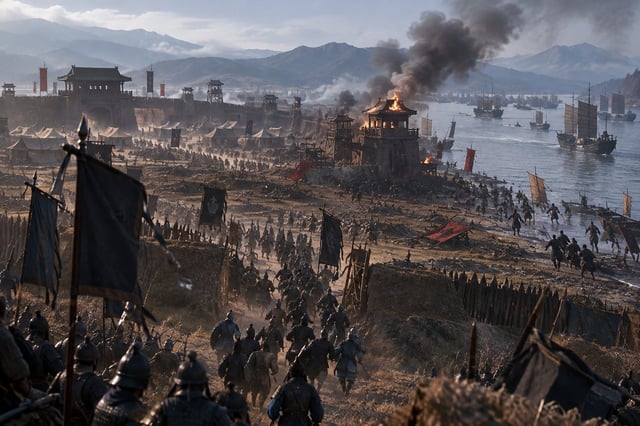
In the winter of the twenty-fourth year of Jian'an (219 CE), Guan Yu's northern campaign against Fancheng had been blunted by Xu Huang's relief force, and as he turned his forces back he received urgent word that Jingzhou had been seized by Lv Meng's Lvmengbaiyidujiang and that Mi Fang and Fu Shiren had opened the city gates to surrender. When Guan Yu's troops learned that their families inside Jingzhou had been treated with care and kept safe, they began drifting away in large numbers, and the army rapidly disintegrated. Guan Yu managed to lead a remnant of several hundred men to fall back on Maicheng, where he held the four gates with what troops remained. He sent Liao Hua to break through the encirclement and seek reinforcements from Shangyong, but Liu Feng and Meng Da refused to dispatch troops on the grounds that the mountain stronghold had only recently come under their control. Zhuge Jin entered the city to urge surrender, but Guan Yu refused, and that night he led a small party including Guan Ping and Zhao Lei in a westward breakout attempt; at the Linzu gorge at Jiashi they were captured by Ma Zhong, a subordinate of Pan Zhang, and both Guan Yu and his son Guan Ping were executed. This defeat marked the total destruction of Shuhan's Jingzhou army, and the Wu-Shu alliance broke apart in its wake.
Shu Ji says that Sun Quan intended to keep Guan Yu to use against Liu Bei and Cao Cao, and ordered his execution only after his attendants advised him to do so; Pei Songzhi, drawing on Wu Shu and geographical knowledge, argues against this, contending that Pan Zhang intercepted Guan Yu and beheaded him upon reaching Linju, leaving Sun Quan perhaps no real opportunity to discuss whether he should live or die.
Romance
The novel depicts Guan Yu's death as the climax of his loyalty and sacrifice for his country: Zhuge Jin enters Maicheng to urge him to surrender but is sternly refused; Guan Yu declares his resolve with the words, "Jade may be shattered, but its whiteness cannot be changed"; and after being captured during his breakout, he calmly accepts death. There is no political calculation about capturing him alive and keeping him in service.
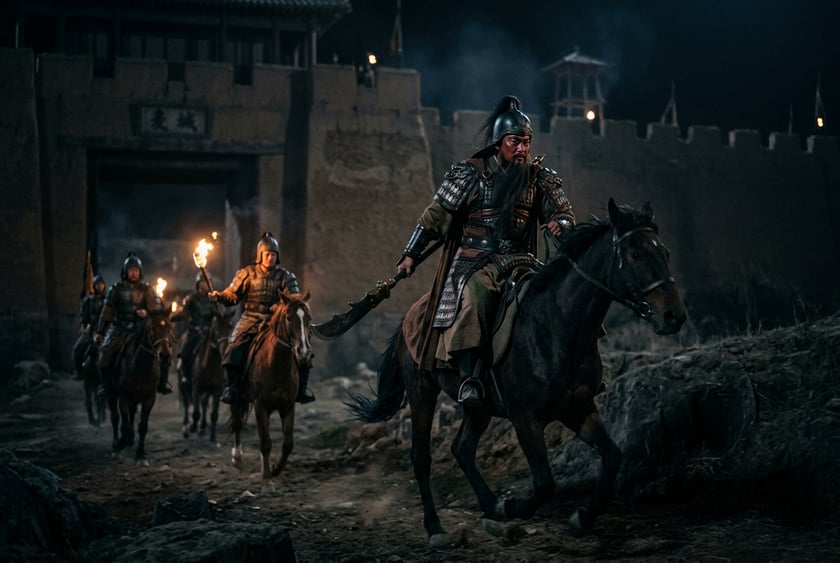
Armored and grim-faced, Guan Yu leads a small remnant of his troops on horseback as they break through the encirclement in the night, with Maicheng’s walls behind them.
Guan Yu's northern campaign against Fancheng in the twenty-fourth year of Jian'an —
the flooding of the Seven Armies and the terror that shook the realm — was the greatest
military gamble Shuhan's Jingzhou forces had undertaken since Chibi. Cao Cao briefly
considered relocating his capital at Xudou to escape Guan Yu's advance; Sima Yi and
Jiang Ji advised him instead to promise the Yangtze south bank to Sun Quan in order to
lure Wu into striking from the rear, and Cao Cao agreed. This meant that Guan
Yu faced not only Xu Huang's relief army marching toward Fancheng, but a second front
quietly opening from the direction of Jiangdong. A deeper layer of context lay within
Sun Quan's camp: Lv Meng had already memorialized the throne proposing that they seize
Nanjun while Guan Yu was fully committed to the north, so strategically Guan
Yu was encircled on two sides with no prospect of relief.
Dispositions of Both Sides
Guan Yu shifted his main force north to the Fancheng front line, leaving Mi Fang to
hold Jiangling in Nanjun and Fu Shiren to hold Gong'an. Both commanders had
long harbored resentment toward Guan Yu and had already been upbraided by him for
failing to supply the army on time; their loyalty was already in doubt. Lv Meng's
dispositions were a masterpiece of deception: he first feigned illness and withdrew to
Jianye to lull Guan Yu's suspicions, then ordered his soldiers to dress as merchants
in white robes and pole their boats quietly along the riverbank, picking off Guan Yu's
lookout posts one by one. By the time the Wu army reached Nanjun, Mi Fang
and Fu Shiren had surrendered one after the other, and Guan Yu's line of retreat was
severed overnight. On the Cao Cao side, Xu Huang was dispatched to relieve Fancheng
and ultimately combined forces with Cao Ren outside the walls to squeeze Guan Yu back
south of the Hanshui from the northern front.
Critical Decision Points
The first fatal misjudgment was Guan Yu's failure to maintain his guard after Lv Meng
feigned illness: he believed Lv Meng genuinely gravely ill and pulled his troops from
Gong'an and Nanjun to concentrate at Xiangyang, surrendering the entire
strategic depth from Jiangling to Gong'an. The second misjudgment came on his march
back, when he sent envoys to Jingzhou to gather intelligence — Lv Meng deliberately
entertained the envoys lavishly, allowed them to wander freely through the city, and
let them deliver letters home; when the envoys returned reporting "all is well at home,"
the fighting spirit in Guan Yu's army collapsed, and soldiers deserted in large numbers
to rejoin their families in Jingzhou. The third and decisive mistake was the
refusal of relief from Shangyong: Liu Feng and Meng Da turned away Liao Hua's plea
for help on the pretext that their "mountain city had only recently submitted", turning Maicheng from a stronghold into a death trap. Structurally, Guan Yu
committed a string of "trust without verification" errors, each of which Lv Meng
exploited in turn.
Outcome and Repercussions
Guan Yu withdrew with his remnants to hold Maicheng; his force had dwindled from tens
of thousands to barely three hundred men. With no relief army from Shangyong
in sight, he chose to break out by night with a dozen or so horsemen, hoping
to cut through the highlands of Linshu and make for Chengdu. He fell into Ma Zhong's
rope trap at Jiashi and was captured, then executed along with his son Guan Ping on
Sun Quan's orders. The immediate consequence was Shuhan's permanent
loss of Jingzhou; the indirect consequence was Liu Bei's full-scale eastern punitive
expedition two years later, which culminated in the defeat at Yiling and left Shuhan's
national strength beyond recovery. The complete rupture of the Wu-Shu alliance and the
subsequent chain defections of Liu Feng and Meng Da at Shangyong all trace back to
this campaign. In strategic terms, Maichengbaizou marked the final failure of Zhuge
Liang's Longzhong strategy of holding both Jingzhou and Yizhou as dual axes of advance;
from this point on, Shuhan could only defend Yizhou on a single front.
Counterfactual Analysis
The most tempting counterfactual is whether Guan Yu would have kept his main force along
the Jiangling–Gong'an line had Lv Meng not staged his false withdrawal. San Guozhi's
account of the entire operation to seize Jingzhou makes clear that the whole plan
depended critically on Guan Yu's credulity; had Guan Yu left even ten thousand
men in Nanjun, Baiyidujiang would not have succeeded at a single stroke. The second
variable is the Shangyong relief: had Liu Feng heeded the call of duty and sent troops
out, Guan Yu might have broken through with his three hundred survivors and a light
cavalry screen into the Shangyong highlands and turned to protracted guerrilla warfare. But the deeper structural problem lay in Guan Yu's relationship with
Jiangdong — he had publicly insulted the envoy Sun Quan sent to propose a marriage
alliance, hardening Sun Quan's resolve to strike his rear; this diplomatic
collapse, in place before the campaign even began, had already narrowed every tactical
counterfactual to the smallest of margins. In other words, Maichengbaizou was not the
loss of a single battle but the final reckoning of years of failed diplomacy, failed
internal coordination, and failed battlefield judgment compounding together.