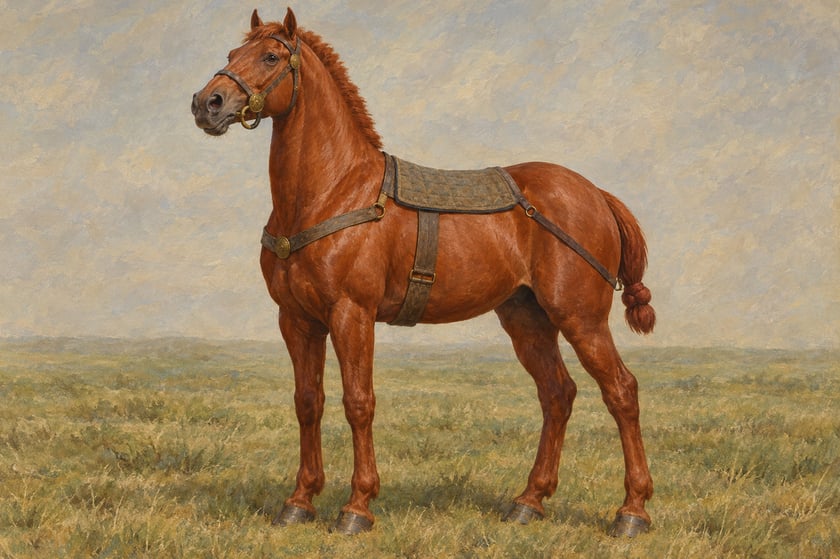
Overview
Red Hare is the mount of Lü Bu. The Records of the Three Kingdoms states that Lü Bu “had a fine horse named Red Hare”. In Romance of the Three Kingdoms, it is originally a prized horse belonging to Dong Zhuo, used to induce Lü Bu to defect, and later given by Cao Cao to Guan Yu. Throughout its chapters, the novel generally calls it “the horse Red Hare”; the Hou Han shu writes its name as “Chitu (赤菟).”
Origins
According to chapter 3 of Romance of the Three Kingdoms, Red Hare is originally Dong Zhuo’s prized horse, reputed to travel a thousand li a day. Li Su, claiming to be from the same hometown as Lü Bu, proposes using the horse, along with gold and pearls, to win Lü Bu’s allegiance and persuade him to abandon Ding Yuan and join Dong Zhuo. Li Ru also says, “My lord wishes to take the realm; why begrudge a single horse?” Dong Zhuo gladly hands over the horse, adding one thousand liang of gold, several dozen lustrous pearls, and a jade belt.
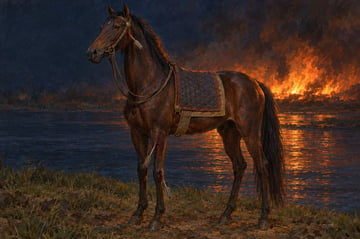
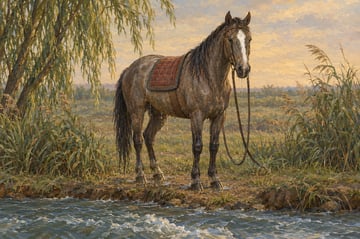
The novel describes the horse as red as burning charcoal from head to foot, without a single hair of another color, one zhang long from head to tail and eight chi tall from hoof to neck. Li Su says it crosses rivers and climbs mountains as though walking on level ground.
Provenance
In the Records of the Three Kingdoms, Lü Bu went north to join Yuan Shao and accompanied him in attacking Zhang Yan in Changshan State (called “Changshan” here). Lü Bu had a fine horse named Red Hare and frequently charged into enemy formations with trusted followers such as Cheng Lian and Wei Yue, eventually defeating Zhang Yan’s army. Pei Songzhi’s commentary quotes the Cao Man zhuan, which recorded a saying of the time: “Among men, Lü Bu; among horses, Red Hare”.
In Romance of the Three Kingdoms, Li Su brings Red Hare and gifts to Lü Bu’s camp and requests an audience as an old acquaintance. Lü Bu is delighted by the horse. Only after they have drunk freely does Li Su reveal that the gold, pearls, and jade belt are all gifts from Dong Zhuo, saying, “The horse Red Hare is also a gift from Lord Dong”. Lü Bu immediately proposes killing Ding Yuan and bringing his troops over to Dong Zhuo, agreeing with Li Su to surrender the next day. This episode forms part of Dong Zhuo's Coup.
In chapter 19 of the novel, Hou Cheng, Song Xian, and Wei Xu agree on a plan. That night, Hou Cheng slips into the stables and steals Red Hare. Wei Xu opens the gate to let him out, and Hou Cheng rides to Cao Cao’s camp to present the horse. He also explains that Song Xian and Wei Xu will raise a white flag as the signal to surrender the gate: this is their plan to “steal the horse and surrender the gate”. The horse thus passes into Cao Cao’s possession.
In chapter 25 of the novel, during the episode in which Guan Yu surrenders to Cao Cao, Cao Cao invites Guan Yu to a banquet. As he sees him out afterward, he notices that Guan Yu’s horse is thin and orders this horse brought forward. Guan Yu recognizes it as Red Hare, the horse Lü Bu rode, and Cao Cao gives it to him together with its saddle and bridle. Guan Yu bows twice in thanks, saying that the horse can travel a thousand li a day, so if he learns his elder brother’s whereabouts, he can reach him in a single day.
In chapter 77 of the novel, after Guan Yu’s death, his mount Red Hare is captured by Ma Zhong and presented to Sun Quan. Sun Quan immediately awards it to Ma Zhong as a mount, but the horse refuses fodder for several days and dies. This episode forms part of the Retreat to Mai Castle.
Notable Episodes
All the following episodes appear in Romance of the Three Kingdoms.
In chapter 5, Lü Bu rides out to face the lords of eight contingents, mounted on “Red Hare, neighing into the wind.” The novel declares, “Among men, Lü Bu; among horses, Red Hare”.
When the three heroes fight Lü Bu before Hulao Gate, Gongsun Zan fights Lü Bu for only a few bouts before fleeing in defeat. Lü Bu spurs Red Hare in pursuit and is about to thrust his weapon into Gongsun Zan’s back when Zhang Fei gallops forward, leveling his Serpent Spear.
In chapter 19, Cao Cao diverts water to flood Xiapi. Confident that Red Hare can “cross water as though on level ground,” Lü Bu spends each day drinking with his wife and concubines.
When Guan Yu slays Yan Liang, his Red Hare is so swift that before Yan Liang can ask a question, Guan Yu is already before him and thrusts him from his horse with a single stroke of his blade.
In chapter 28, Guo Chang’s son comes at night to steal Red Hare and is kicked to the ground by the horse.
Invited by Guo Chang’s son to seize this thousand-li horse, Pei Yuanshao sees that its rider is Guan Yu and immediately tumbles from his saddle to dismount.
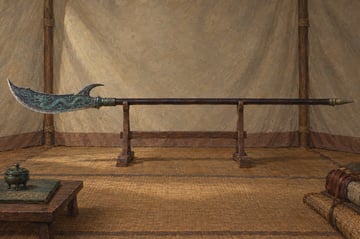
In chapter 50, on Huarong Road, Guan Yu leads five hundred blade-wielding soldiers and, “holding the Green Dragon Blade and riding Red Hare,” blocks Cao Cao’s escape.
The novel also contains two episodes in which Guan Yu appears riding Red Hare after the horse’s death; both are supernatural manifestations. In chapter 77, Guan Yu’s heroic spirit appears above Yuquan Mountain in Dangyang, riding Red Hare and holding the Green Dragon Crescent Blade (called the “Green Dragon Blade” in this chapter). In chapter 94, Guan Xing falls into the water while pursued by the Qiang general Yue Ji. After escaping, he sees his father amid the clouds and mist, holding the Green Dragon Blade and riding Red Hare, showing him the way.
History and the Romance
Lü Bu is the only rider of Red Hare mentioned in the Records of the Three Kingdoms, which states only that he “had a fine horse named Red Hare” when he accompanied Yuan Shao against Zhang Yan. The Records does not record Red Hare’s origins or fate. Dong Zhuo’s gift of the horse, Hou Cheng’s theft of it and presentation to Cao Cao, Cao Cao’s gift of it to Guan Yu, Ma Zhong’s capture of it and presentation to Sun Quan, and the horse’s death after refusing food are all episodes from Romance of the Three Kingdoms. Guan Yu’s slaying of Yan Liang while riding Red Hare also comes from the novel.
Scholarship
According to the biography of Lü Bu in the Hou Han shu, Lü Bu often rode a fine horse named “Chitu (赤菟),” which “could gallop over walls and fly across moats.”
One view holds that “Chitu (赤兔)” is an erroneous form of “Chitu (赤菟),” with 菟 meaning tiger, since the people of Chu called tigers “wutu (於菟).” Another holds that a rabbit-shaped head was a mark of a fine horse in Han-dynasty horse appraisal, so Red Hare may have been a description rather than a proper name.