Overview
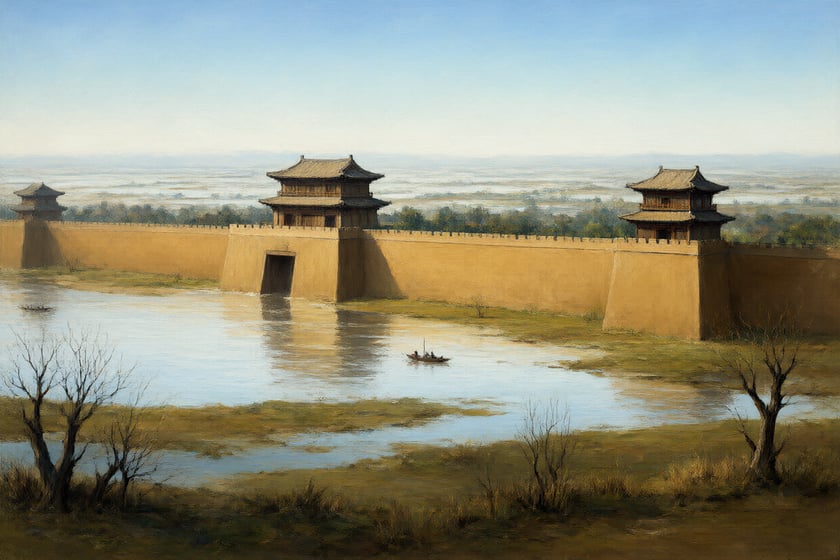
Xiapi was the capital of the Eastern Han state of Xiapi, which belonged to Xu Province. Its ancient city site lies in present-day Gupi Town, Suining County, Jiangsu Province. In the final years of the Han, warlords vied for Xu Province, and Xiapi was a strategic city at the heart of their campaigns: in the first year of Jian’an (196), Lü Bu seized the city while Liu Bei was away on campaign; in the third year of Jian’an (198), Cao Cao besieged Lü Bu there and flooded the city by diverting water into it. Surrounded and desperate at White Gate Tower, Lü Bu surrendered.
History
In the fourth year of Chuping (193), Xiapi native Que Xuan gathered several thousand followers and proclaimed himself Son of Heaven. Tao Qian, governor of Xu Province, briefly allied with him, and they seized Hua, Fei, and other places in Taishan Commandery.
After Liu Bei Took Control of Xu Province, he resisted Yuan Shu at Xuyi and Huaiyin in the first year of Jian’an (196). The two sides faced off for about a month, until Lü Bu took advantage of his absence to seize Xiapi. Xiapi’s defending general, Cao Bao, rebelled and secretly welcomed Lü Bu into the city; Liu Bei’s wife was captured. Pei Songzhi’s commentary, citing the Record of Heroes, says Liu Bei left Zhang Fei to defend Xiapi. It also says that Zhang Fei clashed with Cao Bao, the chancellor of Xiapi, throwing the city into chaos; soldiers from Danyang opened the city gates and let Lü Bu’s troops in. Lü Bu then proclaimed himself Inspector of Xu Province. In the sixth month of the same year, his subordinate Hao Meng launched a revolt, attacking the Xiapi prefectural residence where Lü Bu was staying at night, but Gao Shun put it down.
In the ninth month of the third year of Jian’an (198), Cao Cao campaigned east against Lü Bu. He reached Xiapi in the tenth month. Lü Bu repeatedly suffered defeat in battle and retreated into the city to hold out. Unable to take the city after a prolonged siege, and with his troops exhausted, Cao Cao initially planned to withdraw. He then followed the stratagem of Xun You and Guo Jia, breaching the dikes of the Si and Yi Rivers to flood the city. More than a month later, Lü Bu’s subordinates Song Xian, Wei Xu, and others seized Chen Gong and surrendered with the entire city. Lü Bu and his followers climbed White Gate Tower. Only when they were surrounded and desperate did they come down and surrender. Lü Bu was ultimately strangled, and his head, along with those of Chen Gong, Gao Shun, and others, was sent to Xu.
In the fourth year of Jian’an (199), Liu Bei was ordered to intercept Yuan Shu. At Xiapi, he killed Che Zhou, the Inspector of Xu Province appointed by Cao Cao, left Guan Yu to defend Xiapi and act as its governor, and returned to Xiaopei. In the first month of the fifth year of Jian’an (200), Cao Cao personally led a campaign east, defeated Liu Bei, and drove him to seek refuge with Yuan Shao. Cao Cao attacked Xiapi, which Guan Yu was holding, and Guan Yu surrendered.
During the reign of Emperor Ming of Wei, General Who Conquers the Enemy Huan Fan was appointed commander-in-chief of military affairs in Qing and Xu provinces and stationed at Xiapi. After quarreling with Inspector of Xu Province Zheng Qi over a residence, Huan Fan tried to use his insignia of authority to have Zheng Qi killed. Zheng Qi impeached him, and Huan Fan was dismissed after losing the case.
Notable People
- Born here: Chen Gui once served as chancellor of Pei. Though he had known Yuan Shu since they were young, he replied to Yuan Shu’s letter by refusing to serve him. Chen Deng, Chen Gui’s son, once strongly urged Liu Bei to take control of Xu Province. Others born here include Huan Wei, who wrote the Classic of the Celestial Sphere at the age of eighteen; Chen Hang, a student of Du Kui; and Pei Xuan, who served Wu and rose to the post of Grand Master of the Palace.
- Served here: Sun Jian served successively as assistant magistrate of Yandu and Xuyi before transferring to become assistant magistrate of Xiapi. Pei Songzhi’s commentary, citing the Jiang Biao Zhuan, says Sun Quan was born while his father was serving as assistant magistrate of Xiapi. Ze Rong once served as chancellor of Xiapi, but by the second year of Xingping (195) had already gone south to seek the protection of Liu Yao, Inspector of Yang Province. Liang Xi was transferred from magistrate of Haixi to magistrate of Xiapi and earned a reputation for good governance wherever he served. When Wu Zhou was magistrate of Xiapi, Zang Ba, Inspector of Xu Province, respected him and paid him a personal visit.
- Died here: Besides Lü Bu, Chen Gong, and Gao Shun, Che Zhou was killed by Liu Bei. Cao Bao, a former subordinate of Tao Qian, was said in the Record of Heroes to have been killed by Zhang Fei.
Differences in Historical Fiction
In the Romance of the Three Kingdoms, Zhang Fei is depicted as getting drunk while left in charge, demanding that Cao Bao drink with him, and threatening to beat him a hundred times when he refused. The episode in which Zhang Fei beats Cao Bao after getting drunk does not appear in the Records of the Three Kingdoms. The novel says that after Xiapi was flooded, only the eastern gate remained above water. Lü Bu drank wine all day, then saw in a mirror that drink and women had worn him down, and only then ordered a ban on alcohol in the city. Pei Songzhi’s commentary, citing the Jiuzhou Chunqiu, also records Lü Bu’s ban on alcohol: his subordinate Hou Cheng was reprimanded for presenting wine and grew fearful and suspicious, later leading his men in surrender. In the fifth year of Jian’an, when Guan Yu Surrenders to Cao Cao, the novel says Cao Cao sent soldiers pretending to surrender to act as his agents inside the city. They lured Guan Yu out and trapped him on Earth Hill, then took advantage of his absence to attack Xiapi. Zhang Liao went up the hill and cited “three crimes” and “three advantages” to persuade Guan Yu to surrender. The story of Guan Yu’s agreement to surrender on Earth Hill is not recorded in the Records of the Three Kingdoms.
Present Day
The ruins of ancient Xiapi lie in present-day Gupi Town, Suining County, Jiangsu Province. After an earthquake and Yellow River floods during the Kangxi reign of the Qing dynasty, the site was buried underground. Archaeological excavations have been carried out in recent years, and in 2019 it was designated a Major Historical and Cultural Site Protected at the National Level.