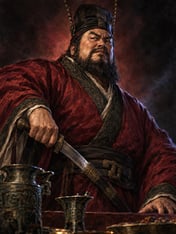
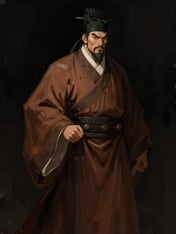
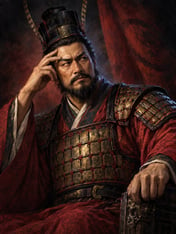
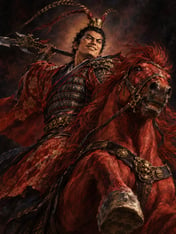
The Dongzhuozhiluan unfolded from Zhongping 6 through Chuping 3 (189–192) and stands as the defining event marking the Eastern Han central government's transition from decline to total collapse. In Zhongping 6, Emperor Ling died and the young Emperor Liu Bian took the throne; Grand General He Jin and Sili Commander Yuan Shao secretly plotted to exterminate the Shichangshi eunuch faction, but blocked by the Empress Dowager's resistance they turned to summoning Dong Zhuo—Governor of Bingzhou (or in some accounts Inspector of Xiliang)—to march troops into the capital and coerce the Empress Dowager. Before Dong Zhuo arrived, He Jin was murdered by the eunuchs and the capital descended into chaos. After Dong Zhuo reached the capital, he absorbed the former troops of He Jin and He Miao and of Commander of the Imperial Guard Ding Yuan—whom he neutralized by enticing Lv Bu to assassinate Ding Yuan and join him—and used this stranglehold on the palace guards to depose the young emperor as Prince of Hongnong, enthrone Liu Xie of Chenliu as Emperor Xian, and subsequently poison both the deposed emperor and He Taihou. Dong Zhuo then appointed himself Grand Commandant and then Chancellor, entitled to enter court with sword and shoes and without the ritual bow. In Chuping 1 (190), the lords of the eastern provinces elected Yuan Shao as generalissimo and formed an anti-Dong coalition; Dong Zhuo burned the palaces of Luoyang, plundered the imperial tombs, and forcibly relocated the emperor and a million civilians to Changan. In the fourth month of Chuping 3, Minister Over the Masses Wang Yun and Lv Bu conspired together; seizing the occasion of a grand court assembly in Weiyang Hall to celebrate the emperor's recovery from illness, they ambushed and killed Dong Zhuo and exterminated his three clans. But Wang Yun could not pacify the Liangzhou troops who had served Dong Zhuo; Li Jue, Guo Si, and others counterattacked Changan, killed Wang Yun, and routed Lv Bu, returning court affairs to the hands of the Xiliangjun warlords—an episode known in history as the Liguozhiluan. The entire episode lasted nearly four years, marking the practical end of Eastern Han central authority and opening the era of warlord fragmentation that would endure for decades.
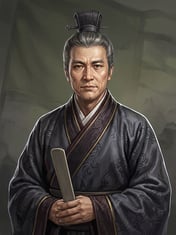
The Records of the Three Kingdoms and the Book of the Later Han record that Wang Yun, Shisun Rui, and Lü Bu plotted in secret. When the emperor, having recovered from illness, held a great gathering at Weiyang Palace, Li Su and others disguised themselves as guards and lay in wait at the side gate. Lü Bu carried an imperial edict and assassinated Dong Zhuo. Afterward, Dong Zhuo’s three clans were exterminated. The whole affair was a political conspiracy between aristocratic bureaucrats and military officers from Bing Province.
Romance
In Chapters 8 and 9, the novel substantially invents the “chain stratagem”: Wang Yun first promises his adopted daughter Diao Chan to Lü Bu, then presents her to Dong Zhuo, provoking Lü Bu’s anger when Dong Zhuo takes her from him at Phoenix Pavilion and ultimately leading Lü Bu to stab Dong Zhuo to death in court. Neither Diao Chan nor the Phoenix Pavilion episode has any basis in historical fact; both are inventions of the novel, designed to reinforce the theme of “using a beauty stratagem to destroy a treacherous tyrant.”
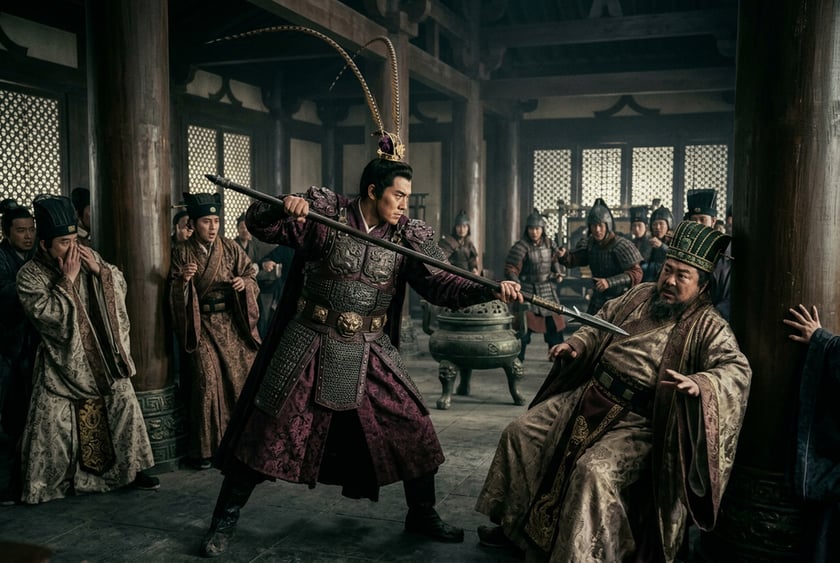
Dong Zhuo is surrounded by hidden soldiers in Weiyang Hall. Lü Bu, holding a spear, is about to strike Dong Zhuo a fatal blow as the civil and military officials in the hall look on in terror.
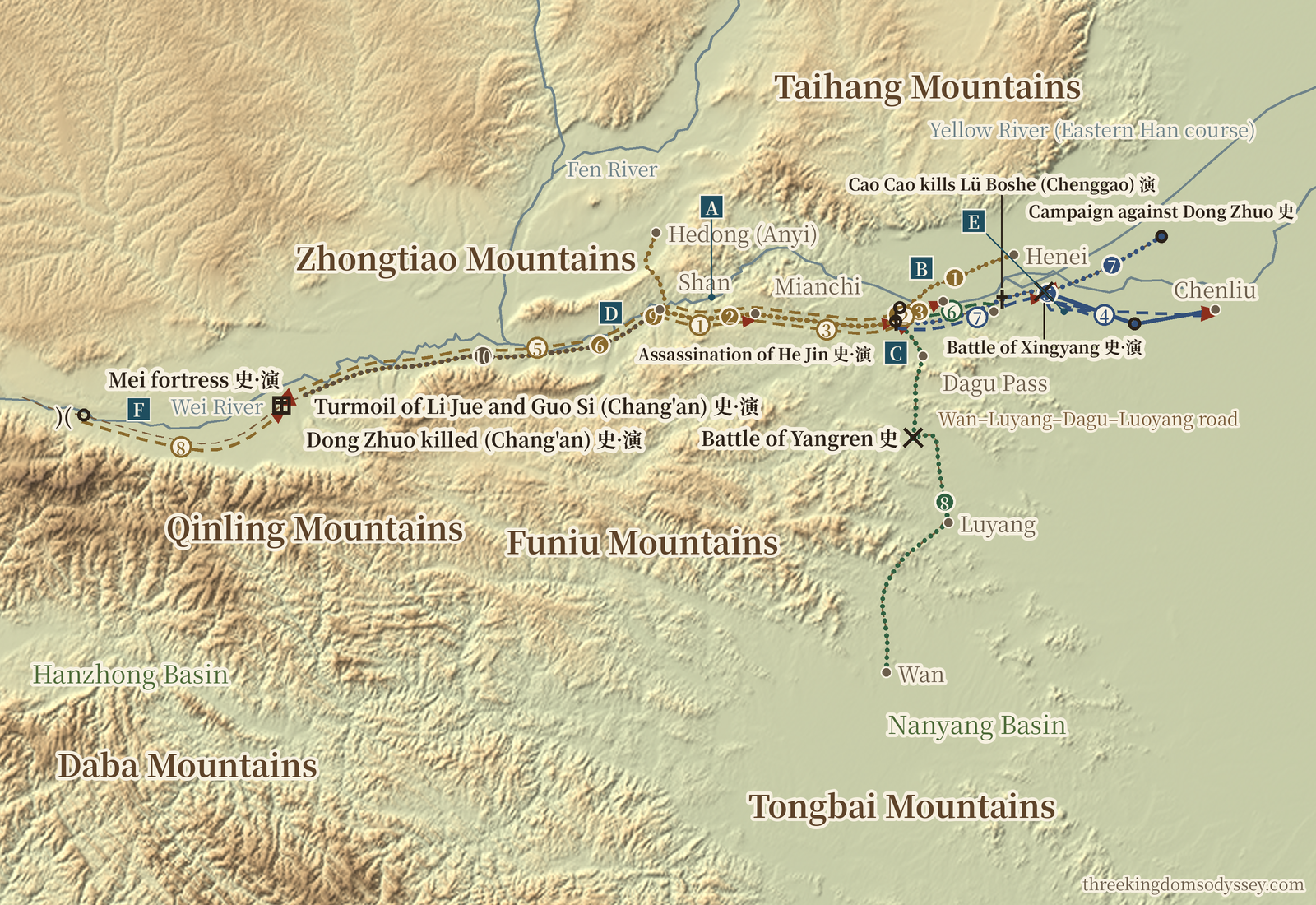
1Ding Yuan marches on LuoyangRecords of the Three Kingdoms, juan 7
2Dong Zhuo marches on Luoyang董卓(维基百科)Records of the Three Kingdoms, juan 6
3Duan Gui falls back to Xiaoping FordRecords of the Three Kingdoms, juan 6
4Dong Zhuo marches on LuoyangRecords of the Three Kingdoms, juan 6
5Cao Cao falls back to ChenliuRecords of the Three Kingdoms, juan 1
6Dong Zhuo's force falls back to Chang'anRecords of the Three Kingdoms, juan 6Records of the Three Kingdoms, juan 1
7Cao Cao and Wei Zi and Cao Hong marches on XingyangRecords of the Three Kingdoms, juan 1
8Sun Jian marches on Luoyangtens of thousandsHist.Records of the Three Kingdoms, juan 46
9Dong Zhuo falls back to Chang'anRecords of the Three Kingdoms, juan 1Records of the Three Kingdoms, juan 46
10Li Jue and Guo Si and Zhang Ji marches on Chang'anover 100,000 menHist.Records of the Three Kingdoms, juan 6Romance of the Three Kingdoms, ch. 9
In the Romance
1Dong Zhuo and Li Jue and Guo Si and Zhang Ji and Fan Chou marches on MianchiRomance of the Three Kingdoms, ch. 3
2Zhang Rang and Duan Gui falls back to Mount Mang (Beimang)Romance of the Three Kingdoms, ch. 3
3Dong Zhuo marches on Mount Mang (Beimang)Romance of the Three Kingdoms, ch. 3
4Cao Cao and Chen Gong falls back to ChenliuRomance of the Three Kingdoms, ch. 4Romance of the Three Kingdoms, ch. 5
5Dong Zhuo and Li Jue and Guo Si falls back to Chang'anRomance of the Three Kingdoms, ch. 6
6Sun Jian marches on LuoyangRomance of the Three Kingdoms, ch. 6
7Cao Cao and Xiahou Dun and Xiahou Yuan and Cao Ren and Cao Hong and Li Dian and Yue Jin pursues to Xingyangover 10,000 menNovelRomance of the Three Kingdoms, ch. 6
8Dong Zhuo and Li Su marches on Chang'anRomance of the Three Kingdoms, ch. 9
In the Sanguozhi's main text Dong Zhuo stays at Luoyang a year after sending the court west and is killed at a court assembly in Chang'an; the novel has him withdraw at once and die when summoned from Mei.
The books mostly say only where an army set out and arrived: a Records line is solid between the places they name and dotted where it follows a reconstructed road between them; an open ring marks an end the books don't give.
Why these routes
ADong Zhuo was in Hedong when He Jin called him: he crossed the Yellow River south and came east down the Xiao–Han road; at Mianchi the court sent Zhong Shao to stop him.Schol.董卓(维基百科)崤函古道(维基百科)Records of the Three Kingdoms, juan 6
BDuan Gui fled north with the emperor to Xiaoping Ford, a Yellow River crossing and one of Luoyang's eight passes; Dong Zhuo met the emperor on Mount Mang north of the city.Schol.后汉书·孝灵帝纪(维基文库)邙山(维基百科)Records of the Three Kingdoms, juan 6
CIn the Sanguozhi's main text Dong Zhuo sends the court west but stays at Luoyang himself until the fourth month of the next year; in the novel he withdraws with the emperor.BothRecords of the Three Kingdoms, juan 1Romance of the Three Kingdoms, ch. 6
DThe novel gives the reason through Dong Zhuo himself: Chang'an is shielded by the Xiao and Hangu passes, is near Longyou, and has timber and stone at hand.NovelRomance of the Three Kingdoms, ch. 6
EThe Lü Boshe story comes from Pei Songzhi's annotations, set at Chenggao; the novel puts it after Zhongmou, so Cao Cao's flight east doubles back west.Schol.Lü Boshe (Wikipedia)Records of the Three Kingdoms, juan 1Romance of the Three Kingdoms, ch. 4
FMei fortress lay west of Chang'an by the Wei, stocked with grain for thirty years; the novel has Dong Zhuo summoned from it to receive the throne, and killed on arrival.BothRecords of the Three Kingdoms, juan 6Romance of the Three Kingdoms, ch. 9
Base map: Natural Earth; terrain: AWS Terrain Tiles (SRTM and others). Roads and marches reconstructed from the sources listed; positions approximate.
The immediate cause of Dong Zhuo's Coup was the power vacuum within the palace after Emperor Ling died in the summer of Zhongping 6 (189). During Emperor Ling’s reign, a dual power structure of “maternal relatives and eunuchs” had already taken shape. The latent threat posed by two possible heirs—Liu Bian, born to Empress He, and Liu Xie, born to Lady Wang—combined with Emperor Ling’s late-reign favor toward the Attendant-in-Ordinary Jian Shuo and his suppression of the General-in-Chief He Jin, leaving the political situation extremely unstable at the start of the young emperor’s reign. He Jin and the Colonel-Director of Retainers Yuan Shao plotted to eliminate the eunuchs; this was no spur-of-the-moment decision, but another round in the cycle of “maternal relatives and eunuchs” vying for power that had persisted since the Eastern Han emperor Hedi. The crucial variable this time, however, was He Jin’s indecisiveness, Empress Dowager He’s refusal to agree, and Yuan Shao’s proposal to summon outside troops to the capital to pressure her. This proposal was a classic blunder in political history: “using outside force to resolve internal divisions.” Its inherent risk was outsourcing the court’s internal power struggle to a frontier general not bound by the court’s rites and laws. Chen Lin had explicitly warned, “To hold the halberd by its blade is to hand another man a weapon”, while Cao Cao stated even more directly, “The man who will bring chaos to the realm is surely He Jin”. He Jin ignored all these warnings. At a deeper level, the root of Dong Zhuo's Coup lay not with Dong Zhuo, but in the Eastern Han central government’s longstanding loss of control over frontier generals. The militarization of Liang Province and Bing Province had created a power structure capable of operating independently of the court, and Dong Zhuo was simply the first representative to mobilize it deliberately.
Forces Involved
The forces involved in Dong Zhuo's Coup can be divided into four tiers. The first was the central government: the young emperor Liu Bian, Empress Dowager He, He Jin, and He Miao represented the maternal relatives, while Zhang Rang, Zhao Zhong, and the other Ten Attendants represented the eunuchs; Yuan Shao, Yuan Shu, Wang Yun, Lu Zhi, Yang Biao, and others represented the scholar-officials. The second tier comprised the palace guards and local military forces: Ding Yuan, Commandant of the Capital, and his subordinate Lü Bu and Bing Province troops; and Dong Zhuo and his subordinates Niu Fu, Li Jue, Guo Si, Zhang Ji, Fan Chou, Hua Xiong, and other Liang Province troops. The third tier was the coalition of eastern forces: Yuan Shao (Bohai), Yuan Shu (Nanyang), Cao Cao (Chenliu), Sun Jian (Changsha), Liu Dai, Zhang Miao, Zhang Chao, Qiao Mao, Yuan Yi, and more than ten other provincial and commandery governors. The fourth was the network of scholar-official families: Xun Shuang, Han Rong, and Chen Ji of Yingchuan, and Xu Jing and Zhou Bi of Runan, among others, were drawn into the new regime by Dong Zhuo’s policy of “eliminating the corrupt and promoting the obscure”. Wang Yun, meanwhile, remained hidden within Dong Zhuo’s regime and ultimately took on the task of overthrowing him. These four tiers overlapped and constantly realigned, making them essential to understanding who stood on which side during Dong Zhuo's Coup. Dong Zhuo’s political abilities are often underestimated: his rapid absorption of Ding Yuan’s army, subjugation of the court, appeasement of some scholar-official families, and promotion of land-reclamation and currency reforms belie the image of a mere warrior. But his tyranny—forcing more than a million people to move to Chang'an, allowing his troops to plunder, and executing surrendered soldiers by burying them alive—ultimately cost him the support of the scholar-official families.
Key Turning Points
There were three major turning points in the entire episode. The first was the Assassination of He Jin. The man who should have initiated the campaign against the eunuchs was instead lured into the palace and killed by them. Dong Zhuo, who had been summoned to the outskirts of the capital, filled the resulting power vacuum in the palace guard, and the court changed hands in an instant. The second was Lü Bu’s killing of Ding Yuan. Dong Zhuo exploited their shared native place to buy Lü Bu’s allegiance, prompting him to present Ding Yuan’s head, his sworn father’s, and join Dong Zhuo. This allowed Dong Zhuo to absorb the Bing Province army and expand his forces from a single Liang Province army to combined Liang and Bing Province armies. This merger also foreshadowed Wang Yun’s later success in persuading Lü Bu to turn against Dong Zhuo: Lü Bu’s “having neither father nor ruler” cut both ways—he could kill his father for gain, and turn against his lord for new gains. The third was Wang Yun’s internal coup. Wang Yun served as Minister over the Masses within Dong Zhuo’s regime, biding his time for years. When Lü Bu and Dong Zhuo fell out, he plotted Dong Zhuo’s assassination. In the fourth month of Chuping 3, taking advantage of an assembly at Weiyang Hall to celebrate the emperor’s recovery, Li Su and others disguised themselves as guards and ambushed Dong Zhuo, exterminating his entire clan down to the third degree. Each of these three turning points altered the course of events, but they also accumulated ever greater political debts. Wang Yun’s failure to deal properly with Dong Zhuo’s former Liang Province subordinates after his assassination in particular set off Li Jue and Guo Si’s counterattack.
Suppression and Outcome
After Dong Zhuo’s death, Li Jue and Guo Si initially intended to disband their forces and return home. Jia Xu persuaded them that “there is nowhere to go if you head east; you might as well counterattack Chang'an,” and they led the remnants of the Liang Province forces in an assault on Chang'an, killing Wang Yun and defeating Lü Bu. From then on, the court had no one capable of directing events, and entered a chaotic period of “division of spoils among Liang Province warlords.” Wang Kuang, Administrator of Henei, tried to organize military action against Dong Zhuo, but Dong Zhuo routed him at Heyang Ford with a flanking maneuver that split his forces. Dong Zhuo burned the palaces in Luoyang, excavated the tombs of successive Eastern Han emperors to seize their treasures, and forcibly relocated the emperor and more than a million residents of Luoyang westward to Chang'an, leaving a scene of devastation in which “for two hundred li, not a chicken or dog remained.” In terms of the outcome, although Dong Zhuo himself died, the mechanism he had established for the Xiliang warlords to dominate the court—coercing it with military force, hollowing out the scholar-official bureaucracy, and controlling the emperor as a source of legitimacy—was inherited by Li Jue and Guo Si and continued for five years in an even more fragmented and violent form. It ended only in Jian'an 1, when Emperor Xian returned east to Luoyang and Cao Cao escorted him to Xudu.
Historical Legacy
Dong Zhuo's Coup left a legacy on at least three levels. The first was political institutions: the Eastern Han central government’s control over the provinces and commanderies was utterly shattered. Provincial governors, inspectors, and commandery administrators evolved into independent military and political leaders, each recruiting troops, raising funds, and appointing officials, laying the foundations for the basic pattern of rival warlords that persisted for nearly forty years. The Han court nominally continued to exist, but the “center” had in practice disappeared. The second was the politics of the scholar-official families: those of Yingchuan, Runan, and Hebei were forced to choose sides between Dong Zhuo’s regime and the eastern coalition. Many opted for temporary cooperation to preserve their families. This pragmatic strategy later provided a talent base for Cao Cao’s policy of “holding the Son of Heaven to command the lords.” After Wang Yun’s death, Xun Yu, Xun You, Zhong Yao, and others from Yingchuan traveled south to join Cao Cao, a landmark event in the migration of scholar-official groups. Wang Ling fled to his home village as a youth after Wang Yun was killed, and later became a senior official of Cao Wei, a typical case of a scholar-official network being passed down across generations. The third was cultural memory: Dong Zhuo’s atrocities, Wang Yun’s patience, Lü Bu’s fickleness, and the fictional figure of Diao Chan formed the core material of popular oral tales and opera about the late Han. Chen Shou’s Records of the Three Kingdoms, Fan Ye’s Book of the Later Han, and Luo Guanzhong’s Romance of the Three Kingdoms each retold this history, and each reinforced the narrative pattern of “a treacherous strongman at the helm—loyal subjects striving to preserve the state—outside forces eliminating the traitor,” deeply shaping Chinese political imagination for more than a thousand years. From a broader perspective, Dong Zhuo's Coup was an experiment in the total breakdown of the triangular relationship between frontier generals, imperial power, and scholar-official families in ancient China. Its lessons—not to summon outside troops into the court, not to let a single military strongman control the palace guard, and not to outsource violence before internal conflicts are resolved—were repeatedly recalled, yet repeatedly ignored.