







Background
Yuan Shao Takes Ji Province took place in the seventh month of autumn in the second year of Chuping (191), after the Campaign against Dong Zhuo. The core fact appears in just one sentence in juan 1 of the Records of the Three Kingdoms: “Yuan Shao coerced Han Fu and took Jizhou.” This record is enough to establish when the action occurred, who the parties were, and its outcome, but it says nothing about the specific negotiations, troop deployments, or reactions within Jizhou. Any discussion must therefore distinguish verifiable, concise historical facts from processes added in later narratives, rather than treating dramatic details as a direct record of events at the time.
Politically, Jizhou was a resource-rich region of great strategic value. Yuan Shao, meanwhile, needed to turn the prestige and military strength he had amassed during the campaign against Dong Zhuo into a secure territorial base and administrative resources. Han Fu was governor of Jizhou and held nominal local authority, but the two men did not have equal power. The Records of the Three Kingdoms describes Yuan Shao’s action with the word “coerced,” suggesting that this was not a simple, peaceful transfer of office but a transfer of power accompanied by pressure. The surviving record does not establish whether that pressure came chiefly from military strength, political isolation, or the threat implicit in negotiations between the two sides.
Principal Figures
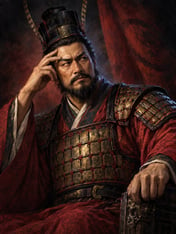
Yuan Shao led the action. Taking Jizhou meant more than acquiring territory: it enabled him to turn the military mobilization of the coalition war into a political base capable of supporting an army, appointing officials, and sustaining continued competition. Han Fu was the one who lost his authority as governor. The histories say Yuan Shao “coerced” him, rather than that he “yielded,” indicating that, at least in the chronicler’s view, Han Fu’s retreat cannot simply be explained as a voluntary abdication. The sources do not describe Han Fu’s decision-making process, however, so it would be unwise to characterize him as incompetent or entirely without options based solely on the outcome.
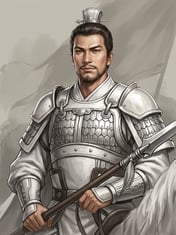
Xun Chen, Gao Gan, Feng Ji, and others, along with Gongsun Zan, Yan Liang, and Wen Chou, fill roles in the related narratives involving political planning, external pressure, and the use of force. In Romance of the Three Kingdoms, Feng Ji is portrayed as devising a plan to pressure Han Fu by using Gongsun Zan, while Xun Chen is depicted as persuading Han Fu to hand over authority over the province. The novel also has Yan Liang and Wen Chou kill Geng Wu and Guan Chun, who attempt to attack Yuan Shao. These episodes help illustrate how the exercise of power could involve planning, intimidation, and violence together. But they are specific details supplied by the novel and cannot be taken as proof that every step appears in early historical sources.
Key Issues
The first issue is the mismatch between “legitimacy” and “control.” Han Fu held the title of governor, while Yuan Shao used military and political pressure to change who actually controlled the province. The transfer of Jizhou was therefore not merely a matter of one individual’s rise or fall; it also shows that, in a time of disorder, the authority of an official post depended on armed force, food supplies, and control over local personnel. After taking authority over Jizhou, Yuan Shao’s ability to consolidate his rule would have depended on turning a coercive takeover into day-to-day governance. But the brief entry in the Records of the Three Kingdoms says only that he “took Jizhou”; it does not describe the transfer of power or the attitude of local society.
The second issue is the inherent paradox of coalition politics. The campaign against Dong Zhuo united its members against a common enemy, but did not eliminate rivalry among allies. Participants could cooperate against an outside foe while competing for territory, resources, and dominance. The novel’s sequence of “shortage of food—plan to take Jizhou—use Gongsun Zan to apply pressure—force Han Fu to seek help” presents this rivalry as a deliberately designed strategy and highlights how seeking assistance could instead create a new form of dependency. Yet this continuous chain of cause and effect comes from Romance of the Three Kingdoms. The surviving excerpt from the Records of the Three Kingdoms confirms only that Yuan Shao coerced Han Fu and took Jizhou; it cannot independently verify the secret letters, food shortages, or specific plans described in the novel.
Political Consequences
For Yuan Shao, taking Jizhou marked a shift in his political identity: from an important military figure in the coalition to a regional power with a territorial base of rule. Territory could provide manpower, provisions, revenue, and an administrative network, reducing his long-term dependence on resources supplied by allies. In this sense, the action changed not only who held the office of governor of Jizhou, but also Yuan Shao’s capacity to compete with the other warlords. However, the Records of the Three Kingdoms account provided here offers no details about how he distributed official posts or integrated local forces after taking control. The novel’s account of appointments cannot be treated as a fact confirmed by this historical entry.
For Han Fu, losing Jizhou meant leaving the center of local power. Romance of the Three Kingdoms says that Yuan Shao allowed him to retain his title as general while stripping him of real authority, and that Han Fu later left Jizhou to seek refuge with Zhang Miao. This portrays how nominal status could be preserved while actual power was taken away, and makes clear that “handing over power” did not necessarily mean safety. These details should still be treated as part of the novel’s narrative. As far as the available official histories are concerned, what can be established is that Han Fu lost Jizhou after Yuan Shao pressured him; this single sentence cannot confirm what became of him afterward or how he was treated.
Counterfactual Analysis
If Han Fu had refused to yield, Yuan Shao would have had to choose among launching an open attack, maintaining pressure, or seeking to turn local elites to his side. Open warfare might have raised the military cost of taking Jizhou and given rivals such as Gongsun Zan an opportunity to intervene. But if Han Fu’s forces lacked internal coordination and outside support was limited, resistance might not have overcome the disparity in strength. What can be explored here is the cost structure of different choices, not the claim that any particular outcome was inevitable. The historical record preserves only the outcome—“coerced” and “took”—and does not say whether Han Fu seriously organized resistance.
Conversely, if Yuan Shao had not brought Jizhou within his sphere of influence, he might have had to continue relying on outside supplies of grain and support from allies, potentially limiting both the pace and independence of his expansion. Avoiding a forcible seizure might also have reduced the risk of conflict with local forces and other lords. The novel’s account of food shortages and using Gongsun Zan to apply pressure provides a narrative model for this counterfactual, but it is not a historical premise that can be directly confirmed. The more cautious conclusion is that the transfer of Jizhou in 191 illustrates a key mechanism by which military prestige in the age of coalitions was converted into territorial power. The precise means by which this occurred, the choices actually made by each side, and the immediate consequences remain difficult to establish because the surviving record is extremely brief.