Background
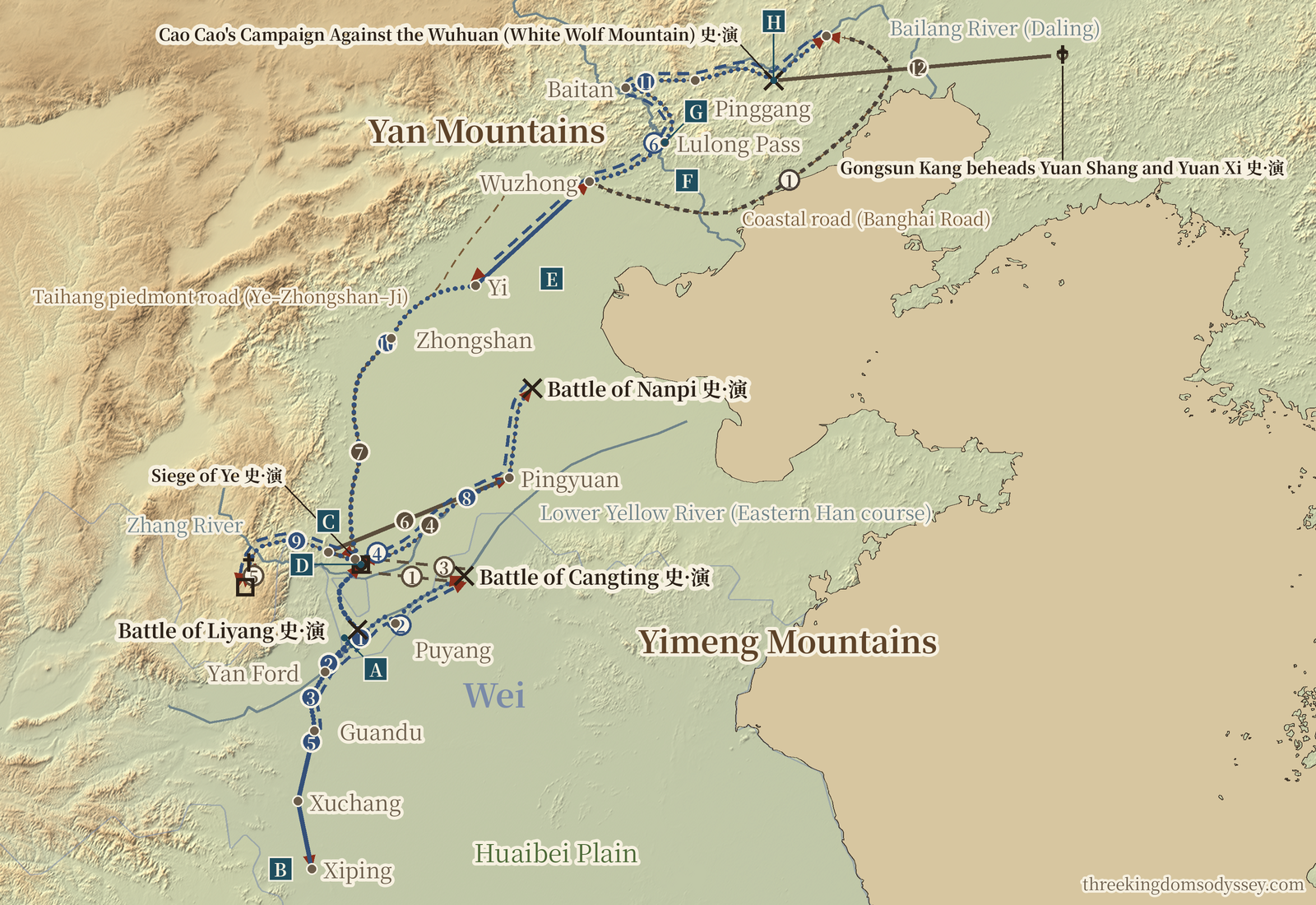
According to the event entry, Cao Cao Pacifies Hebei took place from 201 to 207 (the sixth through twelfth years of the Jian’an era). It involved the Yuan forces of Yuan Tan, Yuan Shang, Yuan Xi, Gao Gan, and others, as well as sub-events including the Battle of Cangting, the Battle of Hugouguan, and the campaign against the Wuhuan. This war cannot be understood merely as a military campaign in which Cao Cao advanced from city to city. After Yuan Shao’s death, disputes over succession and territorial control came into conflict, turning the Hebei coalition from a force united against external enemies into one riven by internal competition. It is important to note that the narrative below is based on the cited passages in chapters 30–34 of Romance of the Three Kingdoms, not on an independent examination of all historical facts. The event entry marks the outcome as “unknown,” so the novel’s ending should be distinguished from the outcome recorded at the event level.
The novel depicts a strategic situation in which Cao Cao faced a Yuan coalition that still possessed troops, cities, and local resources, but gradually found that its internal fractures mattered more than its external defenses. During the fighting at Liyang, Yuan Tan asked Yuan Shang for reinforcements, but Yuan Shang sent only a small contingent. His adviser Shen Pei even argued that they should use Cao Cao to weaken Yuan Tan. Cao Cao’s forces then prevailed in the Liyang area, while suspicion between the Yuan brothers continued to deepen. Hebei, then, was not a unified political community, but a network of power held together by kinship claims, local armies, and factions of advisers that also constrained one another.
Major Figures
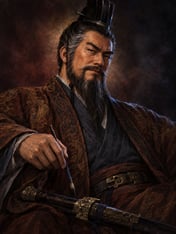
Cao Cao’s advantage lay not only in battlefield command but also in his ability to combine military pressure, political conciliation, and the management of resources. At one point, he accepted Yuan Tan’s appeal for aid and submission, using a marriage promise as part of their alliance. He later adjusted his deployments, citing the need to repair the grain routes and advance on Jizhou. The novel recounts that he first withdrew to Liyang, then worked to transport grain along the Baigou, before sending out his forces as the Yuan brothers fell into conflict. This pacing suggests that Cao Cao did not always seek a swift victory. Instead, he waited for his opponents’ internal alliance to disintegrate while improving his supply lines for a prolonged campaign.
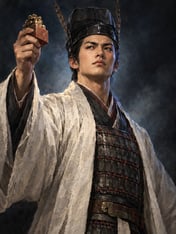
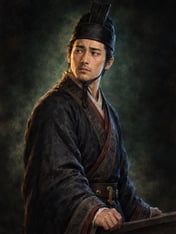
Yuan Tan and Yuan Shang represented more than a simple contest between elder and younger brother: they were competing for control of the Yuan family’s military and political resources. Yuan Tan first relied on Cao Cao to oppose Yuan Shang and accepted the marriage arrangement, but Guo Tu then urged him to guard against Cao Cao and even proposed that Lü Kuang and Lü Xiang secretly act as inside agents. On Yuan Shang’s side, Shen Pei directed defense and decision-making. He was unwilling to give Yuan Tan full support and sought, under pressure from Cao Cao, to eliminate his elder brother first. Both sides treated Cao Cao as an outside power they could exploit, but neither established a credible, stable mechanism for cooperation. This gave their external opponent the opportunity to pressure them one by one.
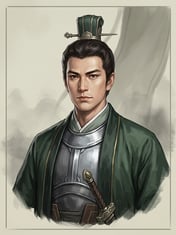
Advisers and generals each played a part in this reshaping of power. Guo Jia judged that “if pressed, the Yuan brothers would come to each other’s aid; if given time, they would fight among themselves,” and advised holding off on a major assault until their rift widened. He later proposed using Yuan defectors to take You Province and other territories. Xun You is listed among the participants, but the cited passages provide no specific examples sufficient to detail his decisions, so it would be inappropriate to add them here. On the battlefield, Xu Huang slew a general, while Xu Chu and Zhang Liao captured key points. Their military actions served broader strategic aims: opening routes, breaking down the defenders, and absorbing defectors. The novel does not portray Cao Cao as resolving the conquest of Hebei through a single decisive battle; instead, it shows generals’ actions working in concert with strategic planning.
Core Issues
The first core issue is the credibility of alliances. Yuan Tan appealed to Cao Cao for help both to escape Yuan Shang’s pressure and to preserve his future claim to Jizhou. Cao Cao’s marriage promise likewise served both as an alliance and as a means of political co-optation. Yuan Tan then grew suspicious of Cao Cao, while Yuan Shang also regarded Cao Cao as an enemy to be dealt with, yet still refused to form reliable cooperation with his elder brother. Each treated cooperation as a short-term expedient rather than a mutually recognized political arrangement. As a result, every appeal for aid came with mistrust, and every alliance carried the expectation of betrayal.
The second issue is supply and control of territory. Cao Cao explained that the grain routes had to be cleared before advancing on Jizhou. He later attacked Yin Kai, Handan, and other places, and cut off Yuan Shang’s supply lines. The narrative thus emphasizes that the fate of cities was not an isolated matter: lines of communication, sources of grain, and outlying strongholds determined whether garrisons could continue to resist. For the Yuan forces, internal conflict also forced them to divide their troops among aiding a brother, defending their own territory, and countering Cao Cao’s army. For Cao Cao, controlling key routes offered a surer way to build an advantage than recklessly besieging a fortified city.
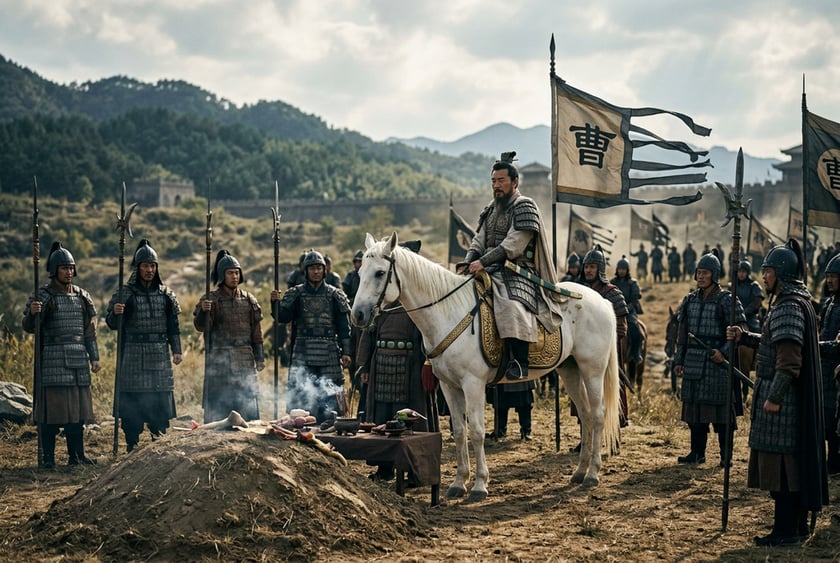
The third issue is the parallel pursuit of conquest and political integration. After occupying Jizhou, Cao Cao went to Yuan Shao’s tomb to make offerings, bestowed goods on Yuan Shao’s family, and announced a reduction in that year’s taxes and levies for the people of Hebei. At the same time, after Yuan Tan was killed, a harsh order was issued forbidding public displays of his body. These measures point to the same aim: the new ruler needed both to weaken the old centers of power and to demonstrate to local society a commitment to restoring order and governing it. Wang Xiu’s mourning for Yuan Tan and the honors he received in turn are presented as the co-optation of a loyal and righteous man. This suggests that political victory meant not only eliminating opponents but also winning the talent and moral standing of the former regime.
Political Consequences
Within the novel’s narrative, after Cao Cao seized Jizhou, Yuan Tan was defeated and killed, while Yuan Shang and Yuan Xi retreated north. Yuan generals, local powers, and defectors then entered Cao Cao’s political and military system. Cao Cao also ordered defectors to take part in the attack on You Province and sent troops against Gao Gan in Bingzhou. This advance turned a victory in the central region into the dismantling of the surrounding political network: the old Yuan armies were divided, persuaded to surrender, or reorganized, while local forces formerly aligned with the Yuan family faced the choice of transferring their allegiance.
In its account of governance, the novel describes both tax relief and efforts to pacify the people, as well as Cao Cao’s absorption of large numbers of Yuan Shao’s former followers and his assignment of generals and official posts. The political consequence it depicts is that Hebei became a region in which Cao Cao could expand his base of rule, rather than a battleground for competition within the Yuan family. This process, however, did not automatically produce stable or uncontested integration. Gao Gan still had to be dealt with separately, while remnants of the Yuan forces retreated toward Liaoxi and the Wuhuan, showing that the expansion of military control left conflicts on the periphery. Since the available citations come mainly from chapters of the novel, they cannot by themselves establish the effectiveness of actual historical governance or the precise extent to which each locality submitted.
The northern campaigns also affected Cao Cao’s strategic priorities. The novel says that after taking Hebei, Cao Cao considered a southern campaign against Liu Biao, but Xun Yu urged him to reconsider because the troops had only just returned from the north and should first rest. Regarding Liaodong, Cao Cao waited for news of the heads of Yuan Xi and Yuan Shang. The novel thus presents a shift in strategy from north to south: expansion created new choices, but also placed demands on troops, provisions, and political attention. The cited passages are insufficient to reconstruct the overall outcome of the campaign against the Wuhuan and other sub-events, so no single episode should be treated as the conclusion of the entire campaign.
Counterfactual Analysis
If Yuan Tan and Yuan Shang had established a credible unified command before Cao Cao crossed the river, they might at least have forced him to face a more cohesive force, rather than gradually ceding the initiative amid mutual appeals for aid and mutual suspicion. The key to this counterfactual is not whether the brothers were on good terms, but whether they could agree on unified supply arrangements, troop deployments, and the distribution of power. If their alliance amounted only to a temporary truce while each retained his claim to Jizhou, Cao Cao could still have waited for it to break down through delay and division. In the novel, Shen Pei’s refusal to provide full support and Guo Tu’s encouragement to use Cao Cao against Yuan Shang show how a lack of internal trust posed a structural obstacle to forming an alliance.
If Cao Cao had chosen to maintain a sustained assault on Jizhou instead of waiting for the conflict between the Yuan brothers to intensify, the war might have entered a high-intensity siege sooner, possibly at greater cost. Guo Jia’s proposal to suspend the attack and turn elsewhere while waiting for internal upheaval expresses a strategic logic of using time to let the enemy weaken itself. But this was not without risk: delay could have allowed the Yuan forces to coordinate again, or given other powers room to act. Conversely, if Yuan Tan had not asked Cao Cao for help, or had been able to restrain his subordinates’ suspicions after accepting that help, Cao Cao might have had fewer opportunities to exploit their internal division. Yuan Tan, however, would still have faced Yuan Shang’s military pressure alone.
The conquest of Hebei should therefore be understood on two levels. Within the narrative of Romance of the Three Kingdoms, Cao Cao gradually overwhelmed the Yuan coalition through battlefield victories, logistical preparations, division, and inducements to surrender. At the event-entry level, however, the overall outcome remains marked as “unknown,” and the material provided is insufficient to explain all the sub-campaigns or their actual historical consequences. The safest conclusion is not to treat the novel’s ending as undisputed historical fact, but to identify its political logic: when a ruling group’s succession dispute prevents it from mounting a common defense, an external power can turn local military superiority into the disintegration of alliances, the transfer of local allegiances, and the expansion of its rule.