Yuan Shao's Faction · Advisor
Guo Tu
courtesy name 公则 · –205
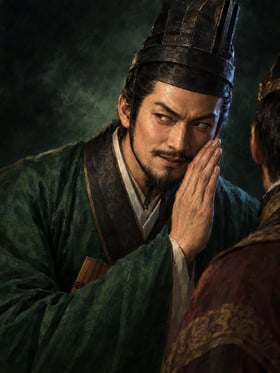
Guo Tu was skilled at framing others to escape blame, full of schemes and adept at sowing discord, and made a habit of dark stratagems. He upheld the primacy of the eldest legitimate heir and understood the currents of the times.

Life
In the novel: 9 chapters · In the Records: 5 volumes
Life?–205
201 CE (Jian'an 6)
- Cao Cao Pacifies HebeiYeAdvisor
202 CE (Jian'an 7)
205 CE (Jian'an 10)
- Battle of NanpiNanpiKilled in action
- Yuan Shao's Faction· Undated
- Life event
- Death
List all 3 stops
- YingchuanBirthplace
- Ye201–202Cao Cao Pacifies Hebei+1 more
- Nanpi205Died hereBattle of Nanpi
On the boards
Compare with someone →Where this person ranks on each board.
Who they were
Character profile
- Character
- Guo Tu was skilled at framing others to escape blame, full of schemes and adept at sowing discord, and made a habit of dark stratagems. He upheld the primacy of the eldest legitimate heir and understood the currents of the times.
- Life
- Guo Tu was a native of Yingchuan. He was once sent by Yuan Shao to Hedong to receive the Son of Heaven, yet later advised Shao not to welcome the emperor. At the Battle of Guandu he, together with Shen Pei, argued for war. In the tenth year of Jian'an, when Cao Cao attacked Nanpi, Guo Tu was beheaded along with Yuan Tan.
- Anecdotes
- Guo Tu was an adviser to Yuan Shao, and later assisted Yuan Tan. He joined Chunyu Qiong and Yan Liang in attacking Baima; at the Battle of Guandu he strongly urged an assault on Cao Cao's camp, and slandered Zhang He so as to drive him to surrender to Cao Cao. He advised Yuan Shao to join with Liu Bei against Cao Cao, and proposed allying with Sun Ce to attack Cao Cao together.
Historical Record
Guo Tu, styled Gongze, was from Yingchuan and was one of Yuan Shao’s key advisers. Historical accounts say Yuan Shao once sent Guo Tu on a mission to Hedong to welcome Emperor Xian of Han. After returning, Guo Tu urged Yuan Shao to bring the emperor to Ye, but Yuan Shao did not accept the proposal. The Biography of Emperor Xian, cited in Pei Songzhi’s annotations, instead records that Guo Tu and Chunyu Qiong opposed Ju Shou’s proposal to welcome the emperor, arguing that the Han dynasty had long been in decline and that receiving the emperor would leave Yuan Shao subject to the court. The sources differ on Guo Tu’s position in this matter, and Pei Songzhi also noted that this account conflicted with the main biography; it is therefore unwise to treat either version as definitive.
Before the Battle of Guandu, Guo Tu and Shen Pei strongly advocated an immediate southern offensive against Cao Cao, opposing the gradual advance and reorganization proposed by Ju Shou and others. Yuan Shao accepted their proposal and divided command of the army among Ju Shou, Guo Tu, and Chunyu Qiong. When Yuan Shao attacked Baima, Guo Tu also went into battle alongside Chunyu Qiong and Yan Liang.
When the garrison at Wuchao in Guandu came under threat, Zhang He urged an immediate rescue of Chunyu Qiong. Guo Tu, however, proposed attacking Cao Cao’s main camp, reasoning that the siege of Wuchao would naturally be lifted once Cao Cao turned his forces back. Yuan Shao sent a large force against Cao Cao’s camp but dispatched only light cavalry to relieve Wuchao. Cao Cao defeated Chunyu Qiong, and Yuan Shao’s army began to collapse. Guo Tu then accused Zhang He of gloating over the defeat and speaking disrespectfully, prompting Zhang He to surrender to Cao Cao. The sources cited in Pei Songzhi’s annotations also note that the Chronicles of Emperor Wu and the Biography of Yuan Shao give different accounts of whether Zhang He’s surrender came before or after the rout of Yuan Shao’s army.
After Yuan Shao’s death, Guo Tu and Xin Ping aligned themselves with Yuan Tan and contended for power with Shen Pei and Feng Ji, who supported Yuan Shang. Yuan Tan ultimately failed to succeed his father and styled himself General of Chariots and Cavalry; the brothers fell out as a result. When Cao Cao attacked Yuan Tan, Guo Tu fought alongside him. In Jian’an 10, Cao Cao’s forces captured Nanpi, and Yuan Tan, Guo Tu, and others were executed.
In the Novel
Romance of the Three Kingdoms portrays Guo Tu as a figure in Yuan Shao’s camp who was eager to offer schemes and advice, but whose political maneuvering and suspicion often made disasters worse. Before the Battle of Guandu, he strongly advocated an attack on Cao Cao and also proposed issuing a proclamation denouncing him. Through these episodes, the novel emphasizes his eagerness for a swift, decisive battle.
When Wuchao was attacked, Guo Tu proposed what he called a “besiege Wei to rescue Zhao” stratagem, urging Yuan Shao to divide his forces and attack Cao Cao’s camp. Zhang He pointed out to him that Cao Cao’s camp might not be undefended, but Guo Tu persisted. The attack on Cao Cao’s camp failed, and Wuchao also fell. The novel goes on to say that, fearing Zhang He and Gao Lan would expose his poor judgment when they returned to camp, Guo Tu first slandered them to Yuan Shao, prompting the two generals to defect to Cao Cao. This chain of “proposing a plan—suffering defeat—framing others” reinforces his literary portrayal as someone adept at shifting blame and eliminating rivals; these details are more dramatic than those in the historical accounts.
When Yuan Shao debated naming an heir, the novel has Guo Tu oppose disinheriting the elder son in favor of the younger, stressing that Yuan Tan was the eldest and that they should first deal with Cao Cao’s forces. After Yuan Shao’s death, Guo Tu again served Yuan Tan and contended with Shen Pei, Feng Ji, and others. This broadly accords with the historical accounts that Guo Tu aligned with Yuan Tan and took part in the power struggle between Yuan Shao’s sons, though the specific words and schemes are the novel’s elaboration.
Key Relationships
- Yuan Shao: Guo Tu’s lord and principal political patron. He took part in deliberations over welcoming the emperor and launching campaigns against Cao Cao, and Yuan Shao entrusted him with command of troops. Both historical accounts and the novel present him as an important figure in Yuan Shao’s Faction.
- Ju Shou: The two men disagreed over welcoming the emperor and military action against Cao Cao. Historical accounts show Guo Tu and Chunyu Qiong opposing Ju Shou’s advocacy of a more cautious approach to war; command of the army was also divided between Guo Tu and Ju Shou.
- Zhang He: During the battle at Wuchao in Guandu, Zhang He urged a rescue, while Guo Tu advocated attacking Cao Cao’s camp. Historical accounts say Zhang He defected to Cao Cao after Guo Tu slandered him. The novel gives a more detailed account of the slander.
- Yuan Tan, Yuan Shang, and Shen Pei: Guo Tu and Xin Ping sided with Yuan Tan, while Shen Pei and Feng Ji supported Yuan Shang. After Yuan Shao’s death, the factions contended for power and drove the brothers into conflict.
Signature Episodes
- The debate over Wuchao at Guandu: Zhang He warned that Cao Cao had personally attacked Wuchao and that the Yuan army’s position would be precarious if its grain stores fell; Guo Tu instead proposed attacking Cao Cao’s camp. The historical accounts clearly record the two assessments and their consequences, making this one of the episodes most often associated with Guo Tu’s military judgment.
- Slandering Zhang He: Historical accounts say Guo Tu slandered Zhang He after the military defeat, and Zhang He, afraid, defected to Cao Cao. The novel further depicts Guo Tu as falsely accusing Zhang He and Gao Lan in advance of deliberately holding back; the two then rebelled and went over to Cao Cao. The latter is a specific dramatization unique to the novel.
- The fall at Nanpi: Cao Cao attacked Nanpi. Yuan Tan fled by night, but the city was still taken, and Guo Tu was executed along with him. The novel additionally has Guo Tu propose driving the common people ahead of the troops before engaging in a decisive battle. After the defeat, he flees into the city and is shot by Yue Jin, falling into the moat. This final detail is unique to the novel.
Quotes
23 lines in the books · 3 featured
「不可。曹軍劫糧,曹操必然親往;操既自出,寨必虛空,可縱兵先擊曹操之寨;操聞之,必速還。此孫臏『圍魏救趙』之計也。」
Although this stratagem was not adopted, it demonstrates Guo Tu's military cunning.
「二人素有降曹之意,今遣擊寨,故意不肯用力,以致損折士卒。」
These words are ironclad proof that Guo Tu framed Zhang He and Gao Lan, revealing his sinister side.
「今城中糧少,彼軍方銳,勢不相敵。愚意可遣人投降曹操,使操將兵攻冀州,尚必還救。將軍引兵夾擊之,尚可擒矣。若操擊破尚軍,我因而斂其軍實以拒操。操軍遠來,糧食不繼,必自退去;我可以仍據冀州,以圖進取也。」
This stratagem shows Guo Tu's scheming and his read of the situation—vicious, but effective.
- Enemies
- Other
Who is Guo Tu connected to?
Pick someone to see how many steps lie between them and Guo Tu.
History vs. novel
7 points · 4 novel-only
| History | Novel |
|---|---|
| Advocating an Attack on Cao CaoNovel embellishes | |
The Records of the Three Kingdoms only records that Guo Tu was employed by Yuan Shao alongside Xun Chen, Xin Ping, and others; it does not say that he advocated attacking Cao Cao. vol. 10 | Guo Tu opposed Tian Feng and Ju Shou’s proposal to delay the campaign, advocating instead that they join forces with Liu Bei and raise troops to attack Cao Cao, claiming this was in keeping with the greater cause. ch. 22 |
| Informing on Liu BeiNovel only | |
| — | After Guan Yu killed Wen Chou, Guo Tu and Shen Pei advised Yuan Shao that Liu Bei was pretending not to know Guan Yu’s whereabouts, enraging Yuan Shao. ch. 26 |
| The Strategy at WuchaoNovel embellishes | |
When Wuchao was attacked, Guo Tu advocated striking Cao Cao’s main camp, while Zhang He believed it would be difficult to take. After Yuan Shao divided his forces, they failed to capture Cao Cao’s camp, and Wuchao fell. vol. 17 | Guo Tu also advocated taking advantage of Cao Cao’s absence to attack his camp, further explaining the strategy with the analogy “besiege Wei to rescue Zhao.” Yuan Shao sent Zhang He and Gao Lan to attack Cao Cao’s camp and dispatched Jiang Qi to relieve Wuchao. ch. 30 |
| Falsely Accusing Zhang HeNovel embellishes | |
After the defeat, Guo Tu falsely claimed that Zhang He was pleased by the army’s defeat and had spoken disrespectfully. Zhang He grew fearful and surrendered to Cao Cao. vol. 17 | Guo Tu falsely claimed that Zhang He and Gao Lan had long intended to surrender to Cao Cao and had deliberately held back. When the two learned that Yuan Shao intended to punish them, they defected to Cao Cao. ch. 30 |
| Serving Yuan TanNovel only | |
| — | After Yuan Shao’s death, the novel says that Guo Tu and Xin Ping served Yuan Tan, forming one faction, while Shen Pei and Feng Ji served Yuan Shang and formed another. ch. 31 |
| Urging Tan to Surrender to Cao CaoNovel only | |
| — | When Yuan Tan was besieged by Yuan Shang at Pingyuan, Guo Tu advised him to seek Cao Cao’s aid and use Cao Cao’s forces to attack Yuan Shang. Once Yuan Shang was defeated, he could seize Jizhou again. ch. 32 |
| Driving Civilians into BattleNovel only | |
| — | Before the decisive battle at Nanpi, Guo Tu advised Yuan Tan to drive the civilians ahead of the army as it went into battle. Yuan Tan followed his advice; many civilians were killed or wounded, Yuan Tan was killed, and Guo Tu was shot by Yue Jin and fell into the moat. ch. 33 |
- Advocating an Attack on Cao CaoNovel embellishes
- History
The Records of the Three Kingdoms only records that Guo Tu was employed by Yuan Shao alongside Xun Chen, Xin Ping, and others; it does not say that he advocated attacking Cao Cao.
vol. 10
- Novel
Guo Tu opposed Tian Feng and Ju Shou’s proposal to delay the campaign, advocating instead that they join forces with Liu Bei and raise troops to attack Cao Cao, claiming this was in keeping with the greater cause.
ch. 22
- Informing on Liu BeiNovel only
- Novel
After Guan Yu killed Wen Chou, Guo Tu and Shen Pei advised Yuan Shao that Liu Bei was pretending not to know Guan Yu’s whereabouts, enraging Yuan Shao.
ch. 26
- The Strategy at WuchaoNovel embellishes
- History
When Wuchao was attacked, Guo Tu advocated striking Cao Cao’s main camp, while Zhang He believed it would be difficult to take. After Yuan Shao divided his forces, they failed to capture Cao Cao’s camp, and Wuchao fell.
vol. 17
- Novel
Guo Tu also advocated taking advantage of Cao Cao’s absence to attack his camp, further explaining the strategy with the analogy “besiege Wei to rescue Zhao.” Yuan Shao sent Zhang He and Gao Lan to attack Cao Cao’s camp and dispatched Jiang Qi to relieve Wuchao.
ch. 30
- Falsely Accusing Zhang HeNovel embellishes
- History
After the defeat, Guo Tu falsely claimed that Zhang He was pleased by the army’s defeat and had spoken disrespectfully. Zhang He grew fearful and surrendered to Cao Cao.
vol. 17
- Novel
Guo Tu falsely claimed that Zhang He and Gao Lan had long intended to surrender to Cao Cao and had deliberately held back. When the two learned that Yuan Shao intended to punish them, they defected to Cao Cao.
ch. 30
- Serving Yuan TanNovel only
- Novel
After Yuan Shao’s death, the novel says that Guo Tu and Xin Ping served Yuan Tan, forming one faction, while Shen Pei and Feng Ji served Yuan Shang and formed another.
ch. 31
- Urging Tan to Surrender to Cao CaoNovel only
- Novel
When Yuan Tan was besieged by Yuan Shang at Pingyuan, Guo Tu advised him to seek Cao Cao’s aid and use Cao Cao’s forces to attack Yuan Shang. Once Yuan Shang was defeated, he could seize Jizhou again.
ch. 32
- Driving Civilians into BattleNovel only
- Novel
Before the decisive battle at Nanpi, Guo Tu advised Yuan Tan to drive the civilians ahead of the army as it went into battle. Yuan Tan followed his advice; many civilians were killed or wounded, Yuan Tan was killed, and Guo Tu was shot by Yue Jin and fell into the moat.
ch. 33
Combat
On the field
Duels, kills and executions as the texts tell them, counted separately for the Records and the Romance.
Records
- Duels
- 0W 0L 0D
DeathKilled by Cao CaoStruck down · Juan 6
Romance
- Duels
- 0W 0L 0D
DeathKilled by Yue JinStruck down · Ch. 33
Battles in command
Battles this person commanded in, with the outcome as each text tells it.
- Records
- 0W 1L 0D 0 undecided
- Records200Battle of BomaLostvs Cao forcesJuan 1「使張遼、關羽前登,擊破,斬良。遂解白馬圍」
Stratagems
Plans this person devised or saw through, as the texts tell them.
- Records
- 1 carried out · 0 worked · 0 turned down · 0 seen through
- Romance
- 8 carried out · 3 worked · 0 turned down · 0 seen through
- RecordsAttack the Camp to Lift the SiegeOtherFailedJuan 17「不如攻其本營,勢必還,此爲不救而自解也」
- RomanceAlly with Wu to Attack CaoPersuasionFailedagainst Cao CaoCh. 29「乃遺陳震回,以書絕袁紹」
- RomanceBesiege Wei to Rescue ZhaoOtherFailedagainst Cao's campCh. 30「此孫臏『圍魏救趙』之計也」
- RomanceSowing DiscordSowing discordWorkedagainst Zhang He and Gao LanCh. 30「二人素有降曹之意,今遣擊寨,故意不肯用力,以致損折士卒」
- RomanceFeign Illness to Request a StrategistDeceptionWorkedagainst Yuan ShangCh. 32「因抱病在軍中,不能相見」
- RomanceLure the Target to a Banquet and KillAmbushSeen throughagainst Yuan ShangCh. 32「此必郭圖之計也。主公若往,必遭奸計」
All stratagems (9)
Loading…
Events
Events (4)
Battles and events the texts place this person in, by date.
Battles
- 200Battle of Guandu
- 205Battle of NanpiKilled in action
Other events
Places
Continue
Cao Cao Pacifies Hebei
Relationship timeline6 entries ▸
History · vol. 17
- Zhang He§21
Rival
disagreed with He over the proposal to attack Taizu's camp; he also slandered He, saying, "was glad the army was defeated"
Novel · ch. 26
Advised
joined Shen Pei in slandering Liu Bei, saying, “Liu Bei pretended to decline and claimed not to know”
Novel · ch. 31
- Yuan Tan§8
Advised
Supported Yuan Tan—as a member of Yuan Tan's faction
Novel · ch. 32
- Yuan Tan§7
Advised
chief strategist; repeatedly offered schemes to sow discord and seize the succession
Novel · ch. 33
- Yuan Tan§17
Advised
Strategist; proposed the plan to "drive the people to the front to fight Cao to the death"
- Yue Jin§18
Slayer
Saw the formation in great disorder and hurriedly galloped into the city; Yue Jin drew his bow and nocked an arrow, shooting him into the city moat, where both he and his horse fell
Inner monologues · AI-generated3 monologues ▸
- After the fires of Guandu had died down, the Yuan brothers turned against each other, and my own path, Guo Tu’s, came to
- I am Guo Tu, courtesy name Gongze. In my youth, Xin Ping, Yuan Chen, and I were all employed by the Yuan clan. At the ti
- I am Guo Tu, courtesy name Gongze, from Jizhou. Even in my youth, I saw that the realm was no longer at peace. Though th