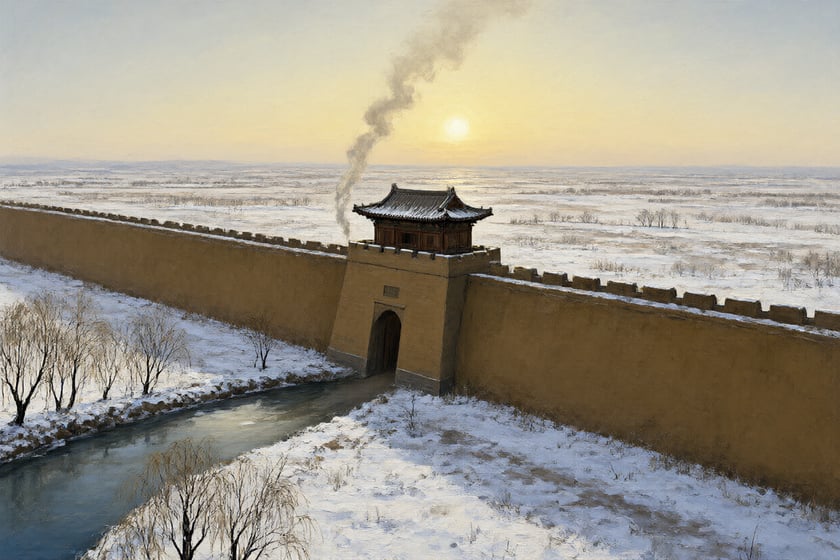
Overview
Nanpi was the seat of Bohai Commandery in Jizhou during the Eastern Han. Its ruins lie northeast of present-day Nanpi County, Cangzhou, Hebei Province. After Yuan Shao’s death, his eldest son, Yuan Tan, made it his last stronghold. In the first month of Jian’an 10 (205), Cao Cao captured Nanpi and executed Yuan Tan, bringing Jizhou under control.
History
In Jian’an 9 (204), while Cao Cao was besieging Ye, Yuan Tan seized the opportunity to take Ganling, Anping, Bohai, Hejian, and other places, and absorbed the forces of his younger brother, Yuan Shang. Cao Cao wrote to rebuke Yuan Tan for breaking their agreement, severed their marriage alliance, and then advanced against him. Yuan Tan withdrew from Pingyuan, took Nanpi, and made his own camp at Longcou. In the twelfth month of that year, Cao Cao’s army reached Longcou. Not daring to fight, Yuan Tan fled to Nanpi under cover of night and set up camp beside the Qing River.
In the first month of Jian’an 10 (205), Cao Cao attacked Nanpi. Yuan Tan came out of the city to meet him in battle. Cao Cao’s troops suffered heavy casualties, and Cao Cao briefly considered easing the assault. Cao Chun, who commanded the Tiger and Leopard Cavalry, urged an immediate attack, arguing that they had advanced a thousand li into enemy territory and could not sustain a prolonged campaign; they had to press their advantage in one decisive push. The two armies fought from morning until noon without a clear victor. Cao Cao beat the war drum himself, and his troops fought with renewed courage, capturing Nanpi in a single assault. Yue Jin was the first to scale the walls and break through the eastern gate, while cavalry under Cao Chun beheaded Yuan Tan. Guo Tu was killed alongside Yuan Tan, and Yuan Tan’s wife and children were also executed. The canals were frozen when Cao Cao campaigned against Yuan Tan, so Cao Cao conscripted laborers to break the ice and open a passage for boats. Fearing the forced labor, people fled. Later, when some of the fugitives came to surrender at the camp gate, Cao Cao told them to go back and hide, and not to let the officials catch them. They left in tears, but were eventually captured.
After taking Nanpi, Cao Cao ordered that all those who had sided with the Yuan clan be given a chance to reform, and forbade private revenge and lavish burials. Zang Ba and the other generals from the east came to congratulate him and asked to send their sons and the families of their generals’ fathers and elder brothers to Ye. Cao Cao compared their gesture to Xiao He’s sending his sons and younger brothers to serve at court, and Geng Chun’s bringing his whole clan to follow the emperor, and accepted their goodwill.
People
- Yuan Tan: Yuan Shao’s eldest son. He occupied Nanpi and made his final stand against Cao Cao, but was beheaded when the city fell.
- Guo Tu: Yuan Tan’s adviser, killed alongside him at Nanpi.
- Cao Chun: Cao Ren’s younger brother. He commanded the Tiger and Leopard Cavalry during the siege and urged an immediate assault.
- Yue Jin: First to scale the walls during the attack on Nanpi, he broke through the eastern gate.
- Qian Zhao: After Cao Cao defeated Yuan Tan at Nanpi, he appointed him an aide in military affairs. Later, when Liaodong sent Yuan Shang’s head, Qian Zhao held a memorial service beneath it. Cao Cao praised his sense of honor.
- Cao Cao: Besides his assault on the city, Pei Songzhi’s annotations quote the Book of Wei as saying that he was skilled at riding and archery, and once shot sixty-three pheasants in a single day at Nanpi.
- Cao Pi: He later wrote to Wu Zhi, recalling their “outing at Nanpi”: studying the classics, playing chess and other board games, riding and hunting, floating melons and sinking plums in a clear spring, and riding together in a carriage through the gardens at night.
Differences Between the Historical Record and the Novel
Both works record the Battle of Nanpi, and the novel also depicts Cao Cao beating the war drum himself to direct the battle. The novel also includes the story of breaking the ice to tow boats and the fugitives surrendering, but omits the detail recorded in the Records of the Three Kingdoms that the fugitives were eventually captured. The Romance of the Three Kingdoms adds that Yuan Tan drove Nanpi’s people ahead of his army, armed with knives and spears, to attack Cao Cao’s camp, where countless civilians were killed—an episode not recorded in the Records of the Three Kingdoms. The novel says that Cao Hong killed Yuan Tan in battle and that Yue Jin shot Guo Tu off the city wall into the moat, where he died. The Records of the Three Kingdoms, by contrast, says that Yuan Tan was beheaded by cavalry under Cao Chun, and that Guo Tu was beheaded alongside him.
Today
Present-day Nanpi County in Cangzhou retains the name of this ancient county.