Overview
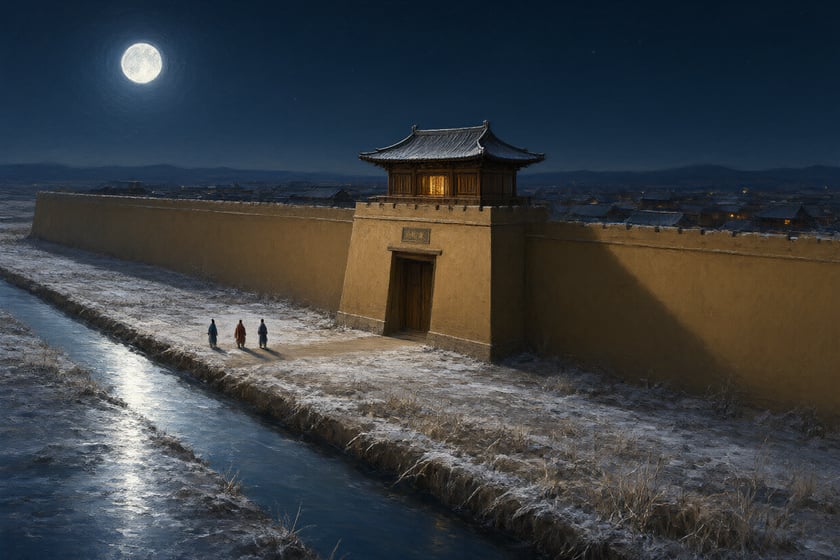
Ye was the seat of Wei Commandery in Jizhou during the Eastern Han. It lay beside the Zhang River, and its former site is southwest of present-day Linzhang County, Handan, Hebei Province. It is often called “Ye City” in historical accounts, and was also known as “the capital of Ye” during the Wei state and Wei king periods. Han Fu, the Han governor of Jizhou in the final years of the dynasty, and Yuan Shao successively made their headquarters there. In the ninth year of Jian’an (204), Cao Cao captured Ye City. Thereafter he made Ye his base, building terraces and ponds there and establishing the altars of soil and grain and ancestral temples of the Wei state. After Cao Pi became emperor, Ye was counted among the Five Capitals along with Chang’an, Qiao, Xu Chang, and Luoyang. Even at the end of Wei, Ye remained a place where members of the imperial clan and princes lived in large numbers, and Emperor Yuan of Wei, Cao Huan, also spent his final years there after abdicating.
History
In the first year of Chuping (190), when the armies of the eastern provinces rose to oppose Dong Zhuo, Han Fu, governor of Jizhou, held Ye City. Yuan Shao later took control of Jizhou and made Ye his seat of government. Around the fourth year of Chuping (193), while Yuan Shao was meeting with guests at Baoluo Ford, troops from Wei Commandery rebelled and, together with the Black Mountain bandit Yu Du, captured Ye City and killed its administrator, Li Cheng. Yuan Shao went into the mountains to suppress the rebels, beheaded tens of thousands, and returned with his army to garrison Ye. When Emperor Xian of Han was wandering in Hedong, Guo Tu urged Yuan Shao to bring the emperor to Ye, but Yuan Shao did not heed him (Pei Songzhi’s annotation, citing the Biography of Emperor Xian, says that Ju Shou was the one who made this proposal). Only after Cao Cao brought the emperor to Xu did Yuan Shao regret his decision. The court made him Marquis of Ye, but he declined the title.
After Yuan Shao’s death, his son Yuan Shang occupied Ye. In the second month of the ninth year of Jian’an (204), Yuan Shang marched against his elder brother Yuan Tan, leaving Shen Pei and Su You to defend Ye. Cao Cao advanced to the Huan River. Su You plotted to assist him from within, but when the plot was exposed, he fought Shen Pei inside the city, was defeated, then fled the city and surrendered. Cao Cao built earthen mounds and dug tunnels to attack the city, then in the fifth month switched to digging a long trench and diverted the Zhang River to flood it. More than half the people inside starved to death. In the seventh month, Yuan Shang returned to relieve the city, approaching along the western hills, but Cao Cao defeated him and drove him to Zhongshan. In the eighth month, Shen Pei’s nephew Shen Rong opened the eastern gate at night and let Cao Cao’s troops into the city. Shen Pei was defeated and captured, then beheaded, and Ye City was pacified. Cao Cao personally went to pay his respects at Yuan Shao’s tomb and comforted Yuan Shao’s family. Cao Cao then assumed the office of governor of Jizhou.
Ye became Cao Cao’s principal base. In the first month of the thirteenth year of Jian’an (208), Cao Cao returned to Ye City and had the Xuanwu Pond dug to train his naval forces. After the Bronze Sparrow Terrace was completed, Cao Cao took his sons up onto it and ordered each of them to compose an essay. Cao Zhi wrote his at once. In the seventh month of the eighteenth year of Jian’an (213), the Wei state established its altars of soil and grain and ancestral temples at Ye. In the ninth month, it built the Golden Tiger Terrace and dug a canal to bring the Zhang River into the Baigou, linking it to the Yellow River. Liang Xi, Inspector of Bingzhou, successively sent tens of thousands of dependents of powerful families to Ye City, and also had large trees felled in Shangdang to supply timber for the construction of palaces at Ye. After Cao Cao pacified Hanzhong, more than eighty thousand people volunteered to move to Luoyang and Ye City. In the twenty-fourth year of Jian’an (219), Wei Feng secretly gathered followers in the capital of Ye and plotted with Chen Yi, Commandant of the Palace Guard at Changle, to seize Ye. When the time came, Chen Yi grew frightened and informed on him. Wei Feng was executed, and dozens of others were implicated and put to death.
Cao Cao died in Luoyang in the first month of the twenty-fifth year of Jian’an (220), while the crown prince Cao Pi remained in Ye City. Jia Kui oversaw the funeral and escorted the coffin back to Ye, while Xiahou Shang also carried the imperial funeral insignia and escorted the coffin back to Ye. When Cao Pi assumed the throne as King of Wei, Ye County had tens of thousands of households living right beneath the capital, many of whom disregarded the law. He therefore appointed Jia Kui as magistrate of Ye. After Cao Pi became emperor, Ye was designated one of the Five Capitals. In the second year of Huangchu (221), Empress Zhen was ordered to die at Ye and was buried there. In the first year of Taihe (227), Emperor Ming of Wei built a temple for her at Ye; in the fourth year of Taihe (230), he sent Zhen Xiang to Ye and had her reburied at Chaoyang Mausoleum. Before the ancestral temple at Luoyang was completed, the spirit tablets of Wei’s former emperors were enshrined at the temple in Ye; they were not transferred to Luoyang until the third year of Taihe (229). During the Jingchu era, Cao Yu, Prince of Yan, returned to live in Ye twice. A memorial submitted during Guanqiu Jian’s uprising accused Sima Shi of gathering the princes and dukes of the imperial clan in Ye in order to wipe them all out at once. In the second year of Xianxi (265), Emperor Yuan of Wei, Cao Huan, abdicated in favor of Jin and ultimately lived out his final years in Ye City.
People
- Yuan Shao and Shen Pei: Yuan Shao used Ye as his base for consolidating control of Hebei. When Yuan Shao governed Jizhou, Shen Pei served as his chief administrative aide. After Yuan Shao’s death, Shen Pei defended Ye for Yuan Shang, holding out for several months. When the city fell, he even sent men to the prison to kill Xin Ping’s entire family. After being captured, he refused to submit and was beheaded.
- Xun Yan: Xun Yu’s third elder brother, he defended Ye as Commandant of the Army and oversaw affairs in Hebei. When Cao Cao campaigned against Yuan Shang, Gao Gan secretly sent troops to attack Ye. Xun Yan discovered them and had them all executed.
- Cao Pi and Cao Zhi: When Cao Cao campaigned in Bingzhou, he left Cui Yan at Ye to tutor Cao Pi. While Zhan Qian was in charge of defending Ye City, he also bluntly advised Cao Pi to make fewer hunting trips outside the city. In the nineteenth year of Jian’an (214), when Cao Cao campaigned east against Sun Quan, he ordered Cao Zhi to remain behind and guard Ye City.
- Magistrates of Ye: Yang Pei was known for strict enforcement of the law. When Cao Cao heard in Qiao County that people in Ye were flouting the laws, he specifically appointed Yang Pei magistrate of Ye from among the convicts. On hearing the news, powerful figures such as Cao Hong and Liu Xun hurriedly disciplined their sons and younger brothers. Jia Kui served as magistrate of Ye for just over a month before being promoted to administrator of Wei Commandery.
- People who relocated there: Tian Chou moved to Ye City with more than three hundred households of his family and clan. After Ma Teng entered the court to serve as Commandant of the Guards, his family was moved to Ye; only Ma Chao remained in the Guanzhong region.
- Others: During the Taihe era, Ding Mi lodged in an unoccupied house in Ye City. Because he slighted the princes, he was imprisoned in Ye’s jail. At seventeen or eighteen, while still a commoner, Li Feng was already known in Ye for his appraisals of prominent figures. Shi Bao once served as an agricultural official at Ye.
Differences from the Historical Record
In Romance of the Three Kingdoms, Ye is often called “Ye Commandery”, but in fact Ye was a county under Wei Commandery. The novel says that after Cao Cao pacified Hebei, he left Cao Zhi and Cao Pi at Ye to build terraces. It places the completion of the Bronze Sparrow Terrace in the spring of the fifteenth year of Jian’an (210), describing it as overlooking the Zhang River, with the Jade Dragon Terrace to the left and the Golden Phoenix Terrace to the right, linked by bridges; Cao Cao then held a grand gathering at Ye to celebrate with his Wen Wu. The Biography of Emperor Wu in the Records of the Three Kingdoms instead records that the Bronze Sparrow Terrace was built in the winter of the fifteenth year of Jian’an. During Cao Wei, the terrace paired with the Bronze Sparrow Terrace was the Golden Tiger Terrace, built in the eighteenth year of Jian’an. The novel says that as Cao Cao lay dying, he ordered seventy-two decoy tombs to be built “outside the military training grounds of Zhangde Prefecture” to prevent later generations from robbing his grave. The Biography of Emperor Wu in the Records of the Three Kingdoms only records his order for a modest burial and his interment at Gaoling in the second month; it makes no mention of decoy tombs. Before Zhuge Liang's Northern Expeditions, Ma Su uses a counterintelligence stratagem to post a notice on the gate of Ye City falsely accusing Sima Yi of plotting rebellion. This episode is not recorded in the Records of the Three Kingdoms.
Today
The ruins of Ye City lie around Yezhen, southwest of present-day Linzhang County, Handan, Hebei Province, and are a nationally protected cultural heritage site. The Bronze Sparrow Terraces Ruins Park has been established in the northwest part of the site. The rammed-earth platform of the Golden Tiger Terrace, later called the Golden Phoenix Terrace, is the best preserved; only the southeastern corner of the Bronze Sparrow Terrace remains. Cao Cao’s Gaoling is located in Xigaoxue Village, Anfeng Township, Anyang, Henan Province, and the Cao Cao Gaoling Ruins Museum has been built there.