Ding Mi
courtesy name 彦靖 · –249
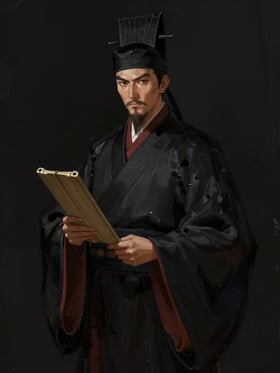
Ding Mi, Cao Shuang's confidant, was executed after the Incident at the Gaoping Tombs for joining his faction's political affairs.

Life
In the novel: 2 chapters · In the Records: 3 volumes
Life?–249
239 CE (Jingchu 3)
- Cao Shuang's RegencyLuoyangAdvisor
Appearances
By chapter (5)
Novel
- 106
- 107
Records
- 4
- 9
- 14
- Life event
List all 2 stops
- Pei StateBirthplace
- Luoyang239Cao Shuang's Regency
On the boards
Compare with someone →Where this person ranks on each board.
Historical Record
Ding Mi, courtesy name Yanjing, was a trusted aide to Cao Shuang, the great general of Cao Wei, and rose to the post of Minister of the Secretariat. Pei Songzhi’s commentary on the Weilüe records that his father, Ding Fei, had accompanied Cao Cao on campaigns. Ding Fei was fond of wealth and often broke the law, but Cao Cao repeatedly pardoned him and restored him to office. As a youth, Ding Mi disliked socializing and devoted himself to reading widely; he was resolute in character and talented in strategy. During the Taihe era, he lived in Ye. When several princes barged into his residence, he refused to defer to them, angering Emperor Ming, who had him imprisoned. He was later released because he was the son of a meritorious official. Hearing that Ding Mi had inherited his father’s bearing, Emperor Ming summoned him and appointed him Gentleman of the Department of Finance. Ding Mi and Cao Shuang had long been close, and after Cao Shuang assumed the regency, he promoted Ding Mi to Regular Mounted Attendant and then to Minister of the Secretariat. Though outwardly careless, Ding Mi was inwardly suspicious. At court, he often impeached officials and challenged official policies, frustrating his colleagues. He looked down on the powerful; although he held office alongside He Yan and Deng Yang, he did not think much of either man, submitting to Cao Shuang only because of Cao Shuang’s power. People of the time mockingly called He Yan, Deng Yang, and Ding Mi “the Three Hounds,” and said Ding Mi was especially formidable. Ding Mi also plotted to have Empress Dowager Guo moved to another palace, to send the Prince of Le’an to Ye, and to order Wen Qin to return to Huainan; Sima Yi therefore came to bear a particular grudge against him. During the Zhengshi era, Cao Shuang ruled autocratically, and Ding Mi and others made light work of altering the laws and regulations. In the first year of the Jiaping era, after the Incident at the Gaoping Tombs, Sima Yi submitted a memorial calling for Cao Shuang and his brothers to be removed from office. After Zhang Dang was imprisoned, he testified that Cao Shuang and the others had plotted treason. Once the court officials had reached their decision, Ding Mi and the rest of Cao Shuang’s faction were arrested, executed, and had their three clans exterminated.
In the Novel
In Romance of the Three Kingdoms, Ding Mi is portrayed as a trusted, ostentatious scholar in Cao Shuang’s circle, and is said to have had the courtesy name “Yanjing,” rather than “Yanjing” as recorded in the historical accounts. The novel places him in a circle of trusted associates comprising He Yan, Deng Yang, Li Sheng, and Bi Gui, and depicts Cao Shuang appointing him Minister of the Secretariat, with all five taking part in discussions day and night. The historical accounts do record that Ding Mi served as Minister of the Secretariat and was a trusted aide to Cao Shuang, but do not include the novel’s specific scenes of the group’s daily activities. The novel also dramatizes the arrests and executions following the coup at the Gaoping Tombs: Zhang Dang implicates Ding Mi and the others as co-conspirators, Sima Yi has them imprisoned, and Cao Shuang’s brothers and the other accused are beheaded in the marketplace and have their three clans exterminated. The historical accounts likewise record that Ding Mi and the others were executed and had their three clans exterminated, but do not give the details of the interrogation scenes depicted in the novel.
Key Relationships
- Cao Shuang: Ding Mi had long been close to Cao Shuang. After Cao Shuang assumed the regency, he promoted Ding Mi to Regular Mounted Attendant and Minister of the Secretariat, and often heeded his advice. The novel likewise emphasizes Ding Mi’s role as Cao Shuang’s trusted aide and participant in discussions.
- Sima Yi: Ding Mi’s political schemes ran counter to Sima Yi’s interests, and the historical accounts explicitly state that Sima Yi therefore came to bear a particular grudge against him. After the Incident at the Gaoping Tombs, Ding Mi and the rest of Cao Shuang’s faction were executed.
- He Yan and Deng Yang: The three held positions together at court and were mockingly dubbed “the Three Hounds.” The historical accounts also say that Ding Mi looked down on the other two; the novel, by contrast, portrays all three as trusted associates who took part in discussions alongside Cao Shuang.
Notable Scenes
In the historical accounts, Ding Mi appears as more than just a trusted aide to Cao Shuang: early in life, he was punished for refusing to show deference to princes who had barged into his residence, but later won Emperor Ming’s favor through his talent and strategic ability. After entering the central government, he became known for impeachments and challenges to official policies, while also taking part in schemes that affected the imperial court and the arrangement of personnel. These experiences reveal a forceful man, adept at weighing political considerations and willing to offend the powerful.
The Incident at the Gaoping Tombs marked the end of his political career. The historical accounts state that Sima Yi took action on the grounds that Cao Shuang and the others had plotted treason; Ding Mi was included on the arrest list and was ultimately executed, with his three clans exterminated. The novel develops Zhang Dang’s testimony, the imprisonment and interrogation, and the beheading in the marketplace into a continuous dramatic sequence; the specific details of the interrogation and execution belong to the novel’s narrative.
Family, lords and rivals
1 relationships

Who is Ding Mi connected to?
Pick someone to see how many steps lie between them and Ding Mi.
History vs. novel
6 points · 3 novel-only
| History | Novel |
|---|---|
| Ding Mi's adviceNovel embellishes | |
Historical records state that Ding Mi personally advised Cao Shuang, suggesting that Sima Yi be reassigned as Grand Tutor in the emperor’s name. This would appear to honor him, but the real aim was to ensure that memorials to the throne passed through Cao Shuang first, allowing him to control the affairs of state. vol. 9 | The novel does not depict Ding Mi proposing the reassignment as Grand Tutor; instead, it attributes the suggestion to He Yan. Only after hearing it does Cao Shuang discuss the matter with the other officials and submit a request. ch. 106 |
| Beginning of the regencyNovel embellishes | |
As the Ming Emperor lay dying, he appointed Cao Shuang General-in-Chief and charged him, together with Grand Commandant Sima Yi, with assisting the young ruler. The historical sources do not give a detailed account of Cao Fang’s accession. vol. 9 | The novel depicts Sima Yi and Cao Shuang installing Cao Fang as emperor and then jointly serving as regents. It also adds details about Cao Fang’s origins and his honoring of Empress Guo. ch. 106 |
| Cao Shuang’s treatment of Sima YiNovel embellishes | |
Historical records state that Cao Shuang and Sima Yi both received the dying emperor’s charge to serve as regents, but do not record how Cao Shuang treated Sima Yi in their daily dealings. vol. 9 | The novel depicts Cao Shuang as initially treating Sima Yi with great respect and consulting him on all important matters; only later does he change his mind after He Yan persuades him. ch. 106 |
| The Five Men of Refined AffectationNovel only | |
| — | The novel lists Ding Mi as one of the five men in Cao Shuang’s circle who “competed in refined affectation,” alongside He Yan, Deng Yang, Li Sheng, and Bi Gui. ch. 106 |
| Five Hundred RetainersNovel only | |
| — | The novel claims that Cao Shuang had five hundred retainers and depicts five of them as competing in refined affectation. The Records of the Three Kingdoms does not mention these retainers. ch. 106 |
| Huan Fan, the StrategistNovel only | |
| — | The novel also depicts Grand Minister of Agriculture Huan Fan as highly resourceful, earning him the sobriquet “Strategist,” and says that both he and the Five Men of Refined Affectation were trusted by Cao Shuang. ch. 106 |
- Ding Mi's adviceNovel embellishes
- History
Historical records state that Ding Mi personally advised Cao Shuang, suggesting that Sima Yi be reassigned as Grand Tutor in the emperor’s name. This would appear to honor him, but the real aim was to ensure that memorials to the throne passed through Cao Shuang first, allowing him to control the affairs of state.
vol. 9
- Novel
The novel does not depict Ding Mi proposing the reassignment as Grand Tutor; instead, it attributes the suggestion to He Yan. Only after hearing it does Cao Shuang discuss the matter with the other officials and submit a request.
ch. 106
- Beginning of the regencyNovel embellishes
- History
As the Ming Emperor lay dying, he appointed Cao Shuang General-in-Chief and charged him, together with Grand Commandant Sima Yi, with assisting the young ruler. The historical sources do not give a detailed account of Cao Fang’s accession.
vol. 9
- Novel
The novel depicts Sima Yi and Cao Shuang installing Cao Fang as emperor and then jointly serving as regents. It also adds details about Cao Fang’s origins and his honoring of Empress Guo.
ch. 106
- Cao Shuang’s treatment of Sima YiNovel embellishes
- History
Historical records state that Cao Shuang and Sima Yi both received the dying emperor’s charge to serve as regents, but do not record how Cao Shuang treated Sima Yi in their daily dealings.
vol. 9
- Novel
The novel depicts Cao Shuang as initially treating Sima Yi with great respect and consulting him on all important matters; only later does he change his mind after He Yan persuades him.
ch. 106
- The Five Men of Refined AffectationNovel only
- Novel
The novel lists Ding Mi as one of the five men in Cao Shuang’s circle who “competed in refined affectation,” alongside He Yan, Deng Yang, Li Sheng, and Bi Gui.
ch. 106
- Five Hundred RetainersNovel only
- Novel
The novel claims that Cao Shuang had five hundred retainers and depicts five of them as competing in refined affectation. The Records of the Three Kingdoms does not mention these retainers.
ch. 106
- Huan Fan, the StrategistNovel only
- Novel
The novel also depicts Grand Minister of Agriculture Huan Fan as highly resourceful, earning him the sobriquet “Strategist,” and says that both he and the Five Men of Refined Affectation were trusted by Cao Shuang.
ch. 106
Combat
On the field
Duels, kills and executions as the texts tell them, counted separately for the Records and the Romance.
- RecordsJuan 9ExecutionLost「於是收爽、羲、訓、晏、颺、謐、軌、勝、範、當等,皆伏誅,夷三族」
Stratagems
Plans this person devised or saw through, as the texts tell them.
- Records
- 1 carried out · 1 worked · 0 turned down · 0 seen through
- RecordsHonor Prince Xuan as Grand TutorDeceptionWorkedJuan 9「外以名號尊之,內欲令尚書奏事,先來由己,得制其輕重也」
Events
Events (2)
Battles and events the texts place this person in, by date.
Other events
- 239Cao Shuang's RegencyAdvisor
- 249Incident at the Gaoping Tombs
Places
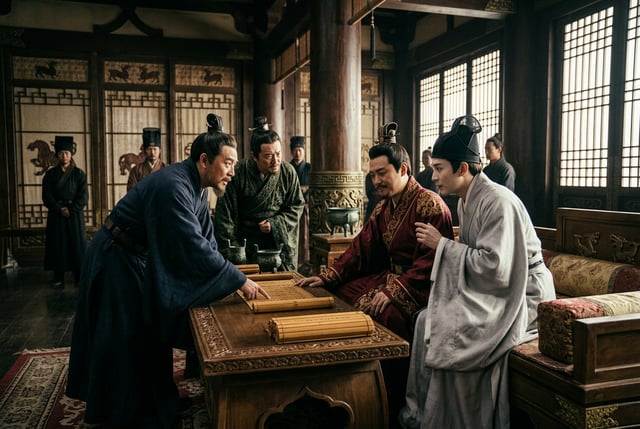
Continue
Cao Shuang's Regency
Relationship timeline2 entries ▸
History · vol. 9
- Cao Shuang§53
Advised
devised a plan for Shuang to report to the emperor and have Sima Yi transferred to the post of Grand Tutor
Novel · ch. 106
- Cao Shuang§12
Advised
a retainer; served as a Secretariat Official
Inner monologues · AI-generated1 monologue ▸
- I am Ding Mi, courtesy name Yanjing. By this time the regency had been settled: Emperor Ming had died, and the King of Q