Cao Wei · General Who Campaigns Against Shu
Wei Zhen
courtesy name 公振 · –248
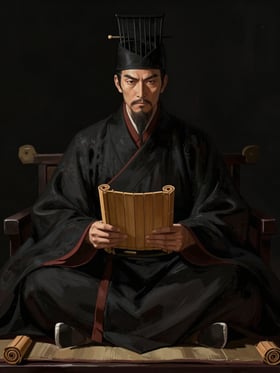
Wei Zhen was a senior Cao Wei official, known for praising the Han, cautious counsel, and rejecting Cao Shuang's overtures.
Life
In the Records: 4 volumes
Life?–248
239 CE (Jingchu 3)
- Cao Shuang's RegencyLuoyangWitness
Appearances
- Cao Wei· Undated
- Life event
List all 2 stops
- ChenliuBirthplace
- Luoyang239Cao Shuang's Regency
On the boards
Compare with someone →Where this person ranks on each board.
Historical Record
Wei Zhen, courtesy name Gongzhen, was from Xiangyi in Chenliu. His father, Wei Zi, was a man of great integrity who declined summonses from the Three Excellencies. When Cao Cao first arrived in Chenliu, Wei Zi judged that he was the man who would pacify the realm. Wei Zi later joined the campaign against Dong Zhuo and was killed in action at Xingyang. In his early years, Wei Zhen was recommended by Xiahou Dun for appointment as a clerk. He was detained after objecting that Xiahou Dun’s wife hosting a banquet was contrary to ritual propriety, but was later pardoned. He subsequently served as a Gentleman of the Yellow Gate under the Han and gradually entered the core of Cao Wei’s government.
After Cao Pi took the title of King of Wei, Wei Zhen became a Regular Mounted Attendant. When Cao Pi ascended the throne, he enfeoffed Wei Zhen as the Marquis of Anguo Pavilion. Many of the ministers praised Wei’s virtue and disparaged the former dynasty, but Wei Zhen explained the legitimacy of the abdication and also praised the Han dynasty’s merits. The Ming Emperor once called him “a treasure of the realm.” Wei Zhen later held such offices as Minister over the Masters of Writing, Palace Attendant, Minister of Personnel, and Right Vice Director, overseeing appointments. In the first year of the Jingchu era, he became Minister of Works; the following year, he was transferred to Minister over the Masses. In the ninth year of the Zhengshi era, he relinquished his post and returned home with the status of Senior Grandee.
Wei Zhen was known for his careful deliberations and his courage in remonstrating. He opposed Jiang Ji’s unconventional promotion of talent, arguing that officials should be promoted or demoted only after their performance had been assessed. When the Ming Emperor built palace halls, Wei Zhen warned that officials acting beyond their authority could undermine the court’s proper functioning. When Zhuge Liang sent troops into Tianshui, Wei Zhen advised sending a surprise force through the San Pass to cut off his supply route, and was ordered to lead troops to Chang'an. When Guanqiu Jian requested an attack on Liaodong, Wei Zhen criticized his strategy as no more than a petty Warring States stratagem, judging that a detached force making a long advance was unlikely to succeed. After Cao Shuang's Regency began, Cao Shuang sought to bring Wei Zhen into the court as Director of the Masters of Writing and also proposed a marriage alliance for his younger brother. Wei Zhen refused both and firmly requested to relinquish his position. He later died and was posthumously granted the title of Grand Commandant, with the posthumous name Jinghou.
In the Novel
The Romance does not portray this person. The available materials provide no words or episodes involving Wei Zhen in the novel, so his memorials and official career as recorded in historical biographies are not recast as scenes from the Romance, nor are they used to infer his portrayal in the novel.
Key Relationships
Wei Zhen’s connection to his father, Wei Zi, is an important starting point in the account of his family background: Wei Zi judged that Cao Cao could pacify the realm, joined him in campaigning against Dong Zhuo, and was killed in action; thereafter, whenever Cao Cao passed through Chenliu Commandery, he still sent envoys to make offerings to Wei Zi. Wei Zhen himself entered official service through Xiahou Dun’s recommendation. In his early years, he clashed with Xiahou Dun over a matter of ritual propriety, but continued his official career after being pardoned.
In his relations with the rulers and ministers of Cao Wei, Wei Zhen accepted office under Cao Wei but did not demonstrate his loyalty by disparaging the Han. His public praise of the Han’s merits reflected his commitment to the legitimacy of the abdication. He repeatedly remonstrated with the Ming Emperor over palace construction and officials exceeding their authority; in response to the proposals of the ministers Jiang Ji and Guanqiu Jian, he respectively argued for a system of official appointments and urged military prudence. Cao Shuang tried to draw him into the central government and cement an alliance through marriage, but Wei Zhen refused both overtures, showing that he was unwilling to attach himself to those in power.
Defining Scenes
The scene that best conveys Wei Zhen’s political stance takes place when the ministers were praising Wei and disparaging Han: he alone explained the principle behind the abdication while also praising the Han dynasty. Cao Pi looked at him several times and called him “a treasure of the realm.” This account juxtaposes his service under Wei with his regard for the former dynasty, showing that he did not equate praising the new dynasty with disparaging the old.
Another scene takes place during Cao Shuang's Regency: Xiahou Xuan conveyed Cao Shuang’s wishes, seeking to have Wei Zhen serve as Director of the Masters of Writing and proposing a marriage for his younger brother. Wei Zhen accepted neither proposal and then firmly requested to relinquish his position. Earlier, when the Ming Emperor was building palace halls, Wei Zhen had submitted a memorial warning that a ruler’s encroachment on officials’ duties was no trivial matter, and could cause the various offices to exceed their authority and the institutions of government to deteriorate. One episode shows him refusing a powerful minister’s advances; the other, candidly laying out the risks to the system. Together, they portray an official who maintained his independence through a commitment to proper boundaries, prudence, and remonstrance.
Quotes
8 lines in the books · 3 featured
「末世之俗,非礼之正」
This line reveals Wei Zhen's criticism of the mores of a decadent age, embodying his Confucian thought.
「古人遺智慧而任度量,须考绩而加黜陟;今子同牧野於成、康,喻断蛇於文、景,好不经之舉,开拔奇之津,將使天下驰骋而起矣。」
Wei Zhen's remark criticizing Jiang Ji for not following established principle reflects his profound insight into the art of governance.
「古制侵官之法,非恶其勤事也,诚以所益者小,所堕者大也。臣每察校事,類皆如此,惧羣司將遂越职,以至陵迟矣。」
This line reflects Wei Zhen's discernment of the ills of officialdom, stressing the importance of institutions.
- Family
- Lord & vassal
- Enemies
- Other
Who is Wei Zhen connected to?
Pick someone to see how many steps lie between them and Wei Zhen.
Combat
On the field
Duels, kills and executions as the texts tell them, counted separately for the Records and the Romance.
Stratagems
Plans this person devised or saw through, as the texts tell them.
- Records
- 0 carried out · 0 worked · 0 turned down · 1 seen through
- RecordsKeeping the Southern Campaign in CheckFeintSaw throughagainst the southern expeditionJuan 22「且爲勢以缀征南耳」
Events
Events (1)
Battles and events the texts place this person in, by date.
Other events
- 239Cao Shuang's RegencyWitness
Places
- Native of
- ChenliuRecords
Continue
Cao Shuang's Regency
Relationship timeline3 entries ▸
History · vol. 12
- Bao Xun§66
Witnessed
Memorialized a request that Bao Xun be punished
History · vol. 22
- Wei Zi§62
Kin
father and son
- Xiahou Dun§63
Lord
Xiahou Dun recommended him as a clerk; ordered his wife to host a banquet, but she refused; he was later pardoned
Inner monologues · AI-generated1 monologue ▸
- I am Wei Zhen; the records here do not give my courtesy name. I rose to the rank of Minister over the Masses, held the t