Sima clan · Vice Director of the Secretariat
Fu Gu
courtesy name 兰石 · 209–255
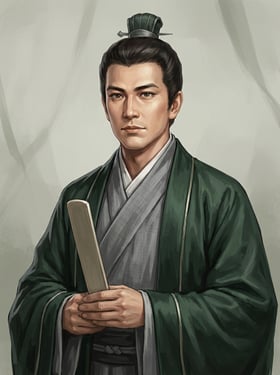
Of pure learning and clear insight, he was fond of discoursing on talent and nature, subtle and refined in his original arguments. Wang Ji recommended him as an upright gentleman fit to share in governance.

Life
In the novel: 2 chapters · In the Records: 3 volumes
Life209–255
239 CE (Jingchu 3)
- Cao Shuang's RegencyLuoyangAdvisor
252 CE (Jiaping 4)
- Battle of DongxingDongxingAdvisor
255 CE (Zhengyuan 2)
Appearances
By chapter (5)
Novel
- 108
- 110
Records
- 21
- 27
- 28
- Sima clan· Undated
- Life event
- Death
List all 3 stops
On the boards
Compare with someone →Where this person ranks on each board.
Who they were
Character profile
- Character
- Of pure learning and clear insight, he was fond of discoursing on talent and nature, subtle and refined in his original arguments. Wang Ji recommended him as an upright gentleman fit to share in governance.
- Manner of speech
- He recommended Deng Ai as 'resourceful and full of stratagems,' and to take Lejia directly.
- Life
- A native of Niyang in Beidi, styled Lanshi, a descendant of Fu Jiezi. He was first recruited by the Minister of Works Chen Qun as an aide, then served as Gentleman of the Masters of Writing and Gentleman of the Yellow Gate; because of discord with Cao Shuang and He Yan he was dismissed from office. Later Sima Yi invited him to be Attendant Gentleman of the Bureau; after Cao Shuang was executed he served as Intendant of Henan and Master of Writing. At the end of the Jiaping era he was granted the rank of Marquis Within the Passes, and when the Duke of Gaogui Village ascended the throne he was advanced to Marquis of Wuxiang Village. In the second year of Zhengyuan he urged Sima Shi to campaign in person against Guanqiu Jian and Wen Qin; after the death of King Jing, he returned directly to Luoyang with Sima Zhao to assist him in the regency. For his merit he was advanced to Marquis of Yangxiang, and died in the same year at the age of forty-seven; he was posthumously granted the office of Grand Master of Ceremonies and given the posthumous name Marquis Yuan.
- Anecdotes
- The fifth of the principal subjects of this scroll's biographies. He once conferred with Zhong Hui and stayed behind at Xuchang as support both within and without. He once remonstrated against attacking Wu, and also offered a plan to divide the forces along three routes.
Historical Record
Fu Gu, courtesy name Lanshi, was a native of Niyang, Beidi, and a descendant of Fu Jiezǐ. His uncle, Fu Xun, served as Palace Attendant and Minister of the Secretariat during the Huangchu era. Fu Gu was renowned for his talent, learning, and clear judgment. He excelled at debating the nature of talent, and his arguments probed fundamentals and discerned subtle points. He also cared whether institutions suited the times, and opposed merely citing ancient precedents while neglecting the realities of governing.
Chen Qun, the Minister over the Masses, recruited Fu Gu to serve as an assistant. Early in the Zhengshi era, Fu Gu became a Gentleman of the Secretariat, and later was promoted to Palace Attendant. At the time, Cao Shuang held power, and He Yan served as Minister of Personnel. Fu Gu once pointed out to Cao Shuang’s younger brother, Cao Xi, that He Yan seemed calm on the surface but was calculating within, prized profit, and slighted fundamentals. He worried that He Yan would mislead the Cao brothers, alienate worthy men, and neglect the affairs of state. He Yan and the others therefore fell out with Fu Gu and used a minor pretext to have him dismissed. Thereafter, Grand Tutor Sima Yi invited him to serve as an Aide-de-Camp. After Cao Shuang was executed, Fu Gu became Intendant of Henan. He put officials’ duties and appointments in order, made moral instruction the basis of governance, enforced the law consistently and clearly, and allowed no casual violations. He also resolved lawsuits without relying on torture to establish the facts. He was later promoted to Minister of the Secretariat.
Fu Gu once opposed the examination system proposed by Liu Shao. He argued that the evolution of Wei’s institutions differed from that of the Zhou, and that the foundations for selecting talent had yet to be established. If examinations were introduced before the fundamental principles of governance were put in place, it would be difficult to distinguish the worthy from the foolish accurately. He was also once ordered to assess plans for attacking Wu. He advocated advancing troops, farming to build up grain stores, and carefully judging the moment, rather than rashly crossing the river to seek battle. The court did not adopt his advice, and Wei’s forces were later defeated by Zhuge Ke at Dongguan.
Toward the end of the Jiaping era, Fu Gu was granted the title Marquis within the Passes. After the Noble Prince of Gaogui ascended the throne, he was elevated to Marquis of Wuxiang Ting. In the second year of Zhengyuan, when Guanqiu Jian and Wen Qin rebelled, Fu Gu and Wang Su urged Sima Shi to lead the eastern campaign in person. Sima Shi went despite his illness, while Fu Gu remained as Left Palace Aide and accompanied the army east. After the rebellion was put down, Sima Shi died, and Fu Gu returned directly to Luoyang with Sima Zhao, helping Sima Zhao secure the position of regent. Zhong Hui consequently grew self-important, and Fu Gu warned him that his ambition exceeded his capacity, making great achievements hard to attain, and that he should be cautious. For his service, Fu Gu was elevated to Marquis of Yangxiang and his fief increased to 1,200 households. He died that same year, aged forty-seven, and was posthumously awarded the title Grand Master of Ceremonies and the posthumous name Marquis Yuan.
In the Novel
Romance of the Three Kingdoms portrays Fu Gu as a minister at the Wei court who dared to speak frankly about the stakes and was skilled at planning military affairs. In Chapter 108, after Sun Quan’s death, Sima Shi discussed attacking Wu. Citing the natural barrier of the Yangtze and Wei’s repeated failures to achieve its aims in past campaigns, Fu Gu urged him to make border defense the best policy. Sima Shi nevertheless accepted Sima Zhao’s view that the new ruler was young and that they could exploit the opportunity, and launched an invasion along three routes.
Chapter 110 relates that, after Guanqiu Jian retreated, Fu Gu went further, proposing that the forces be divided to seize Lejia, Xiangcheng, and Shouchun, and recommending that Deng Ai be sent directly to take Lejia. Sima Shi followed his plan and ordered Deng Ai to set out. The novel thus highlights Fu Gu’s ability to assess the enemy and deploy troops. In contrast to the historical accounts of his opposition to a rash attack on Wu and his advocacy of farming while waiting for an opening, the novel depicts him remonstrating against the campaign but failing to prevent it. The related dialogue and specific proposal to divide the forces into three routes are fictional elaborations; the Records of the Three Kingdoms makes no explicit mention of them.
Key Relationships
Early in his career, Fu Gu disagreed with Cao Shuang and He Yan over political views. His frank criticism of He Yan led to his being sidelined and dismissed. After Cao Shuang’s downfall, he entered the Sima clan’s circle: first recruited by Sima Yi, he then played a role at the crucial moments of Sima Shi’s eastern campaign and Sima Zhao’s assumption of the regency.
During the rebellion of Guanqiu Jian and Wen Qin, Fu Gu and Wang Su jointly urged Sima Shi to lead the campaign in person. After Sima Shi’s death, Fu Gu quickly returned to Luoyang with Sima Zhao, who consequently became regent. The Records of the Three Kingdoms also records that Zhong Hui took part in secret deliberations: Fu Gu and Zhong Hui agreed that Fu Gu would submit a memorial, and they set out together from Xu Chang. Fu Gu later cautioned Zhong Hui against growing self-important over his achievements, showing a relationship in which they could both work together and speak frankly to one another.
Defining Scenes
The scene that best demonstrates Fu Gu’s caution in the use of force is his assessment of the proposed campaign against Wu. Faced with various plans from the generals, including crossing the river, attacking along multiple routes, and farming to provision the troops, he focused on the difficulties posed by Wu’s defenses along the river and Wei’s inadequate intelligence. He argued for first farming and stockpiling grain, tightening the pressure on Wu’s forces, and waiting for an opportunity. His judgment was not adopted, and the subsequent defeat at Dongguan showed the risks of pressing ahead rashly.
Another scene takes place when Sima Shi is gravely ill and Guanqiu Jian and Wen Qin rise in rebellion. Fu Gu stressed the strength of the forces in Huai and Chu, warning that a setback would put the overall situation in grave danger. This persuaded Sima Shi to head east in person despite his wounds and illness. After Sima Shi’s death, Fu Gu quickly returned to Luoyang with Sima Zhao and took part in the transfer of power. These recorded actions show that Fu Gu was not only a skilled debater but also present at a turning point in Wei’s late-period politics.
The novel condenses his character into two military councils: in one, he urges Sima Shi not to attack Wu; in the other, he proposes dividing the forces into three routes to suppress the rebellion and recommends that Deng Ai take Lejia. The first recasts the cautious strategy of the historical accounts as a scene of remonstrance, while the specific plan in the second is unique to the novel. Together, they portray a Wei official who could read the situation and dared to speak out.
Lines
- 演 ch.108 §7
「吳有長江之險,先帝屢次征伐,皆不遂意;不如各守邊疆,乃為上策。」
- 演 ch.110 §4→ Sima Shi
「壽春若失,吾歸何處!」
- Friends
- Enemies
- Other
Who is Fu Gu connected to?
Pick someone to see how many steps lie between them and Fu Gu.
History vs. novel
8 points · 2 novel-only
| History | Novel |
|---|---|
| He Yan's warningHistory only | |
Fu Gu once warned Cao Xi that He Yan was greedy for profit and neglected fundamentals, and might mislead the Cao brothers and cause the government to fall into disarray. As a result, He Yan and others became hostile to him, and he was removed from office. vol. 21 | — |
| Governance as Henan YinHistory only | |
While serving as Henan Yin, Fu Gu broke with local customs for selecting officials, choosing them according to ability. He made moral instruction the foundation and applied the law consistently. Historical accounts say that under his governance, officials and commoners gradually settled into order. vol. 21 | — |
| Discourse on talent and natureHistory only | |
Fu Gu often discussed whether talent and nature were alike or different, and Zhong Hui compiled his arguments. Historical accounts describe his insights as subtle and profound, with few able to match them. vol. 21 | — |
| Proposal to attack WuNovel only | |
| — | After Sun Quan's death, Sima Shi proposed attacking Wu. Fu Gu argued that Wu had the natural defense of the Yangtze River and that they should each guard their own frontiers. Sima Shi did not accept his advice and still decided to send out troops. ch. 108 |
| Urging Sima Shi to lead the campaign in personNovel embellishes | |
When Guanqiu Jian and Wen Qin rebelled, Fu Gu and Wang Su urged Sima Shi to lead the campaign in person. Historical sources record that Fu Gu stressed the strength of the Huai and Chu forces and warned that the course of the battle could not be taken lightly. vol. 21 | During the suppression of the rebellion, the novel has Fu Gu analyze why Guanqiu Jian was retreating and recommend splitting the forces to seize Lejia, Xiangcheng, and Shouchun, thereby forcing the Huainan army to withdraw. ch. 110 |
| Deng Ai captures LejiaNovel only | |
| — | Fu Gu praised Deng Ai as resourceful and advised sending him with troops to take Lejia directly, then supporting him with a large force. Sima Shi accepted the proposal and sent messengers to mobilize troops. ch. 110 |
| Sima Shi campaigns while illHistory only | |
Historical sources record that Sima Shi's eye injury had not yet healed. After listening to Fu Gu's advice, he decided to head east despite his illness. Fu Gu accompanied the army in his capacity as acting Shangshu Pushe. vol. 21 | — |
| Sima Zhao takes charge of governmentHistory only | |
After Sima Shi died, Fu Gu and Sima Zhao returned directly to Luoyang, after which Sima Zhao was able to take charge of government. vol. 21 | — |
- He Yan's warningHistory only
- History
Fu Gu once warned Cao Xi that He Yan was greedy for profit and neglected fundamentals, and might mislead the Cao brothers and cause the government to fall into disarray. As a result, He Yan and others became hostile to him, and he was removed from office.
vol. 21
- Governance as Henan YinHistory only
- History
While serving as Henan Yin, Fu Gu broke with local customs for selecting officials, choosing them according to ability. He made moral instruction the foundation and applied the law consistently. Historical accounts say that under his governance, officials and commoners gradually settled into order.
vol. 21
- Discourse on talent and natureHistory only
- History
Fu Gu often discussed whether talent and nature were alike or different, and Zhong Hui compiled his arguments. Historical accounts describe his insights as subtle and profound, with few able to match them.
vol. 21
- Proposal to attack WuNovel only
- Novel
After Sun Quan's death, Sima Shi proposed attacking Wu. Fu Gu argued that Wu had the natural defense of the Yangtze River and that they should each guard their own frontiers. Sima Shi did not accept his advice and still decided to send out troops.
ch. 108
- Urging Sima Shi to lead the campaign in personNovel embellishes
- History
When Guanqiu Jian and Wen Qin rebelled, Fu Gu and Wang Su urged Sima Shi to lead the campaign in person. Historical sources record that Fu Gu stressed the strength of the Huai and Chu forces and warned that the course of the battle could not be taken lightly.
vol. 21
- Novel
During the suppression of the rebellion, the novel has Fu Gu analyze why Guanqiu Jian was retreating and recommend splitting the forces to seize Lejia, Xiangcheng, and Shouchun, thereby forcing the Huainan army to withdraw.
ch. 110
- Deng Ai captures LejiaNovel only
- Novel
Fu Gu praised Deng Ai as resourceful and advised sending him with troops to take Lejia directly, then supporting him with a large force. Sima Shi accepted the proposal and sent messengers to mobilize troops.
ch. 110
- Sima Shi campaigns while illHistory only
- History
Historical sources record that Sima Shi's eye injury had not yet healed. After listening to Fu Gu's advice, he decided to head east despite his illness. Fu Gu accompanied the army in his capacity as acting Shangshu Pushe.
vol. 21
Combat
On the field
Duels, kills and executions as the texts tell them, counted separately for the Records and the Romance.
Stratagems
Plans this person devised or saw through, as the texts tell them.
- Records
- 0 carried out · 0 worked · 0 turned down · 1 seen through
- RecordsMake a Sound in the East, Strike in the WestFeintSaw throughagainst the imperial courtJuan 21「恪不過遣偏率小將素習水軍者,乘海泝淮,示動青、徐」
Events
Events (4)
Battles and events the texts place this person in, by date.
Battles
- 252Battle of DongxingAdvisor
Other events
- 239Cao Shuang's RegencyAdvisor
- 255Rebellion of Guanqiu Jian and Wen QinAdvisor
- 257Zhuge Dan's Rebellion
Places
- Governed
- Henan Commandery (Henan Yin)Records
Continue
Rebellion of Guanqiu Jian and Wen Qin
Relationship timeline6 entries ▸
History · vol. 21
- Cao Shuang§91
Rival
Was at odds with Cao Shuang, He Yan, and others; was dismissed from office over a minor matter
- He Yan§91
Rival
said that Shuang's younger brother Xi described Yan as "outwardly calm, inwardly keen and clever, and fond of profit"; was consequently shunned by Yan
- Sima Shi§94
Advised
in the second year of Zhengyuan, urged Jing Wang to personally lead an expedition against Mouqiu Jian and Wen Qin; Gu served as Shangshu Pushe, and both went east
- Sima Zhao§94
Advised
After King Jing died, returned directly to Luoyang with King Wen, who then took charge of assisting with the government
- Zhong Hui§94
Friend
Gu often discussed whether talent and nature were the same or different; Zhong Hui gathered people to discuss the matter. Later Gu warned Hui, “Your ambitions exceed your capacity”
Novel · ch. 110
- Sima Shi§4
Advised
Proposed “dividing the forces into three routes to take Lejia, Xiangcheng, and Shouchun, and sending Deng Ai directly to take Lejia”
Inner monologues · AI-generated1 monologue ▸
- I am Fu Gu, courtesy name Lanshi. In serving at court, what I valued was not winning praise in the moment, but understan