Overview
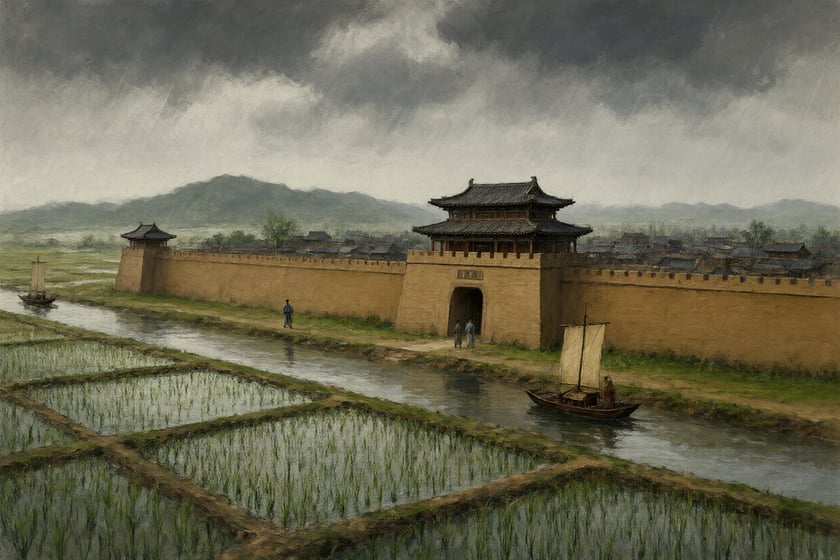
Shouchun lay on the south bank of the Huai River. In the Eastern Han, it belonged to Jiujiang Commandery and was the former seat of the Yangzhou Inspector; its site is in present-day Shouxian County, Huainan, Anhui Province. At the end of the Han, Yuan Shu occupied it and proclaimed himself emperor. In the seventeenth year of Jian’an (212), Xun Yu died there after falling ill. After Wei was established, Shouchun remained the seat of Yangzhou and an important stronghold on the front against Wu. Guanqiu Jian and Zhuge Dan successively raised troops there in opposition to the Sima clan.
History
When Sun Jian served as an assistant general, he settled his family in Shouchun. As a young man, Sun Ce made friends with notable figures there; Zhou Yu later persuaded him to move to Shuxian County. Yuan Shu later took up residence in Shouchun, preventing Liu Yao, the Inspector of Yangzhou, from taking up his post there; Liu Yao had no choice but to cross the river and govern from Qu'e. The Grand Tutor Ma Midi also stopped in Shouchun while on an imperial mission to pacify and settle the eastern region. In the second year of Jian’an (197), Yuan Shu usurped the title of emperor in Shouchun and appointed officials to all the offices. In the fourth year of Jian’an (199), Yuan Shu died. His younger cousin Yuan Yin, his son-in-law Huang Yi, and the others feared Cao Cao and did not dare remain in Shouchun. They carried Yuan Shu’s coffin and fled to Liu Xun in Wan.
Shouchun thereafter came under Cao Cao’s control. During the Jian’an era, the seat of Yangzhou was established in Shouchun, where Shi Miao served as magistrate and Jiang Ji as an administrative aide in Yangzhou. In the seventeenth year of Jian’an (212), Xun Yu accompanied Cao Cao on a campaign against Sun Quan but remained in Shouchun because of illness, where he died in sorrow. In the twenty-first year of Jian’an (216), Cao Biao was enfeoffed as the Marquis of Shouchun; in the fifth year of Huangchu (224), his title was changed to Marquis of Shouchun County. In the eighth month of that same year, Emperor Wen of Wei, Cao Pi, personally traveled by dragon boat along the Cai and Ying Rivers into the Huai, made an inspection tour of Shouchun, and pardoned those in Yangzhou guilty of minor offenses. During the Zhengshi era, Deng Ai surveyed the region from Chen and Xiang eastward to Shouchun. He proposed digging canals, cultivating garrison fields, and stockpiling grain. In the second year of Zhengshi (241), the Guangcao Canal was opened; thereafter, military forces operating in the southeast could travel by water directly to the Jiang and Huai regions.
In the first month of the second year of Zhengyuan (255), Guanqiu Jian, General Who Pacifies the East, and Wen Qin, Inspector of Yangzhou, raised troops against Sima Shi. They drove all the officials, soldiers, and commoners of Huainan into Shouchun and built an altar west of the city, where they swore an oath over sacrificial blood. After their rebellion failed, Zhuge Dan first entered Shouchun. More than a hundred thousand people in the city feared execution and fled through the gates; some went into the mountains and marshes, while others fled to Eastern Wu. The Wu general Sun Jun seized the opportunity to attack, but seeing that the city was already prepared, he withdrew his army.
In the fifth month of the second year of Ganlu (257), Zhuge Dan Holds Shouchun and Rebels against Wei. He submitted to Wu, which sent Wen Qin, Tang Zi, Quan Duan, and others with thirty thousand men into the city to reinforce it. Sima Zhao did not rush to attack the city, but instead built a long encircling wall and laid siege. Zhuge Dan initially laughed that the Huai flooded every year and the siegeworks would inevitably collapse on their own. But during the siege, the region suffered a drought lasting more than a year; it did not rain heavily until the very day the city fell. In the first month of the third year of Ganlu (258), the city ran out of provisions, and Zhuge Dan killed Wen Qin after an argument. In the second month, Sima Zhao captured Shouchun and executed Zhuge Dan.
People
- Native sons: Hu Zhi, an official of Wei, was from Shouchun. While serving as magistrate of Dunqiu, he exposed a wrongful conviction. The Wu general Jiang Qin was also from Shouchun. He crossed the river with Sun Ce and later became the commander at Ruxu.
- Residents in exile: Lü Fan fled to Shouchun to escape turmoil in his youth. There he met Sun Ce and joined him with a hundred retainers. Zhu Zhi was recruited by Ma Midi as a subordinate official in Shouchun.
- Zhuge Dan: He spent many years in Huainan and, after Guanqiu Jian’s rebellion, was reappointed General Who Pacifies the East and appointed commander of Yangzhou, with his headquarters at Shouchun. When the city fell, he broke through the small gate on horseback but was killed by troops under Hu Fen, a general serving under Sima Zhao. Several hundred of his followers stood in formation with their hands clasped and chose death rather than surrender; people of the time compared them to Tian Heng.
Differences in Historical and Fictional Accounts
The Romance of the Three Kingdoms says that Liu Yao had originally encamped in Shouchun and was driven across the river into Jiangdong by Yuan Shu. The Records of the Three Kingdoms, by contrast, says that Shouchun was already occupied by Yuan Shu, so Liu Yao was unable to enter the city and went directly across the river to govern from Qu'e. The novel also depicts Cao Cao personally leading the campaign that captured Shouchun in the second year of Jian’an, executing Li Feng and others and burning Yuan Shu’s palaces. The Records of the Three Kingdoms, “Annals of Emperor Wu,” says only that Yuan Shu invaded Chen, Cao Cao campaigned east, and Yuan Shu abandoned his army and fled; Cao Cao defeated and executed the generals left behind, including Qiao Rui and Li Feng. It does not mention the capture of Shouchun. Regarding Death of Xun Yu, the Records of the Three Kingdoms says that he remained in Shouchun because of illness and died in sorrow, while the Romance of the Three Kingdoms says that he knew Cao Cao intended to kill him and pretended to be ill so he could remain in Shouchun.
Today
The site of ancient Shouchun is present-day Shouxian County, Huainan, Anhui Province. The existing ancient city walls of Shouxian were built in or after the Song dynasty, and the Huai River and Bagong Mountain lie a short distance north of the city. Anfeng Pond, south of the city, is the ancient Shaobei and is still used to irrigate farmland.