Overview
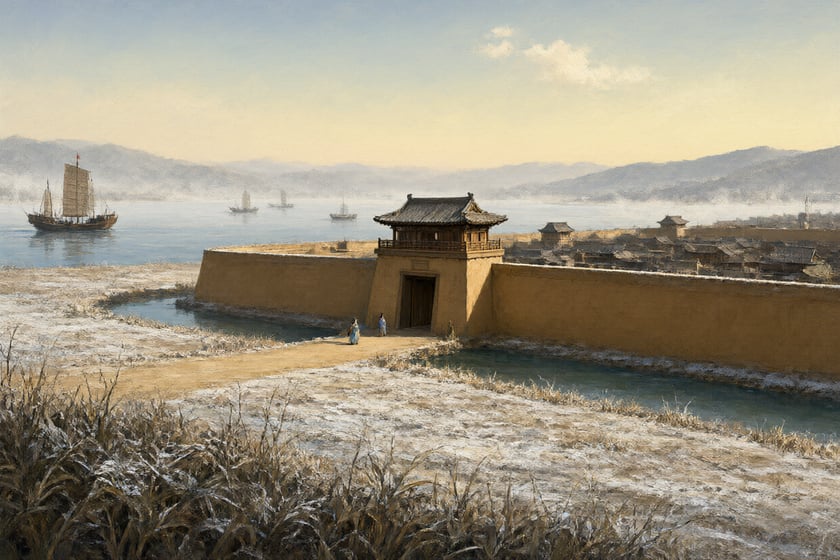
Hefei Xincheng was a fortress built by Cao Wei on the Huainan front in Yangzhou, about thirty li west of the old city of Hefei. Its site is in today’s Sangan’gang Township, Luyang District, Hefei, Anhui Province. Historical works often refer to it simply as “Xincheng.” It shared its name with the Wei Xincheng Commandery in the Fangling–Shangyong area, so the two must be distinguished. Built on the recommendation of General Who Attacks the East Man Chong, it was completed in the first year of Qinglong (233). Sun Quan and Zhuge Ke later each led large forces to attack it, but both withdrew without success. Emperor Ming of Wei called Hefei, Xiangyang, and Mount Qi the three cities that Wei was bound to contest.
History
In the first year of Qinglong (233), Man Chong submitted a memorial arguing that the old city of Hefei lay close to lakes and rivers to the south and too far from Shouchun to the north. When Wu forces attacked, they could use the waterways to their advantage, while Wei forces would find relief difficult. He proposed building a new city thirty li to the west, at a defensible site, to draw Wu forces away from the water and then cut off their retreat. General of the Central Army Jiang Ji objected, arguing that this would show weakness before a battle had even begun. Man Chong submitted another memorial, citing the stratagem “show them a form and lure them”; the minister Zhao Zi supported him, and Emperor Ming of Wei approved the proposal. That same year, Sun Quan personally led an expedition to surround the new city, but because it stood far from the waterways, he remained aboard his ships for twenty days, afraid to go ashore. Man Chong judged that Sun Quan would surely land to display his military might, so he laid an ambush of six thousand infantry and cavalry. When the Wu troops came ashore, he launched a sudden attack and took hundreds of heads.
In the fifth month of the second year of Qinglong (234), Sun Quan personally led an army said to number one hundred thousand into the mouth of Lake Chao, making straight for Hefei Xincheng. He also sent Lu Xun and Sun Shao, each at the head of more than ten thousand men, into the Huai and Mian rivers. Man Chong briefly considered abandoning the new city and drawing the Wu forces toward Shouchun, but Emperor Ming of Wei refused, ordering his generals to hold their positions while he himself sailed east on a dragon boat. Man Chong recruited several dozen stout-hearted men, made torches from pine branches, soaked them in sesame oil, and set fire from upwind to the Wu army’s siege equipment. He also shot and killed Sun Quan’s nephew, Sun Tai. General Zhang Ying and others fought fiercely to hold the city. Before Emperor Ming of Wei’s army had come within hundreds of li, Sun Quan had already withdrawn.
In the fifth month of the second year of Jianxing (253; the fifth year of Jiaping under Wei), the Wu Grand Tutor Zhuge Ke dispatched troops to attack Wei. He had initially intended to flaunt Wu’s might in Huainan and seize people, but later followed his subordinates’ advice and turned back to besiege Xincheng. On the Wei side, Guanqiu Jian and Wen Qin resisted him, while Grand Commandant Sima Fu brought the central army east to relieve the siege. The three units under the defenders Zhang Te and Le Fang had only three thousand men between them, and more than half had been killed in battle or died of illness. When the city was on the verge of falling, Zhang Te deceived the Wu army, claiming that Wei law allowed defenders who had held out for a hundred days without relief to surrender without their families being held liable. He asked for an extension. The Wu troops stopped their assault, but Zhang Te spent the night dismantling buildings to repair the breaches in the walls, building two layers of defenses. The next day, he announced that they would fight to the death. The Wu army attacked again but still could not take the city. The soldier Liu Zheng was ordered to break out and carry a message, but was captured by the Wu army and refused to yield, even at the cost of his life. After months of fighting, the Wu army still could not breach the city. Its soldiers drank water in the summer heat and suffered diarrhea and swelling; more than half were sick. In the seventh month, Zhuge Ke withdrew.
People
- Man Chong: General Who Attacks the East; he strongly advocated building the new city and twice thwarted Sun Quan.
- Zhang Ying: A Wei general who fought fiercely to hold the city when Sun Quan besieged it in the second year of Qinglong.
- Sun Tai: Son of Sun Quan’s younger brother Sun Kuang and a nephew by marriage of the Cao clan; he was killed by a stray arrow while accompanying Sun Quan in the siege of Xincheng.
- Zhang Te: A native of Zhuo Commandery, he had previously served under Zhuge Dan without being given important responsibilities. After Guanqiu Jian replaced Zhuge Dan, he assigned Zhang Te to garrison Xincheng. After defending the city, Zhang Te was enfeoffed as a marquis and promoted to Administrator of Anfeng.
- Liu Zheng and Zheng Xiang: Two Wei soldiers who separately risked leaving the city to carry messages. After being captured by Wu forces, one died while cursing the enemy, while the other shouted into the city that reinforcements were on their way. Both were posthumously awarded the title of Marquis of Guanzhong.
Differences in Historical and Fictional Accounts
In Romance of the Three Kingdoms, the battle in the second year of Qinglong is described as follows: Cao Rui divided his forces into three columns to meet the enemy. Man Chong offered a plan, and Cao Rui ordered the valiant general Zhang Qiu and Man Chong to lead two separate night attacks on the Wu naval camp at the mouth of Lake Chao, burning their ships and supplies. Zhuge Jin fled to Miankou. In the Records of the Three Kingdoms, Man Chong’s fire attack involved recruiting men to burn the Wu army’s siege equipment from upwind below Xincheng. The novel also has Lu Xun submit a memorial urging Sun Quan to lift the siege of Xincheng and instead cut off the Wei army’s retreat. A junior officer carrying the memorial was intercepted by Wei forces, and after reading it Cao Rui praised Lu Xun’s brilliant strategy. As for Zhuge Ke’s siege, the novel has Ding Feng advise that “Wei uses Xincheng as its chief strategic pass,” after which Zhuge Ke heads straight for Xincheng. Zhang Te shuts the gates and holds the city, broadly in keeping with the historical accounts.
Today
The site of Hefei Xincheng is in today’s Sangan’gang Township, Luyang District, Hefei, Anhui Province. Archaeological excavations have confirmed the locations of the city walls and gates, and a Three Kingdoms Xincheng Ruins Park has been built there.