Overview
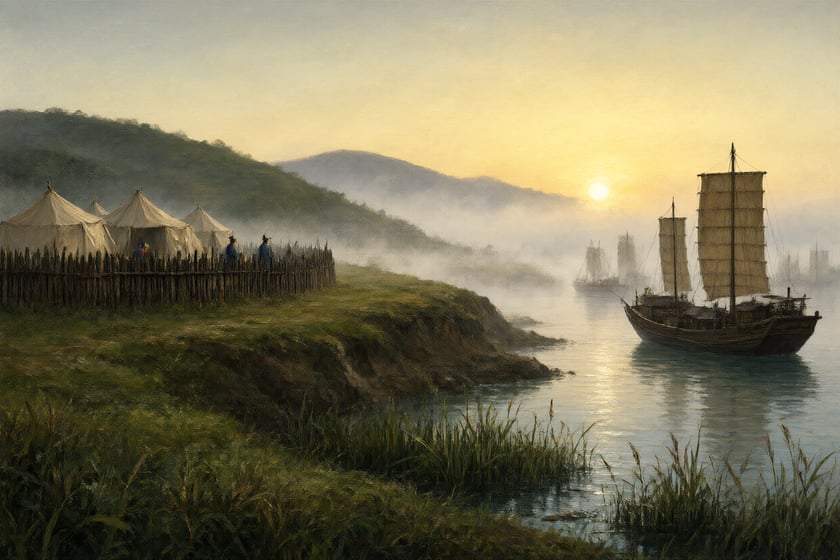
Ruxukou is the point where the Ruxu River flows into the Yangtze. Historical accounts often abbreviate it to Ruxu. Its mouth lies near present-day Yuxikou, opposite Wuhu City on the north bank of the Yangtze, not far from Wuhu on the south bank; Ruxu Fort, meanwhile, stood upstream, in the area northeast of present-day Wuwei City and around Hanshan County. In 212, the seventeenth year of the Jian’an era, Sun Quan built Ruxu Fort here. Thereafter it became Eastern Wu’s gateway for defending against Cao Wei on the north bank of the Yangtze: Cao Cao personally led two campaigns here, and Cao Ren launched one major attack, but after facing off against Wu forces, all withdrew. Successive Eastern Wu regimes appointed a Ruxu Commandant to garrison the area.
History
Construction of the fort: In 212, the seventeenth year of the Jian’an era, Sun Quan renamed Moling Jianye. That same year, on hearing that Cao Cao planned to invade, he built Ruxu Fort. This was Lü Meng’s proposal. He urged Sun Quan to build a fort beside the mouth of the Ruxu River. The other generals argued that they could simply land to attack the enemy and board their ships again afterward, so a fort was unnecessary. Lü Meng replied that the fortunes of war could turn; if enemy infantry and cavalry pressed close and they had no time to retreat to the water’s edge, how could they board their ships? Sun Quan accepted his advice.
First Battle of Ruxu: In the first month of 213, the eighteenth year of the Jian’an era, Cao Cao advanced on Ruxukou, broke through Sun Quan’s camps west of the river, and captured the Commandant Gongsun Yang. The two armies faced off for more than a month. Seeing that Sun Quan’s troops were well ordered, Cao Cao withdrew. Pei Songzhi’s commentary, citing the Wu Calendar, gives a fuller account: Cao’s forces crossed at night in oil boats to a sandbar in the river, where Sun Quan’s navy surrounded them. More than three thousand men were captured, and several thousand drowned. Seeing the order of Wu’s ships and equipment, Cao Cao exclaimed, “To have a son, one should have one like Sun Zhongmou.” Sun Quan sent him a letter saying, “The spring waters are rising; you should leave at once.” Cao Cao then withdrew.
Second Battle of Ruxu: In the winter of 216, the twenty-first year of the Jian’an era, Cao Cao garrisoned his troops at Juchao and attacked Ruxu. In the first month of the following year (217), he was still stationed at Juchao; in the second month, he advanced to Hao Creek west of the river. Sun Quan built a city at Ruxukou and held his ground, but after Cao’s forces pressed the attack, he retreated. In the third month, Cao Cao led his army north and left Xiahou Dun, Cao Ren, Zhang Liao, and others garrisoned at Juchao. Wu accounts say that Sun Quan appointed Lü Meng as commander for this campaign and held the fort built earlier. He installed ten thousand powerful crossbows on the fort and attacked Cao’s vanguard before its camp was complete, forcing Cao Cao to withdraw. After Cao Cao withdrew, Zhou Tai remained as Commandant of Ruxu.
The Wu general Dong Xi also died at Ruxukou. His biography in the Records of the Three Kingdoms does not specify the year. When Cao Cao advanced to Ruxu, Dong Xi commanded five tower ships stationed at Ruxukou. A storm struck during the night and the ships capsized. His attendants urged him to escape in a small boat, but he refused to leave. The ship sank that night, and he died.
Cao Ren attacks Ruxu: In 222, the first year of the Huangwu era, Cao Wei’s Grand Marshal Cao Ren led tens of thousands of infantry and cavalry to press toward Ruxu. The Ruxu Commandant Zhu Huan had only five thousand men under his command. He lowered the banners and muffled the drums, feigning weakness to lure the enemy. Cao Ren sent his son Cao Tai to attack Ruxu city, and ordered Chang Diao to command Zhuge Qian and Wang Shuang in a surprise attack by oil boat on the sandbar where the Wu army’s dependents were stationed. The Wei general Jiang Ji urged Cao Ren not to attack the sandbar, saying that Wu forces held the west bank and their warships were arrayed upstream; attacking the sandbar would be like throwing themselves into hell. Cao Ren ignored him. Zhu Huan personally held off Cao Tai, forcing him to burn his camp and retreat. Wu forces killed Chang Diao and captured Wang Shuang, while more than a thousand Wei troops were killed or drowned. Luo Tong and Yan Gui also defeated Chang Diao on the sandbar. The “Biography of the Wu Ruler” dates the Battle of the Sandbar to the third month of 223, the second year of the Huangwu era, and records that all Wei forces withdrew that month.
People
- Killed here: Dong Xi would rather die than abandon his ship, and Sun Quan donned mourning clothes and attended his funeral in person. The Wei general Chang Diao was defeated and beheaded on the sandbar.
- Commandants of Ruxu: Jiang Qin distinguished himself in fierce fighting at the battle north of Hefei Ford, and was promoted to General Who Quells Bandits and appointed Commandant of Ruxu. Zhou Tai bore dozens of wounds. His subordinates Zhu Ran, Xu Sheng, and others initially refused to accept his authority, so Sun Quan went in person to Ruxu Fort and hosted a banquet for the generals. In front of them all, he had Zhou Tai remove his clothes and pointed to each scar, asking about the battle in which he had received it. From then on, the men accepted Zhou Tai. Zhu Huan succeeded Zhou Tai as Commandant of Ruxu and was made Marquis of Jiaxing for his service in defending Ruxu. After distinguishing himself on the sandbar, Luo Tong was also appointed Commandant of Ruxu. Zhang Cheng, son of Zhang Zhao, served as Commander of Ruxu and General Who Inspires Might, commanding five thousand troops. At the end of Eastern Wu, after Zhongli Mu pacified Wuxi, he was reassigned from Commandant of Gong’an to Commandant of Ruxu.
Differences between history and fiction
The account of the Battle of Ruxu in Romance of the Three Kingdoms largely follows historical records: Lü Meng’s proposal to build Ruxu Fort and the other generals’ opposition, as well as Cao Cao seeing Sun Quan’s forces at Ruxukou and exclaiming, “To have a son, one should have one like Sun Zhongmou”, accord with the Records of the Three Kingdoms. The novel adds a scene in which Cao Cao orders his generals to climb a mountain and capture Sun Quan, only to be ambushed by the four generals Han Dang, Zhou Tai, Chen Wu, and Pan Zhang, who lead archers and crossbowmen; Xu Chu then leads troops to rescue Cao Cao. This episode does not appear in the Records of the Three Kingdoms. The novel also says that Gan Ning led one hundred cavalrymen, marked by white goose feathers, in a nighttime raid on Cao’s camp, riding back and forth through it before returning unharmed. The nighttime raid is also recorded in the “Biography of Gan Ning” in the Records of the Three Kingdoms and in the Jiangbiao Zhuan cited in Pei Songzhi’s commentary. They say that Gan Ning selected more than a hundred seasoned men, crossed the palisades and entered the camp, and took dozens of heads. The white goose feathers as a signal are a detail added by the novel.
Today
The Ruxu River is the present-day Yuxi River, which flows from the southeast of Lake Chao into the Yangtze. Its mouth lies near present-day Yuxikou. Accounts differ on the precise location of Ruxu Fort; one theory places it between present-day Wuwei City and Hanshan County, where the river runs between Ruxu Mountain and Qibao Mountain.