Strategic Background
Ruxukou lies at the outlet of the waterway connecting Lake Chao to the Yangtze River and served as the gateway through which Eastern Wu defended the north bank of the river. Cao Cao had already faced off against Sun Quan here once in 213, then withdrew without success. In the winter of 216, after pacifying Hanzhong and becoming King of Wei, Cao Cao once again led an eastward campaign. In the spring of the twenty-second year of Jian’an (217), he reached the Ruxu front: this was the Battle of Ruxu (217). Sun Quan had just suffered a defeat at Xiaoyao Ford in Hefei, and his troops’ morale needed a boost. Cao Cao’s forces, meanwhile, were enormous. The Jiangbiao Zhuan gives their numbers as 400,000 infantry and cavalry, while Sun Quan had only 70,000.
When the forces were so uneven and it was unwise for the main armies to risk a decisive battle, a typical defensive strategy was to hold fast behind fortifications while using small-scale raids to undermine the enemy’s confidence and judgment. Gan Ning’s night raid was a carefully designed operation of this kind: small in scale and manageable in risk, but with its psychological impact maximized.
Deployment of the Two Sides
Sun Quan appointed Gan Ning commander of the vanguard. According to the Jiangbiao Zhuan, he led 3,000 men and was positioned at the very front of the defensive line. The appointment itself conveyed both trust and a test of his abilities. In his early years, Gan Ning had gathered followers and led a band of wandering knights (the novel calls them “the Brocade Sails Bandits”). After joining the Sun family, he repeatedly distinguished himself in battle, but among Wu’s commanders he still had the air of an outsider.
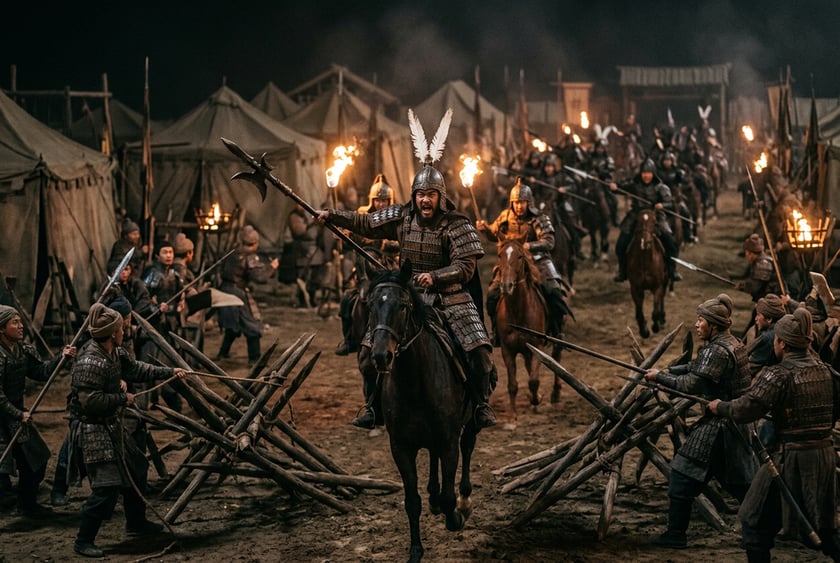
Cao Cao’s encampment was ringed with obstacles such as wooden palisades. The novel goes further, describing Cao Cao’s central camp as enclosed by a defensive ring of wagons and guards, so that even if attackers broke through, they could not reach the command center directly. This detail reflects the standard defensive arrangements of a large army’s encampment: obstacles on the outside, layers of protection around the core. A night raiding party could cause only limited disorder; its real effect lay in startling and unsettling the enemy.
Gan Ning took only a little over a hundred men. The Biography of Gan Ning describes a drinking ceremony before their departure: Sun Quan bestowed food and wine; Gan Ning drank first, then poured a cup for the commander. The commander was too frightened to accept it, so Gan Ning laid a saber across his knees and challenged him. Only then did the commander rise to receive the wine, after which every man in the army drank a cup. This was not merely a send-off ritual; it was also a pre-battle effort to steel their nerves and affirm discipline. For a small unit about to penetrate an enemy camp in the dark, even one man’s hesitation could mean the annihilation of the entire force.
Key Decisions
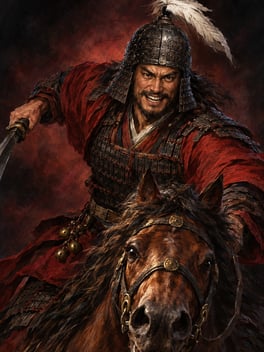
The first decision was when to strike. The Biography of Gan Ning says they set out at the second watch, with gags in their mouths. By then, most of the enemy camp would have been asleep, and the darkness could conceal the raiders’ true numbers. The novel has them place white goose feathers in their helmets as nighttime recognition markers. Though this detail was added in the Romance, it captures the central challenge of night fighting: how to tell friend from foe amid the confusion.
The second decision was the choice of target. The Biography of Gan Ning says Sun Quan ordered an attack on the enemy’s forward camp. The Jiangbiao Zhuan, by contrast, says that Gan Ning went straight to Cao Cao’s camp, pulled apart the palisades, and climbed over the ramparts. After taking dozens of heads, he withdrew swiftly. The two historical sources differ in how they describe the target, but both emphasize that the raiders struck and then retreated. The novel goes further, having Gan Ning charge straight toward the central camp in an attempt to assassinate Cao Cao. When wagons and guards blocked his way, he instead rampaged through the camp. It turns a night raid into an all-or-nothing assassination attempt, heightening the drama.
The third decision was when to withdraw. The success of a night raid often depends on whether the attackers can return safely. The Jiangbiao Zhuan gives a vivid account: as the Cao army beat drums, shouted, and lit fires everywhere, Gan Ning had already returned to camp, where he struck up music and shouted, “Long live the king!” In the novel, Sun Quan sends Zhou Tai to support him, while the Cao army, fearing an ambush, dares not pursue. In either version, striking quickly and withdrawing quickly was key to the operation’s success.
Outcome and Repercussions
In terms of tactical results, taking dozens of heads with a little over a hundred men was negligible against an army said to number in the hundreds of thousands. But the operation’s real value lay in its psychological impact. The Jiangbiao Zhuan records that Sun Quan summoned Gan Ning that night and happily remarked that the raid was enough to give Cao Cao a fright. He then bestowed a thousand bolts of silk and a hundred swords, saying that Cao Cao had Zhang Liao and he had Gan Ning, so they were evenly matched. By putting Gan Ning on a par with Zhang Liao, who had just dealt Wu’s forces a heavy blow at Xiaoyao Ford, Sun Quan was clearly seeking to restore his own side’s honor. The Biography of Gan Ning also says that Gan Ning was held in even higher regard as a result, and was given an additional 2,000 troops.
According to the Jiangbiao Zhuan, after the two sides had faced off for over a month, the Cao army withdrew. The Biography of the Wu Ruler in the Records of the Three Kingdoms says that in that year Sun Quan sent Commandant Xu Xiang to Cao Cao to request surrender. Cao Cao left troops behind and returned, while Wu’s forces held the defensive line. Gan Ning’s night raid was not the decisive cause of Cao Cao’s withdrawal, but together with the formidable defenses of Ruxu Fort, it showed Cao Cao that Wu’s forces would not collapse at the first blow.
Counterfactual Analysis
If Gan Ning had really charged toward the central camp as the novel describes, and the Cao army’s central camp was as heavily defended as depicted, his hundred-man unit would very likely have been surrounded and wiped out. Whether the historical sources are referring to the forward camp or Cao Cao’s own camp, Gan Ning withdrew as soon as he had taken his prizes, demonstrating a seasoned commander’s ability to manage risk.
Without this night raid, the slump in Sun Quan’s forces’ morale after their defeat at Xiaoyao Ford might have lasted longer. In fact, Sun Quan still requested surrender from Cao Cao after this campaign (Biography of the Wu Ruler), showing that Wu’s overall strength was indeed at a disadvantage. Gan Ning’s raid with a hundred men could not alter the balance of power, but at a critical moment it won Wu’s forces a symbolic victory—an achievement that was no less essential over the course of a prolonged standoff.