
Background
Hefei was Cao Wei’s gateway to Huainan and a necessary staging point for Eastern Wu’s advance north. After the Battle of Red Cliffs, Sun Quan attacked Hefei repeatedly, and Zhang Liao’s defense of the city made it a symbol of Wei’s defenses in Huainan. However, the old city of Hefei had a structural weakness: it stood right beside the network of lakes and waterways to the south, while Shouchun, Wei’s major rear stronghold in Huainan, lay far to the north. Wu forces excelled at water warfare and could sail straight to the city walls, keeping their supply lines secure via the waterways during a siege. Wei reinforcements, by contrast, had to march a long way south and could relieve the city only after first defeating the enemy’s main force, which held the advantage of favorable terrain.
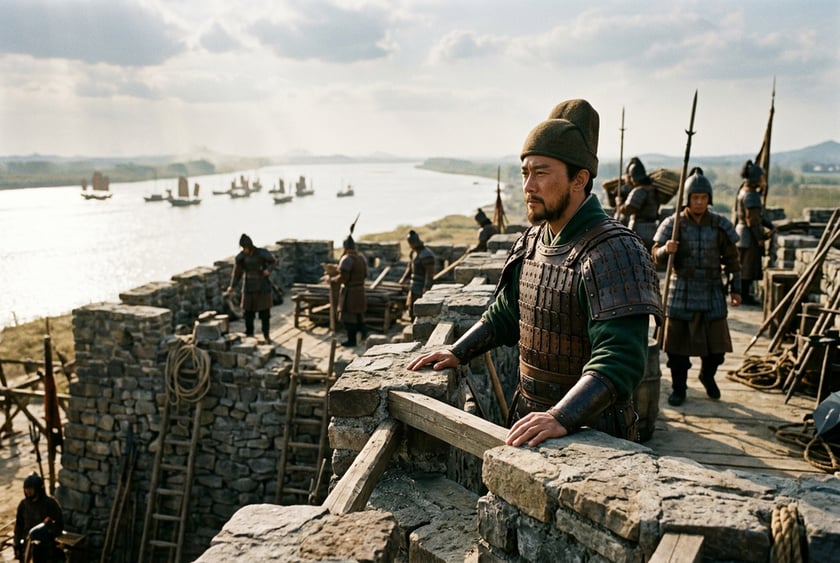
After Cao Xiu died, Man Chong took charge of military affairs in the Yangzhou region. During the prolonged standoff, he recognized this disadvantage. In 233 (the first year of the Qinglong era), he formally submitted a memorial proposing that the old city be abandoned and a new one built 30 li to the west.
Key Figures
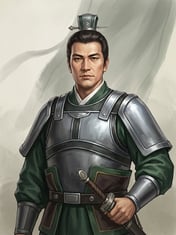
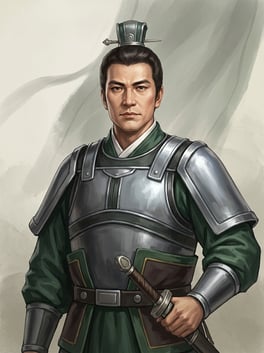
Man Chong proposed and carried out this decision. He came from a family of judicial officials and was known for strict enforcement of the law. Later, he spent many years defending the frontier, earning a reputation for pragmatism and sound judgment of the enemy’s intentions.
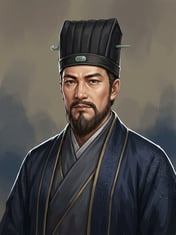
Jiang Ji represented the opposition. As General of the Guards, he was familiar with affairs in Huainan and had previously predicted Wu movements accurately. He argued that voluntarily moving the city would amount to showing weakness to all under Heaven: dismantling one’s own city before the enemy had even arrived was more like retreat than defense. Once they abandoned the old city, vast areas of Huainan would be left open to Wu raids, and in the end they would have no choice but to retreat north of the Huai River.
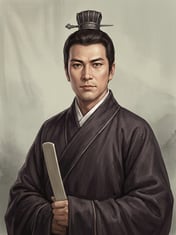
Zhao Zi, then serving as a palace official, sided with Man Chong in the court debate, judging his strategy superior.
Emperor Ming of Wei, Cao Rui, was the final decision-maker. He initially rejected the proposal, but changed his mind only after Man Chong submitted another memorial and Zhao Zi voiced his support, then issued an edict approving the plan.
Core Issue
At its heart, the debate concerned the relationship between appearances and reality. Jiang Ji focused on political perception: moving the city backward would look like a retreat both to the court and to the enemy. In his second memorial, Man Chong cited The Art of War, arguing that warfare is fundamentally a matter of deception, and that outward weakness need not reflect actual weakness. “One who is skilled at manipulating the enemy shapes appearances for him.” Moving the city was precisely a way of “feigning weakness to lure the enemy”—drawing Wu forces away from the water, where they excelled, and onto land, where they did not.
From the perspective of military geography, Man Chong’s plan addressed the fundamental asymmetry between Wu and Wei: Wu was strong on water and weak on land, while Wei was the opposite. The new city lay 30 li west of the old one, in a defensible position and far from the waterways. To attack it, Wu forces would have to leave their ships and fight on land. Wei forces, meanwhile, could put their infantry and cavalry to use on open ground and cut off the Wu troops’ route back to their ships.
Events soon confirmed this assessment. The year the new city was completed, Sun Quan personally led a large army there, but because the city stood far from the waterways, he remained aboard his ships for twenty days, not daring to come ashore. Man Chong judged that Sun Quan would eventually have to land to maintain the appearance of strength, so he laid an ambush in advance with six thousand infantry and cavalry. Sun Quan did indeed come ashore; the ambush sprang, and hundreds of Wu soldiers were killed, while others drowned in the confusion. The following year, Sun Quan claimed to have an army of 100,000 and again besieged the new city. Man Chong recruited several dozen brave men, soaked pine branches in sesame oil, and set fire to Wu’s siege equipment from upwind. They also shot and killed Sun Quan’s nephew, Sun Tai, and the Wu forces withdrew. A year later, Man Chong again took advantage of the Wu forces’ autumn harvest while they were farming on the north bank of the Yangtze, launching an attack and burning their grain.
Political Consequences
The construction of Hefei Xincheng shifted Wei’s defensive line in Huainan from “passive relief” to “proactive attrition.” Wu forces attacked Hefei Xincheng repeatedly thereafter, including a later siege by Zhuge Ke with the full strength of his state, but never managed to capture it. In effect, relocating a single city changed the cost of offense and defense on the Huainan battlefield for decades.
The episode also illustrates how the court under Cao Rui handled frontier defense issues: commanders on the front proposed plans, senior officials at court debated them, and the emperor weighed the competing views. Jiang Ji’s objections were not without merit, but Man Chong’s persistence and Zhao Zi’s support allowed a plan that seemed to “show weakness” to be implemented—a difficult outcome to achieve in a court culture that prized appearances.
Counterfactual Analysis
If Cao Rui had accepted Jiang Ji’s advice and continued to hold the old city, Wu forces could still have used the waterways to besiege Hefei repeatedly, forcing Wei troops to march all the way from Shouchun each time to relieve it. Given how often Sun Quan launched major northward campaigns during the Jiahe era, the old city could easily have been caught in a cycle of constant emergency responses. If reinforcements arrived late, the risk of losing the city would have been considerable.
Conversely, if the new city had been poorly sited, or if Sun Quan had seen through Man Chong’s ploy and refused to come ashore, then relocating the city really would have amounted to “pulling oneself out before being attacked,” as Jiang Ji put it. The people and farmland of the old Huainan region would have been exposed to Wu forces. Man Chong’s plan succeeded not only because of his geographical assessment, but also because he understood Sun Quan’s mindset: having led an imposing campaign in person, Sun Quan could hardly return empty-handed, and was bound to come ashore and try his luck.