Background
In 238 (the second year of the Jingchu era), relations between the Gongsun regime in Liaodong and the Wei court reached a breaking point. Romance of the Three Kingdoms portrays Gongsun Yuan’s rise as a series of political choices: he seized his uncle Gongsun Gong’s position, first accepted a title from the Wei court, then, after Wu sent envoys, killed them and presented their heads to Wei. He subsequently proclaimed himself King of Yan and changed the era name to Shaohan. Through this sequence, the novel highlights a regional regime’s wavering between Wei and Wu, and the process by which Gongsun Yuan ultimately openly challenged the Wei court. This narrative, however, should not be treated as evidence on the same footing as the official histories without distinction.
The military information provided by the official histories is much more limited. The Records of the Three Kingdoms states that when Sima Yi led an army to attack Gongsun Yuan in the second year of Jingchu, the King of Goguryeo, Wugong, sent his secretary, Dae Ga, with several thousand men to aid Wei. This shows that the conflict involved more than an internal power struggle in Liaodong; it also drew in outside forces from the Northeast. The surviving historical sources, however, do not explain the details of the siege, the full strength of either side, or Gongsun Yuan’s ultimate fate. The following discussion must therefore clearly identify such material as coming from the literary account in Romance of the Three Kingdoms.
Main Figures
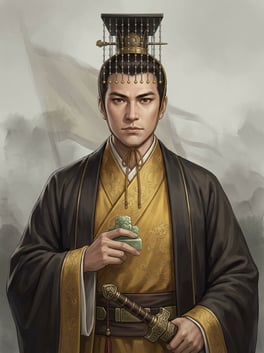
Sima Yi was the commander dispatched by the Wei court, while Cao Rui was the highest decision-maker behind the campaign. The novel casts their interaction as a model of “imperial authorization, with the commander exercising independent judgment”: Cao Rui worries about the long distance and small number of troops, as well as the possibility that Wu and Shu might seize the opportunity to attack; Sima Yi responds with estimates of the time needed to march, besiege the city, and rest, and says that he has already arranged defensive measures. This scene not only conveys Sima Yi’s confidence but also presents the pressures on the central government as it weighs a frontier war against risks on other fronts.
Gongsun Yuan was the central figure of the Liaodong regime, while Bei Yan and Yang Zuo serve as field commanders in the novel. Hu Zun commanded the vanguard; Xiahou Ba and Xiahou Wei were ordered to lie in ambush. Guanqiu Jian appears in a separate episode of Northeast military history described in chapter 30 of the Records of the Three Kingdoms: the biography states that he defeated Goguryeo in the fifth year of Zhengshi.
Key Issues
The novel’s central concern is not merely the siege, but how time, provisions, and choices create an advantage on the battlefield. After the Wei army arrived, Bei Yan and Yang Zuo judged that its long lines of march and difficult supply transport would work against it, and sought to wear it down by holding their positions. Sima Yi, however, bypassed the defenses at Liaosui, lured the Liaodong army away from its positions, and then struck it with ambush troops. The logic of the narrative is that there is no need to fight head-on on ground chosen by the enemy; instead, one should force the opponent to alter its deployment, preventing its numerical strength from being reliably converted into a defensive advantage.
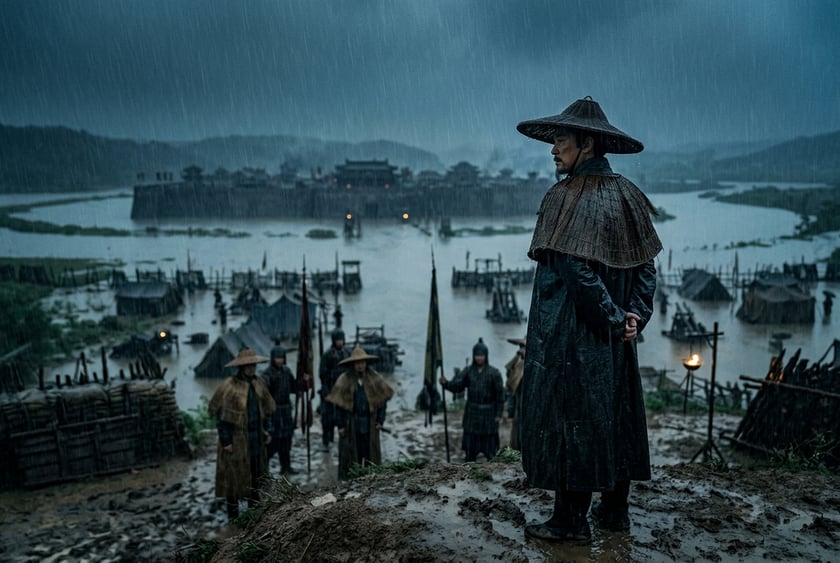
Relentless autumn rains and flooding brought logistical problems further to the fore. The novel describes the Wei army’s camps as muddy and its soldiers as suffering, to the point that a general asked to move camp. Sima Yi refused and severely punished those who disobeyed. He later explained that leaving the roads open and allowing the city’s soldiers and civilians to gather firewood and graze livestock was intended to make the defenders keep consuming their provisions and wait for them to disperse on their own. The story thus presents a tension between governance and warfare: strict military discipline can preserve the army’s organization, but may increase the burden on its soldiers; avoiding a hasty assault can reduce direct losses, but requires the commander to bear uncertainty over time, disease, and supplies.
This intricate strategy, however, is primarily part of the Romance of the Three Kingdoms’ portrayal of a celebrated general. Through elements such as astrological predictions, a refusal to negotiate, and an ambush that captures the enemy, the novel shapes the outcome into a story in which Sima Yi sees events coming and his opponents are drawn into his trap step by step. The material in the Records of the Three Kingdoms, by contrast, confirms only Sima Yi’s campaign and Goguryeo’s aid to Wei; it does not corroborate each of the stratagems described above. One may therefore discuss the strategic logic presented by the novel when analyzing its military thought, but should not treat its literary episodes as battlefield records verified by the official histories.
Political Consequences
In the novel’s account, after Gongsun Yuan was captured and executed and Xiangping fell, Sima Yi dealt with members of the Gongsun clan and associated officials, while also honoring Jia Fan and Lun Zhi, who had urged Gongsun Yuan not to rebel, and reassuring the local population. This arrangement extends military conquest into political consolidation: eliminate forces regarded as the core of the rebellion, set up those loyal to Wei as examples, and reduce resistance in the newly occupied region through relief and rewards. It should be emphasized that these specific measures come from chapter 106 of Romance of the Three Kingdoms; the cited chapter 30 of the Records of the Three Kingdoms alone cannot establish that every detail is historical fact.
For the Wei court, the Liaodong campaign in the novel demonstrates the central government’s capacity to project military power to the frontier, while also underscoring Cao Rui’s trust in Sima Yi, to whom he entrusted the distant expedition. Later generations have incorporated this campaign into the narrative of “The Sima Clan's Seizure of Power,” making it easy to project Sima Yi’s later political standing back onto 238. An expedition ordered by Cao Rui to resolve the Liaodong problem cannot, by itself, prove that a plan to seize power or a transfer of power had already taken place. A more cautious conclusion is that successfully commanding the army may have increased the commander’s prestige and political capital, but the available citations are insufficient to measure this effect or to prove that it directly led to the Sima clan’s rise to power.
Counterfactual Scenarios
If Gongsun Yuan had followed Jia Fan’s advice in the novel, refraining from publicly proclaiming himself king or changing the era name, and continued to maintain nominal submission to the Wei court, it is impossible to determine from the available material whether Wei would still have launched a campaign, or on what scale. A reasonable inference is that the political grounds for publicly challenging central authority would at least have been weaker. Yet Liaodong’s existing autonomy, its contacts with Wu, and the Wei court’s desire to control the frontier could still have led to conflict. A counterfactual should not equate “avoiding a royal proclamation” with “guaranteeing peace,” much less assert that the Gongsun clan would necessarily have retained its regime for the long term.
Conversely, if Bei Yan and Yang Zuo had not left the defenses at Liaosui, or if rain and supply pressures had forced the Wei army to withdraw, the campaign might have turned into a much longer siege or a temporary stalemate. The novel emphasizes Sima Yi’s tactics of luring the enemy out and holding his ground precisely because these choices turned the Liaodong army’s advantage in time into a burden of supply. But the actual course of the conflict would also have depended on roads, the season, manpower, and external aid, and the available Records of the Three Kingdoms material does not provide enough information to test these variables. The safest conclusion, then, is not to treat the novel’s path to victory as inevitable, but to recognize that the pacification of Liaodong depended on the combined effects of central mobilization, frontier alliances, and logistical endurance.