Overview
Xiangping was the seat of Liaodong Commandery in You Province during the Eastern Han, located in present-day Liaoyang, Liaoning. From the sixth year of Zhongping (189), the Gongsun clan of Liaodong made Xiangping their base. Gongsun Du, Gongsun Kang, Gongsun Gong, and Gongsun Yuan successively established independent rule over Liaodong, spanning three generations and fifty years in all. In the second year of Jingchu (238), Sima Yi besieged and captured Xiangping; Gongsun Yuan and his son were executed, and the commanderies of Liaodong came under Wei.
History
Gongsun Du was originally from Xiangping. Before he took office as Administrator of Liaodong, Gongsun Zhao, a man from a dependent state, served as magistrate of Xiangping County and had once appointed Gongsun Du’s son Gongsun Kang as a squad leader. After Gongsun Du took office, he arrested Gongsun Zhao and flogged him to death in Xiangping’s marketplace. He also used the law to exterminate more than a hundred prominent families in the commandery, leaving its people terrified. Around the first year of Chuping (190), a large stone appeared in the communal grounds of Yanli, Xiangping. Someone told Gongsun Du it was an auspicious sign that he would soon possess land, making him even more pleased with himself. He subsequently declared himself Marquis of Liaodong and Governor of Pingzhou, and set up an altar south of Xiangping’s walls to offer sacrifices to Heaven and Earth, acting like a ruler in his own domain.
In the second year of Jiahe (233), Sun Quan sent Zhang Mi, Xu Yan, and others to Liaodong with gold, jade, and other treasures to install Gongsun Yuan as King of Yan. After the mission arrived at Xiangping, Gongsun Yuan first dispersed the more than four hundred accompanying officials among the counties, then killed Zhang Mi and the others and sent their heads to Wei. During the Qinglong era, Emperor Ming of Wei sought to seize Liaodong and sent Guanqiu Jian, Inspector of You Province, with the troops of You Province to Xiangping. They garrisoned at Liaosui, where Gongsun Yuan engaged them in battle. Guanqiu Jian was unable to prevail and withdrew.
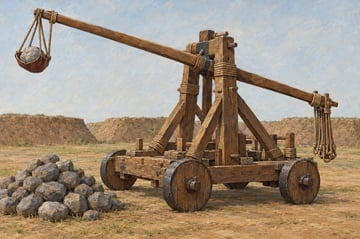
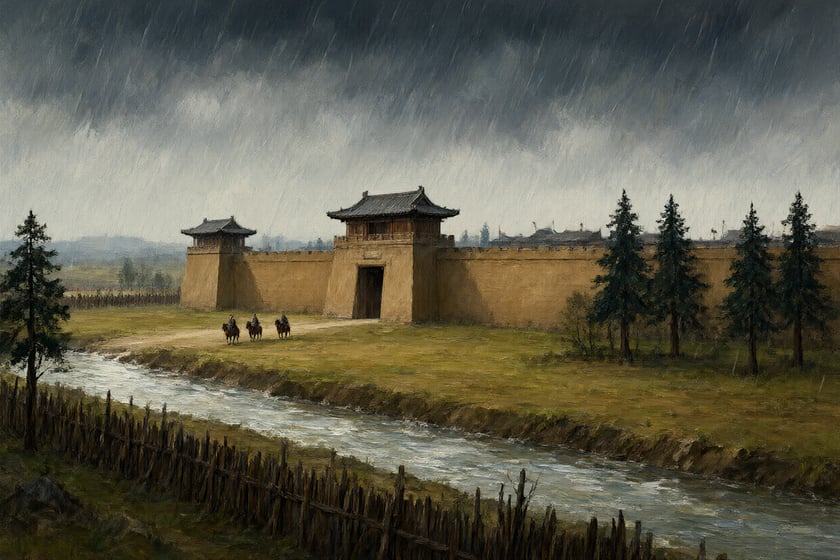
In the second year of Jingchu (238), Sima Yi was ordered to campaign against Gongsun Yuan and arrived in Liaodong in the sixth month. Gongsun Yuan sent Bei Yan, Yang Zuo, and others with tens of thousands of infantry and cavalry to garrison at Liaosui. Sima Yi sent Hu Zun to defeat them, then took a roundabout route to make directly for Xiangping. Fearing that Xiangping would be left undefended, Bei Yan and the others withdrew there overnight. They fought again at Shoushan and were defeated once more. The Wei army advanced to the city and dug trenches to encircle it. Heavy rain then fell for more than thirty days, and the Liao River swelled; grain boats traveled from Liaokou directly to the city walls. When the rain stopped, the Wei army built earthen mounds and watchtowers, and fired stone-throwing engines and repeating crossbows into the city. With food exhausted, the people inside resorted to cannibalism, and Yang Zuo and the others surrendered. On the night of the bingyin day in the eighth month, a large shooting star fell from northeast of Shoushan to the southeast of Xiangping. On the renwu day, Gongsun Yuan and his son Gongsun Xiu led several hundred cavalry in a breakout to the southeast. They were executed where the shooting star had fallen; the city was taken, and the four commanderies of Liaodong, Daifang, Lelang, and Xuantu were all pacified. Before the campaign, court officials had complained that forty thousand troops were too many; after the army reached Liaodong and encountered prolonged rain, some urged that Sima Yi be recalled. Emperor Ming of Wei ignored them all, and in the end, “everything turned out exactly as he had planned”.
Figures
- Gongsun Du: A native of Xiangping, he began his career as a minor official in Xuantu Commandery. Recommended by Xu Rong, a fellow commandery native, he was appointed Administrator of Liaodong. He later campaigned east against Goguryeo and west against the Wuhuan, laying the foundations of the Gongsun clan’s power in Liaodong.
- Gongsun Zhao: Magistrate of Xiangping before Gongsun Du took office. For having once slighted the Gongsun family, he was flogged to death in Xiangping’s marketplace.
- Gongsun Yuan: Son of Gongsun Kang, he seized power from his uncle Gongsun Gong. The last ruler of the Gongsun clan, he first accepted a royal title from Sun Quan, then killed the Wu envoys, and ultimately rebelled against Wei and was executed outside Xiangping’s walls.
- Gongsun Xiu: Son of Gongsun Yuan, he was executed alongside his father when they attempted to break out.
- Guanqiu Jian and Sima Yi: Wei commanders who led successive campaigns against Liaodong. Guanqiu Jian was also serving in Sima Yi’s army when Liaodong was pacified in the second year of Jingchu.
Differences Between Historical Records and the Novel
According to the Records of the Three Kingdoms, before the city fell, strange events repeatedly occurred in the Gongsun family: a dog wearing a headscarf and red clothes climbed onto a roof; a child was steamed to death in a rice steamer; and a lump of flesh with a head and eyes but no limbs appeared in Xiangping’s northern market. Diviners said these were omens of the state’s destruction. The Romance of the Three Kingdoms recasts these strange events as words of warning spoken to Gongsun Yuan by the military adviser Lun Zhi. Gongsun Yuan ignored him and had him and Jia Fan executed in the marketplace. The novel says that Gongsun Kang was “a native of Xiangping”, whereas the Records of the Three Kingdoms says it was his father, Gongsun Du, who was originally from Xiangping. The novel also says Cao Pi enfeoffed Gongsun Gong as Marquis of Xiangping. The “Biography of Gongsun Du” in the Records of the Three Kingdoms records that Gongsun Kang was enfeoffed as Marquis of Xiangping, while after Cao Pi’s accession he enfeoffed Gongsun Gong as Marquis of Pingguo.
Today
The ruins of Xiangping are in present-day Liaoyang, Liaoning. The group of Han, Wei, and Jin mural tombs discovered in the Liaoyang area is an important remnant of local life in Liaodong during this period.