Gongsun Zan's faction · Administrator of Liaodong
Gongsun Du
courtesy name 升济 · c. 150–204
Not to be confused with Gongsun Du (公孙犊) — Gongsun Du, appointed a Gentleman of the Palace by Yuan Shao, once joined Guo Zu and others in banditry before surrendering to Lu Qian with his followers.
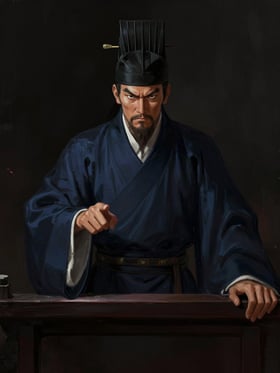
Gongsun Du, courtesy name Shengji, ruled Liaodong and was known for harsh rule and naming himself its marquis and Pingzhou governor.

Life
In the novel: 2 chapters · In the Records: 3 volumes
Life150–204
189 CE (Zhongping 6)
- Gongsun Zan's faction· Undated
- Life event
On the boards
Compare with someone →Where this person ranks on each board.
Historical Record
Gongsun Du, courtesy name Shengji, was originally from Xiangping in Liaodong. His father, Gongsun Yan, fled from official persecution and moved to Xuantu. In his youth, Gongsun Du was known as Bao and once served as a clerk in Xuantu Commandery. The commandery administrator, Gongsun Yu, grew fond of him because he was the same age as Gongsun Yu’s son, who had died young; he arranged for Gongsun Du to study under a teacher and found him a wife. Gongsun Du was later recommended as a man of virtue and talent, served as a Gentleman of the Secretariat, and gradually rose to become Inspector of Jizhou. He was dismissed because of rumors, but Xu Rong, a fellow commandery native, recommended him for the post of Administrator of Liaodong.
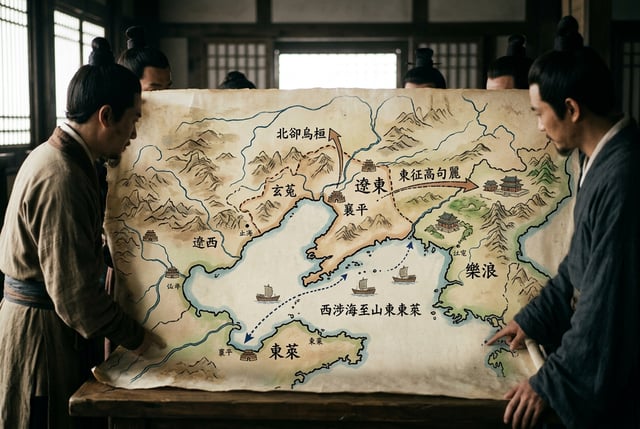
When Gongsun Du first arrived in Liaodong, the commandery’s residents looked down on him because he had risen from a low-ranking clerk. He investigated Gongsun Zhao, the Magistrate of Xiangping, who had once appointed Gongsun Du’s son, Gongsun Kang, as a squad leader, and had him flogged to death in the marketplace. He also executed prominent local figures such as Tian Shao under the law, destroying more than a hundred families and filling the commandery with terror. At the same time, he campaigned east against the Goguryeo and west against the Wuhuan, extending his influence far beyond the seas. In the first year of Chuping, judging that the Central Plains were in turmoil, he told his close subordinate officials Liu Yi and Yang Yi that he intended to establish a kingdom. He then established Liaoxi and Zhongliao commanderies, crossed the sea to seize several counties in Donglai, and created the post of Inspector of Yingzhou. He declared himself Marquis of Liaodong and Shepherd of Pingzhou, and posthumously enfeoffed his father as Marquis of Jianyi. He also conducted sacrifices to Heaven and Earth in the suburbs, held the plowing ceremony, and reviewed his troops, adopting ceremonial forms such as the luan carriage and nine streamers. Cao Cao memorialized him for appointment as General of Martial Might and enfeoffment as Marquis of Yongning Township, but Gongsun Du stored the seal and ribbon in the armory.
Gongsun Du dealt harshly with potential threats. Li Min, disgusted by his conduct, took his family and fled by sea; Gongsun Du dug up Li Min’s father’s grave, burned the corpse, and executed his clan. He also tried to retain talented men of repute. When Guan Ning and others arrived in Liaodong, Gongsun Du received them with an empty residence. Guan Ning, however, lived in the mountain valleys and avoided discussing worldly affairs, gradually attracting refugees and scholars to settle around him. Liu Zheng, whom Bing Yuan was sheltering, was the subject of a manhunt: Gongsun Du seized Bing Yuan’s household and ordered that anyone who hid Liu Zheng be punished as an accomplice. Bing Yuan urged him that since Liu Zheng had already escaped, he should pardon his family; Gongsun Du eventually released Liu Zheng’s relatives.
He also once asked Liang Mao whether he should take advantage of Cao Cao’s distant campaign to attack Ye. Liang Mao bluntly declared that such an act would be unjust and bring swift ruin. The assembled generals were shaken, and Gongsun Du conceded that Liang Mao was right. Gongsun Du died in the ninth year of Jian’an, and his son Gongsun Kang succeeded him.
In the Novel
In Romance of the Three Kingdoms, Gongsun Du appears chiefly as the founder of the Liaodong Gongsun clan and part of its family background, rather than as a character who directly drives the plot. When Gongsun Kang is introduced in Chapter 33, he is identified as Gongsun Du’s son, while Gongsun Du is referred to retrospectively as General of Martial Might. The dramatic focus, however, shifts to how Gongsun Kang deals with Yuan Xi and Yuan Shang, who come seeking refuge. Chapter 106 likewise recounts the family lineage, identifying Gongsun Yuan as Gongsun Du’s grandson and Gongsun Kang’s son, using Gongsun Du’s name to connect several generations of power shifts in Liaodong.
Here, the novel emphasizes the line of succession through which the Gongsun clan rose from a local power in Liaodong to an independent ruling house. Gongsun Du himself takes no new action or speaks in the episodes provided; his declaration of himself as Marquis of Liaodong and Shepherd of Pingzhou, among other acts, is also recorded in the Records of the Three Kingdoms and was not invented solely by the novel.
Key Relationships
- Gongsun Yan: Father. Gongsun Du posthumously enfeoffed his father as Marquis of Jianyi, thereby establishing a symbolic succession of family status.
- Gongsun Kang: Son and successor. In childhood, Gongsun Kang was appointed squad leader by Gongsun Zhao; after Gongsun Du took power, he killed Gongsun Zhao. Gongsun Kang succeeded Gongsun Du after his death.
- Gongsun Yu: Early patron. Gongsun Yu, Administrator of Xuantu, took a liking to Gongsun Du because he was the same age as his deceased son, and arranged for him to study under a teacher and marry.
- Liang Mao and Bing Yuan: Men whose candid advice influenced his decisions. Liang Mao advised against attacking Ye, while Bing Yuan urged him to release Liu Zheng’s family. These two episodes show that although Gongsun Du was forceful, he could reconsider after being admonished.
- Gongsun Kang and Gongsun Yuan: Later generations as presented in the novel (novel-specific). The novel links the Liaodong family story by presenting Gongsun Kang as Gongsun Du’s son and Gongsun Yuan as his grandson. Historical accounts also record Gongsun Kang’s succession and Gongsun Yuan’s inheritance of three generations of family control over Liaodong, but the novel’s specific account of later titles and succession is part of its narrative elaboration.
Signature Scenes
A brutal show of authority in Xiangping’s marketplace. When he first took office as Administrator of Liaodong, Gongsun Du had Gongsun Zhao, Magistrate of Xiangping, flogged to death in the marketplace and exterminated more than a hundred families, including those of Tian Shao and others, filling the commandery with terror. The episode juxtaposes the forceful means by which he quickly established local power with their brutal cost.
Making Liaodong an independent domain. Amid turmoil in the Central Plains, he expanded the commanderies and counties, took control of several counties in Donglai, established the post of Inspector of Yingzhou, and declared himself Marquis of Liaodong and Shepherd of Pingzhou. He also adopted rites such as sacrifices in the suburbs, the plowing ceremony, and military reviews. When Cao Cao bestowed on him a general’s title and a marquisate, he retorted, “I am king in Liaodong—what need have I of Yongning?” and then put the seal and ribbon away.
Liang Mao openly talks him out of attacking Ye. Gongsun Du asked his generals whether they could lead an army straight to Ye. Liang Mao warned that such an act would violate a subject’s duty and, with the realm newly pacified, would quickly decide their survival or ruin. Gongsun Du ultimately accepted his advice, showing that even his expansionist ambitions could be stopped by a direct admonition.
The Liaodong succession in the novel. The novel depicts Yuan Xi and Yuan Shang seeking refuge in Liaodong, where Gongsun Kang summons his officials to discuss whether to shelter or kill the two men who had come to offer their allegiance. Gongsun Du is mentioned in this passage only as Gongsun Kang’s father; he does not appear. (Novel-specific)
Quotes
7 lines in the books · 3 featured
「漢祚將絕,當與諸卿圖王耳。」
This line shows Gongsun Du's ambition to declare himself king, an important historical record of his warlord rule over Liaodong.
「我王遼東,何永寧也!」
This line displays Gongsun Du's overbearing dominance in carving out his own domain, a declaration of his independent kingship.
「聞曹公遠征,鄴無守備,今吾欲以步卒三萬,騎萬匹,直指鄴,誰能禦之?」
This line reflects Gongsun Du's military ambition to strike while the enemy is vulnerable, an embodiment of his expansionist strategy.
- Family
- Lord & vassal
- Friends
- Enemies
- Other
Who is Gongsun Du connected to?
Pick someone to see how many steps lie between them and Gongsun Du.
Events
Events (2)
Battles and events the texts place this person in, by date.
Other events
Places
- Native of
- XiangpingRecords
- Governed
- Ji ProvinceRecords
- Liaodong CommanderyRecords
Continue
Gongsun Clan's Autonomous Rule of Liaodong
Relationship timeline2 entries ▸
History · vol. 11
- Gongsun Kang§54
Child
father and son (Kang was Du’s son and succeeded him in governing the commandery)
History · vol. 30
- Gongsun Yuan§24
Kin
Gongsun Yuan’s father and grandfather had held Liaodong for three generations
Inner monologues · AI-generated1 monologue ▸
- I am Gongsun Du, courtesy name Shengji. Now that my authority and commands are established in Liaodong, I can attack Gao