Cao Wei · Chief Clerk to the General of the Household
Bing Yuan
courtesy name 根矩
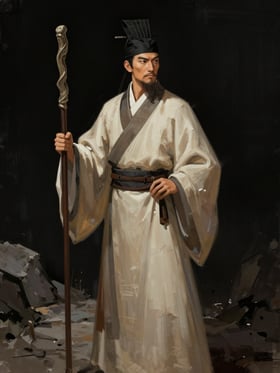
Bing Yuan, Cao Cao’s scholar famed for virtue and propriety and aiding Liu Zheng in Liaodong, is only the “belly” of the novel’s “One Dragon.”
Appearances
In the novel: 1 chapter · In the Records: 2 volumes
- Cao Wei· Undated
On the boards
Compare with someone →Where this person ranks on each board.
Historical Record
Bing Yuan, courtesy name Genju, was from Zhuxu, Beihai. In his youth, he and Guan Ning became known for their lofty conduct, and both declined all summonses from the provincial and county offices. After the Yellow Turban Rebellion broke out, he took his family and went by sea, settling in the mountains of Yuzhou; later, he traveled to Liaodong. Gongsun Du was wary of Liu Zheng, a fellow commandery native, and had his family hunted down. With nowhere else to turn, Liu Zheng sought refuge with Bing Yuan. Bing Yuan hid him for over a month, then entrusted him to Taishi Ci to take away. He also urged Gongsun Du: since Liu Zheng had already left the region, the threat was gone; it would be better to pardon his family and avoid incurring even deeper resentment. Gongsun Du therefore released Liu Zheng’s family, and Bing Yuan also provided them with funds to return to their home commandery. While in Liaodong, hundreds of households came to settle under his protection in the space of a year, and students continually came to study with him. This episode not only shows that he feared no powerful men, but also reflects his way of resolving disputes through persuasion and aiding those in distress.
Bing Yuan later returned to the Central Plains, where Cao Cao summoned him to serve as an aide in the Office of the Excellency of Works. His daughter had died young, and Cao Cao had also suffered the loss of his beloved son Cangshu. Cao Cao once proposed that the two be buried together, but Bing Yuan politely declined, saying that joint burial was contrary to ritual. He made clear that Cao Cao valued him precisely because he upheld ritual without wavering. Cao Cao accepted his refusal and instead appointed him as an Attendant in the Chancellor’s Office. Cui Yan praised Bing Yuan and Zhang Fan for their unblemished virtue and loyal, upright conduct, calling them treasures of the state. Later, Bing Yuan succeeded Liang Mao as Chief Clerk to the General of the Five Offices. He kept to himself behind closed doors and went out only on official business.
When Cao Cao campaigned against Wu, Bing Yuan accompanied the army and died on the way. The Additional Biography of Yuan, cited in Pei’s annotations, records other episodes from his early years: his studies, travels and teaching, and his flight from disorder in Liaodong. These details are among the materials preserved in the annotations. The biography also relates that at a banquet hosted by Cao Cao, Bing Yuan upheld the proper bond between father and son. When the Crown Prince asked whom one should save first if the ruler and one’s father both needed treatment, he answered frankly that one should save one’s father.
In the Novel
Chapter 66 of Romance of the Three Kingdoms mentions Bing Yuan, but gives him very little attention. It mainly introduces the epithet “One Dragon” through his association with Hua Xin and Guan Ning: Hua Xin was the dragon’s head, Bing Yuan its belly, and Guan Ning its tail. The novel does not explore Bing Yuan’s flight from disorder, his rescue of Liu Zheng, or his service under Cao Cao, nor does it depict any specific scenes between him and Cao Cao or Cao Pi. Thus, in the novel, Bing Yuan is more a member of a trio renowned for their reputations than a character with a story of his own. Compared with the historical biographies’ portrayal of him as renowned for his integrity, observance of ritual, and acts of rescue, the novel provides far less information about his character.
Key Relationships
Guan Ning: In their youth, Bing Yuan and Guan Ning were both renowned for their noble conduct. They later became close to Hua Xin and also traveled together to study; after the realm fell into chaos, Bing Yuan and Guan Ning went to Liaodong with others. The Records of the Three Kingdoms recounts their association and their flight from disorder together, but does not record the episode in the novel in which they cut their mat and ended their friendship after seeing gold while hoeing and hearing the carriage of a nobleman.
Liu Zheng: When Gongsun Du pursued Liu Zheng, Liu sought refuge with Bing Yuan. Bing Yuan sheltered him and arranged for him to leave, while also providing support for his family. When speaking with Gongsun Du, he appealed to considerations of advantage and the virtue of clemency to persuade him to release Liu Zheng’s family. This is one of the clearest examples in the historical biographies of Bing Yuan’s aid to others and his skill in resolving disputes.
Cao Cao and Cao Pi: Cao Cao summoned Bing Yuan to office, both respecting his character and accepting his remonstrance on ritual grounds against the proposal for joint burial. During Cao Cao’s campaigns, Bing Yuan once stayed behind with Zhang Fan to assist the Heir Apparent, Cao Pi. Cao Pi treated him with the rites due from a descendant to an elder, and the historical biographies also record that, when asked to distinguish between ruler and father, Bing Yuan insisted that one’s father came first.
Hua Xin: The Weilüe, cited in Pei’s annotations, says that Bing Yuan, Hua Xin, and Guan Ning were close, and that people of the time called them “One Dragon.” Romance of the Three Kingdoms adopts this epithet and casts Bing Yuan as the “dragon’s belly.”
Signature Scenes
Sheltering Liu Zheng and doing more than hide him: Liu Zheng sought protection with the words, “A desperate bird flies into one’s bosom.” The Wei Chunqiu, cited in Pei’s annotations, records Bing Yuan’s cautious response: he asked whether this bosom could receive him. Still, he hid Liu Zheng for over a month, then arranged for him to leave and went on to persuade Gongsun Du to release Liu Zheng’s family. The linked acts of sheltering him, seeing him off, and urging reconciliation make this more than a story of concealment; they also show Bing Yuan’s judgment of risk and resentment.
Refusing joint burial on grounds of ritual: Cao Cao proposed that Bing Yuan’s daughter, who had died young, be buried together with Cangshu. Bing Yuan did not agree out of deference to power or grief, but cited ritual and pointed out that Cao Cao respected him precisely because he upheld the classical teachings and did not change his principles lightly. Cao Cao ultimately dropped the proposal. This scene captures his image as a man who would not flatter the powerful and who stood by his principles.
Answering “My father” at the banquet: Cao Pi posed a question: if one’s ruler and father were both gravely ill and there were only one pill, whom should one save? The guests debated at length, while Bing Yuan initially said nothing. When asked, he answered plainly that one should save one’s father, and Cao Pi did not press him further. This scene appears in the Additional Biography of Yuan, cited in Pei’s annotations. It reflects the position on familial ethics found in the historical sources and is not a scene unique to the novel.
Cutting the mat and sitting apart: The story of Guan Ning and Hua Xin seeing gold and the carriage of a nobleman, and Guan Ning cutting the mat to end his friendship with Hua Xin as a result, belongs to the narrative of Romance of the Three Kingdoms. Bing Yuan is mentioned in this passage only as the dragon’s belly in the epithet “One Dragon”; he takes no part in the mat-cutting incident. (Unique to the novel)
Quotes
3 lines in the books · 2 featured
「君之畏政者,以其有智也。今政已免,智將用矣,尚奚拘政之家?不若赦之,無重怨。」
This line reveals Bing Yuan's wisdom and daring, persuading Gongsun Du to release Liu Zheng and thereby avoid making an enemy.
「合葬,非禮也。原之所以自容於明公,公之所以待原者,以能守訓典而不易也。若聽明公之命,則是凡庸也,明公焉以為哉?」
This line embodies Bing Yuan's character of holding fast to propriety and not drifting with the current, a manifestation of his core trait.
- Lord & vassal
- Friends
- Teacher & student
- Other
Who is Bing Yuan connected to?
Pick someone to see how many steps lie between them and Bing Yuan.
History vs. novel
6 points · 1 novel-only
| History | Novel |
|---|---|
| The Three Men’s FriendshipNovel embellishes | |
The historical records, citing the Weilüe, say that Hua Xin, Bing Yuan, and Guan Ning traveled together to study, were close friends, and were known as “one dragon.” Pei Songzhi also pointed out that Bing Yuan’s reputation was not necessarily inferior to Hua Xin’s, and Guan Ning did not necessarily deserve to be ranked last. vol. 11 | The novel retains the saying that the three men were “one dragon,” and further recounts how Guan Ning and Hua Xin associated with each other before eventually cutting their mat to end their friendship. ch. 66 |
| Cutting the Mat to End Their FriendshipNovel only | |
| — | The novel describes Guan Ning and Hua Xin hoeing a garden together and finding gold, then reading together and encountering a nobleman. Guan Ning despises Hua Xin for his reaction, and ultimately cuts his mat to end their friendship. ch. 66 |
| Taking Refuge in LiaodongHistory only | |
After the Yellow Turban uprising, Bing Yuan took his family to seek refuge on Yuzhou Mountain, then later went to Liaodong. There he lectured, and several hundred households sought refuge at his residence. vol. 11 | — |
| Rescuing Liu ZhengHistory only | |
When Liu Zheng was pursued by Gongsun Du, he sought refuge with Bing Yuan. Bing Yuan hid him for over a month, then entrusted Taishi Ci with escorting him away. He subsequently urged Gongsun Du to release Liu Zheng’s family and provided them with funds to return home. vol. 11 | — |
| Refusing a Joint BurialHistory only | |
Cao Cao wanted Bing Yuan’s daughter, who had died young, to be buried together with Cao Chong. Bing Yuan refused, arguing that a joint burial was contrary to ritual and that he should abide by the teachings of the classics. Cao Cao then dropped the matter. vol. 11 | — |
| Cao Cao Recruits Bing YuanHistory only | |
After Bing Yuan returned, Cao Cao appointed him as an assistant in the Ministry of Works. He was later reassigned as an administrative aide to the chancellor and also served as Chief Clerk to the General of the Household. vol. 11 | — |
- The Three Men’s FriendshipNovel embellishes
- History
The historical records, citing the Weilüe, say that Hua Xin, Bing Yuan, and Guan Ning traveled together to study, were close friends, and were known as “one dragon.” Pei Songzhi also pointed out that Bing Yuan’s reputation was not necessarily inferior to Hua Xin’s, and Guan Ning did not necessarily deserve to be ranked last.
vol. 11
- Novel
The novel retains the saying that the three men were “one dragon,” and further recounts how Guan Ning and Hua Xin associated with each other before eventually cutting their mat to end their friendship.
ch. 66
- Cutting the Mat to End Their FriendshipNovel only
- Novel
The novel describes Guan Ning and Hua Xin hoeing a garden together and finding gold, then reading together and encountering a nobleman. Guan Ning despises Hua Xin for his reaction, and ultimately cuts his mat to end their friendship.
ch. 66
- Taking Refuge in LiaodongHistory only
- History
After the Yellow Turban uprising, Bing Yuan took his family to seek refuge on Yuzhou Mountain, then later went to Liaodong. There he lectured, and several hundred households sought refuge at his residence.
vol. 11
- Rescuing Liu ZhengHistory only
- History
When Liu Zheng was pursued by Gongsun Du, he sought refuge with Bing Yuan. Bing Yuan hid him for over a month, then entrusted Taishi Ci with escorting him away. He subsequently urged Gongsun Du to release Liu Zheng’s family and provided them with funds to return home.
vol. 11
- Refusing a Joint BurialHistory only
- History
Cao Cao wanted Bing Yuan’s daughter, who had died young, to be buried together with Cao Chong. Bing Yuan refused, arguing that a joint burial was contrary to ritual and that he should abide by the teachings of the classics. Cao Cao then dropped the matter.
vol. 11
- Cao Cao Recruits Bing YuanHistory only
- History
After Bing Yuan returned, Cao Cao appointed him as an assistant in the Ministry of Works. He was later reassigned as an administrative aide to the chancellor and also served as Chief Clerk to the General of the Household.
vol. 11
Places
- Native of
- BeihaiRecords
- Was at
- Liaodong CommanderyRecords
Continue
Cao Cao
Lord
Relationship timeline5 entries ▸
History · vol. 11
- Guan Ning§46
Friend
Was renowned alongside Guan Ning for integrity and high principles from a young age; both traveled abroad to study
- Liu Zheng§46
Friend
from the same commandery, both possessed courage, resourcefulness, and a bold spirit; when Gongsun Du wanted to kill Zheng, Yuan hid him for more than a month, then entrusted Zheng to Taishi Ci
- Gongsun Du§47
Advised
Ju pleaded with Du to release Liu Zheng
- Cao Cao§48
Lord
Taizu appointed him as an Assistant in the Office of the Sikong; later, he declined the joint burial and was transferred to serve as a Consultant; he succeeded Liang Mao as Chief Clerk to the General of the Five Offices
- Liang Mao§48
Friend
Succeeded Liang Mao as Chief Clerk to the General of the Five Offices
Inner monologues · AI-generated1 monologue ▸
- In my youth, Guan Ning and I were both renowned for our integrity and lofty conduct. The provincial government repeatedl