Cao Wei · Chancellor of State
Hua Xin
courtesy name 子鱼 · 157–232
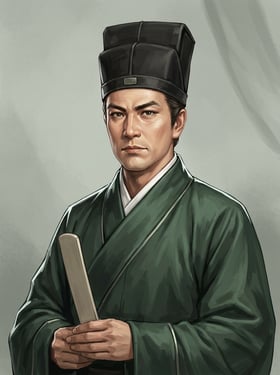
Hua Xin was frugal and sparing, meticulous and careful, and was praised by Chen Qun as "penetrating yet not overbearing, pure yet not aloof." But in the Romance he fawns upon Wei, drafting edicts to coerce Emperor Xian, sinister and calculating, single-mindedly bent on eliminating threats; he even personally seized Empress Fu by the hair and dragged her out, gripping his sword and pointing at the emperor, speaking in a harsh voice.

Life
In the novel: 10 chapters · In the Records: 12 volumes
Life157–232
200 CE (Jian'an 5)
208 CE (Jian'an 13)
- The Death of Hua TuoXuchangWitness
214 CE (Jian'an 19)
- Death of Empress FuXuchangWarrior
1 more event
220 CE (Huangchu 1)
220 CE (Huangchu 1)
- Cao Wei
- Sun Quan's Faction
- Hatched: dated by chapter
- Life event
List all 4 stops
- Pingyuan157Birthplace
- Xuchang200–214Hua Xin Leaves Wu and Enters Xu (Capital)+2 more
- Abdication Platform220Cao Pi Supplants the Han+1 more
- Ye220The Quatrain of Seven Steps
On the boards
Compare with someone →Where this person ranks on each board.
Who they were
Character profile
- Character
- Hua Xin was frugal and sparing, meticulous and careful, and was praised by Chen Qun as "penetrating yet not overbearing, pure yet not aloof." But in the Romance he fawns upon Wei, drafting edicts to coerce Emperor Xian, sinister and calculating, single-mindedly bent on eliminating threats; he even personally seized Empress Fu by the hair and dragged her out, gripping his sword and pointing at the emperor, speaking in a harsh voice.
- Manner of speech
- When urging the abdication, Hua Xin cited the affairs of Yu Shun and Tang Yao to gloss over the usurpation, and intimidated the sovereign with the peril of turmoil on all sides and the calamity of regicide.
- Life
- Hua Xin, a native of Gaotang in Pingyuan, styled Ziyu, was ranked together with Bing Yuan and Guan Ning as "the One Dragon," Xin being the dragon's head. He once served as Administrator of Yuzhang, governing with pure tranquillity, and was later recruited by Cao Cao, holding in turn the offices of Master of Writing, Master of Writing-in-Chief, and Grandee Secretary. After the founding of the state of Wei, he rose to Chancellor, Minister over the Masses, and Grand Commandant, and under Emperor Ming was advanced to Marquis of Boping. He died in the fifth year of Taihe, with the posthumous title Marquis Jing.
- Anecdotes
- Hua Xin was a senior minister of Cao Wei who once bore the imperial credentials to confer upon Cao Pi the seals of the Chancellor and the seal and sash of the King of Wei, and was the first to advocate the abdication, coercing Emperor Xian. He also invoked Cao Cao's words about Sima Yi's "hawk's gaze and wolf's glance," memorializing for Sima Yi's swift execution, and later memorializing to strip him of military power and send him back to the fields.
Historical Record
Hua Xin, courtesy name Ziyu, was a native of Gaotang in Pingyuan. In his youth he was already renowned for his lofty and pure conduct. He studied together with Bing Yuan and Guan Ning of Beihai; the three were close friends, and the men of the time called them "one dragon," with Hua Xin as the dragon's head. Pei Songzhi, however, held this characterization to be somewhat biased, considering that Guan Ning's lofty, transcendent virtue ought not to occupy the dragon's tail. Hua Xin was meticulous and prudent in his dealings, even-handed in discussing matters, and never slandered others. A fellow commander, Tao Qiuhong, considered his own perception superior to Hua Xin's; but in the affair of Wang Fen's plot to depose Emperor Ling, Hua Xin dissuaded Tao Qiuhong from taking part, predicting that Wang Fen would surely fail. When events turned out as he had said, Tao Qiuhong was convinced by Hua Xin.
Recommended as Filial and Incorrupt, Hua Xin was appointed a Gentleman of the Interior, but later left office on account of illness. After Emperor Ling's death, when He Jin held the regency, he summoned Hua Xin to be a Gentleman of the Imperial Secretariat. When Dong Zhuo moved the Son of Heaven to Chang'an, Hua Xin requested to be sent out as Prefect of Xiagui, but was unable to take up the post because of illness. He traveled from Lantian to Nanyang, where Yuan Shu detained him at Rang. Hua Xin once urged Yuan Shu to campaign against Dong Zhuo, but Yuan Shu would not adopt his advice. When Hua Xin then wished to depart, it happened that the Grand Tutor Ma Midi was pacifying the region east of the passes and recruited Hua Xin as an aide. Going east to Xu Province, he received an imperial edict appointing him Administrator of Yuzhang. In Yuzhang his governance was quiet and undisturbing, and he won the deep affection of officials and people.
When Sun Ce took Jiangdong, Hua Xin, foreseeing that Sun Ce was skilled in arms, welcomed him "in plain headcloth," and Sun Ce treated him with the courtesy due an honored guest. After Sun Ce's death, Cao Cao, at Guandu, memorialized the Son of Heaven to summon Hua Xin. Sun Quan at first did not wish to send him, but Hua Xin persuaded Sun Quan, pointing out that keeping him would bring no benefit, and that it was better to let him serve Sun Quan's interests at Cao Cao's side. Sun Quan, greatly pleased to hear this, then sent Hua Xin north. Before his departure, his guests presented gifts of several hundred pieces of gold; Hua Xin accepted them all but quietly marked each. At parting, he gathered all the gifts together and declared to the guests that, traveling far alone in a single carriage, "to carry a jade is to invite blame," and asked that the guests take back their gifts. All admired his virtue.
After reaching Cao Cao, Hua Xin was first appointed a Counsellor and took part in the military affairs of the Minister of Works; later he entered as Master of the Imperial Secretariat, was transferred to Palace Attendant, and succeeded Xun Yu as Prefect of the Imperial Secretariat. When Cao Cao campaigned against Sun Quan, he memorialized to make Hua Xin Army Adviser. After the founding of the state of Wei, Hua Xin served as Grandee Secretary. When Emperor Wen took the rank of king, he appointed Hua Xin Chancellor and enfeoffed him as Marquis of Anle District. After Emperor Wen ascended the throne, he transferred him to Minister over the Masses. Hua Xin had always been poor; most of the salary he received he used to relieve relatives and old friends, and his household held no surplus wealth. Emperor Wen once bestowed on the nobles the bondservants confiscated from condemned families, but Hua Xin alone married his off. Emperor Wen sighed at this and issued an edict specially bestowing imperial robes and having clothing made for Hua Xin's household, praising him as "an elder statesman of the realm."
In the fourth year of Huangchu, Emperor Wen issued an edict for the nobles to recommend men of singular conduct, and Hua Xin recommended Guan Ning. After Emperor Ming ascended the throne, Hua Xin was advanced to Marquis of Boping, his fief increased by five hundred households to a total of one thousand three hundred, and he was transferred to Grand Commandant. He once pleaded illness to retire, wishing to yield his place to Guan Ning, but Emperor Ming would not permit it. During the Taihe era, Hua Xin submitted a memorial remonstrating against Emperor Ming's campaign against Shu, pointing out that transporting grain a thousand li and penetrating deep across difficult terrain was no advantage in warfare, and that the levies had already affected agriculture and sericulture; he advised that the sovereign should first attend to the way of good governance and treat military campaigns as a secondary matter. Emperor Ming adopted his words and in the end issued an edict for Cao Zhen to withdraw his army.
In the Novel
In Romance of the Three Kingdoms, Hua Xin's portrayal is given a stronger cast of political opportunism and fawning on the powerful, diverging from the pure and lofty virtue of the histories. He first appears in the novel when Sun Quan wishes to send an envoy to Xu, and Gu Yong recommends Hua Xin, calling him a man Cao Cao admired. Receiving the commission, Hua Xin went to Ye Commandery to meet Cao Cao. Cao Cao adopted Cheng Yu's plan, granting offices to Zhou Yu and Cheng Pu, and appointed Hua Xin Chief of the Court of Judicial Review, keeping him at Xu in an important post. This differs in order from the histories, in which Hua Xin, after being summoned by Cao Cao, first held posts such as Counsellor and Master of the Imperial Secretariat, and only later rose to high offices such as Grandee Secretary and Chancellor.
The most controversial element of the novel's portrayal of Hua Xin is his conduct in the affair of Cao Cao's deposing of Empress Fu. Hua Xin led troops into the palace and personally hunted out Empress Fu, even "with his own hands seizing the empress by her hair-knot and dragging her out", harshly upbraiding her and ordering her to "go and plead with the Duke of Wei yourself." This episode greatly debases Hua Xin's refined image from the histories, depicting him as a cold and ruthless political henchman. The novel also uses this affair to recall the allusion of Hua Xin and Guan Ning "dividing the mat and sitting apart," implying that Hua Xin's character had degenerated through coveting wealth and rank, forming a sharp contrast with Guan Ning's loftiness and purity. Yet the historical account of the "dividing the mat" episode does not clearly attribute it to money or office, but emphasizes rather the difference in the two men's aspirations.
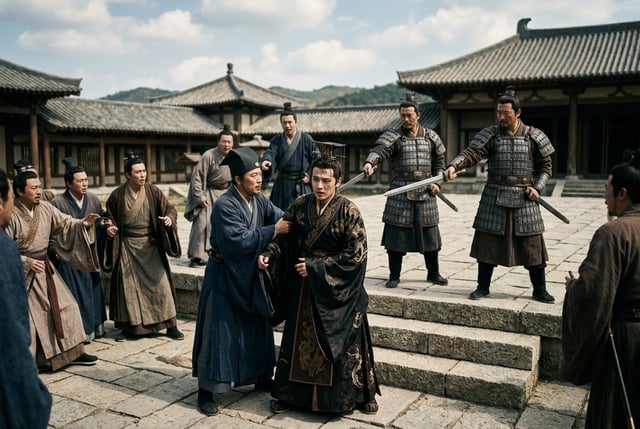
In the process of Cao Pi supplanting the Han and founding Wei, Hua Xin acted as an active mover. He advised Cao Pi that, if Cao Zhi were not removed early, he would surely become a future menace, and proposed testing him with his talent—if he could not compose a poem, he should be put to death. At the abdication ceremony, Hua Xin charged forward, joining Wang Lang and others in forcing Emperor Xian of Han to abdicate. He even "laid his hand on his sword, pointed at the emperor, and said in a stern voice: 'To set up one emperor and depose another is the constant way of antiquity!'", and advised Cao Pi to settle the Han's Liu family at Shanyang, forbidding them to come to court—further highlighting his loyalty to Cao Wei and his ruthlessness toward the Han house. Such episodes are not described in such detail or with such drama in the histories; they are largely the novel's artistic elaboration to establish the legitimacy of the Cao Wei regime and the tragic decline of the Han house.
Key Relationships
Cao Wei*: Hua Xin served the Cao Wei regime throughout his life; summoned in Cao Cao's time, he held a succession of important posts down to the reigns of Cao Pi and Cao Rui, rising to Grand Commandant and Chancellor. He was an important strategist and senior official in the founding and consolidation of Cao Wei.
Guan Ning*: Hua Xin and Guan Ning were fellow students and close friends, together called "one dragon." In the histories Hua Xin recommended Guan Ning to Emperor Wen as a man of singular conduct, and after Emperor Ming's accession even pleaded illness to retire, wishing to yield his place to Guan Ning—showing his esteem for Guan Ning's virtue. In the novel, however, the emphasis is on the allusion of the two "dividing the mat and sitting apart," implying that Hua Xin, coveting wealth and rank, parted ways with Guan Ning as men of different paths. (novel only).
Bing Yuan*: Hua Xin, together with Bing Yuan and Guan Ning, was called "one dragon," and the three were close friends. The histories record that Pei Songzhi held Bing Yuan's virtue to be no less than Hua Xin's.
Bao Xun*: Hua Xin, together with Zhong Yao, Chen Qun, and other nobles, submitted a memorial pleading for Bao Xun, but it was not granted by Cao Pi, and Bao Xun was in the end put to death.
Sun Quan*: While Hua Xin was Administrator of Yuzhang, Sun Quan wished to keep him, but Hua Xin persuaded Sun Quan to release him by appeal to the greater good, bringing about his return north to Cao Wei.
Cao Pi*: Hua Xin was an important mover in Cao Pi's supplanting of the Han and founding of Wei, playing a key role at the abdication ceremony.
Sima Yi*: In Cao Rui's time, Hua Xin, together with Wang Lang, memorialized suspecting that Sima Yi harbored rebellious intent, and advised dismissing him from his military command and sending him back to his fields. (novel only).
Iconic Scenes
Dissuading Tao Qiuhong from joining Wang Fen's plot to depose Emperor Ling*: With his wisdom and foresight, Hua Xin dissuaded Tao Qiuhong from taking part in Wang Fen's plot to depose and set up emperors, foreseeing that it would surely fail, and thus saving Tao Qiuhong from disaster, displaying his meticulous and prudent character.
Returning north alone, scattering all the gifted gold*: When Hua Xin left Sun Quan to return north to Cao Cao, he accepted in full the several hundred pieces of gold his guests presented and marked them, yet at parting returned them all, declaring that "to carry a jade is to invite blame." This act made all admire his conduct, reflecting his integrity and purity.
Recommending Guan Ning, pleading illness to yield his place*: In the fourth year of Huangchu, Hua Xin recommended Guan Ning as a man of singular conduct, and after Emperor Ming's accession even pleaded illness to retire, wishing to yield the office of Grand Commandant to Guan Ning. This reflected not only Hua Xin's recognition of Guan Ning's virtue but also his indifference to fame and gain.
Remonstrating against Cao Rui's campaign against Shu*: During the Taihe era, Hua Xin submitted a memorial remonstrating against Emperor Ming Cao Rui's campaign against Shu, pointing out that it exhausted the people and squandered wealth for no commensurate gain, and stressing that the people should be the foundation, governance first and campaigns after. This act displayed Hua Xin's deep foresight as chancellor and his sense of responsibility for the state.
Hunting out Empress Fu*: In Romance of the Three Kingdoms, Hua Xin personally led armed soldiers to hunt out Empress Fu, even "with his own hands seizing the empress by her hair-knot and dragging her out," and harshly upbraiding her. This scene greatly shaped his cold and ruthless image, becoming a major blemish on him in the novel. (novel only).
Forcing Emperor Xian of Han to abdicate*: At the abdication ceremony of Cao Pi's supplanting of the Han and founding of Wei, Hua Xin, together with Wang Lang and others, actively forced Emperor Xian of Han to abdicate, even "laying his hand on his sword, pointing at the emperor, and speaking in a stern voice." This scene is the concentrated expression of Hua Xin's political opportunism and fawning on the powerful in the novel. (novel only).
Quotes
30 lines in the books · 3 featured
「天下之人,皆知陛下無人君之福,以致四方大亂!若非魏王在朝,弒陛下者,何止一人?陛下尚不知恩報德,直欲令天下人共伐陛下耶?」
These words fully expose Hua Xin's shameless demeanor as he pressed Emperor Xian of Han into the Abdication of Emperor Xian of Han, emblematic of his character.
「立一帝,廢一帝,古之常道!今上仁慈,不忍加害,封汝為山陽公。今日便行,非宜召不許入朝!」
This line shows Hua Xin's hardline attitude toward Emperor Xian of Han, an epitome of his political stance and personality.
「司馬懿上表乞守雍、涼,正為此也。先時太祖武皇帝嘗謂臣曰:『司馬懿鷹視狼顧,不可付以兵權;久必為國家大禍。』今日反情已萌,可速誅之。」
These words reveal Cao Cao's wariness of Sima Yi, and also reflect Hua Xin's political foresight.
- Family
- Lord & vassal
- Friends
- Enemies
- Other
Who is Hua Xin connected to?
Pick someone to see how many steps lie between them and Hua Xin.
History vs. novel
7 points · 4 novel-only
| History | Novel |
|---|---|
| Yuzhang Welcomes Sun CeNovel embellishes | |
When Sun Ce was conquering Jiangdong, Hua Xin foresaw his skill in military affairs and welcomed him wearing a simple headcloth; Sun Ce treated him with the courtesy due a guest. vol. 13 | The novel does not depict Sun Ce personally conquering Yuzhang or Hua Xin welcoming him. Instead, it portrays Hua Xin as an envoy sent by Sun Quan to Xu. ch. 56 |
| Sun Quan Allows Hua Xin to Return NorthNovel embellishes | |
When Cao Cao summoned Hua Xin, Sun Quan initially wanted to keep him. Hua Xin urged Sun Quan to let him return north, and Sun Quan agreed. Guests presented him with gold, but Hua Xin returned it before his departure, earning everyone’s admiration. vol. 13 | The novel depicts Hua Xin as traveling to Xu on Sun Quan’s orders. Cao Cao adopted Cheng Yu’s plan and kept him at court, where he entrusted him with important responsibilities; it does not mention Sun Quan allowing him to leave or his returning the gifts of gold. ch. 56 |
| Search for Empress FuNovel only | |
| — | The novel depicts Hua Xin leading five hundred soldiers into the imperial harem, breaking through a wall to find Empress Fu, then grabbing her by the hair and dragging her out himself. ch. 66 |
| Breaking Ties by Cutting the MatNovel only | |
| — | The novel says that when Hua Xin picked up gold and abandoned his reading to watch a noble’s carriage pass, Guan Ning judged him to be covetous of wealth and status and cut their mat in two to end their friendship. The Records of the Three Kingdoms does not record this story. ch. 66 |
| Urging Cao Pi to Eliminate Cao ZhiNovel only | |
| — | The novel depicts Hua Xin urging Cao Pi to regard Cao Zhi as a future threat and proposing that he test him with The Quatrain of Seven Steps: if Cao Zhi could not compose a poem, he would be killed; if he could, he would be demoted. ch. 79 |
| Forcing Emperor Xian to AbdicateNovel embellishes | |
Official histories record that when Emperor Wen received the abdication, Hua Xin presided over the ceremony on the altar and presented him with the imperial seal and ribbons; they do not record him coercing Emperor Xian. vol. 13 | The novel depicts Hua Xin taking part in forcing Emperor Xian to abdicate, tugging at the emperor’s robe and demanding the jade seal. After Cao Pi took the throne, Hua Xin also ordered Emperor Xian at swordpoint to leave and forbade him from attending court without an edict. ch. 80 |
| Urging the Removal of Sima Yi’s Military AuthorityNovel only | |
| — | The novel depicts Hua Xin suspecting Sima Yi of plotting rebellion and urging Cao Rui not to entrust him with military authority. He also advocates stripping Sima Yi of his office and ordering him to return to the countryside. ch. 91 |
- Yuzhang Welcomes Sun CeNovel embellishes
- History
When Sun Ce was conquering Jiangdong, Hua Xin foresaw his skill in military affairs and welcomed him wearing a simple headcloth; Sun Ce treated him with the courtesy due a guest.
vol. 13
- Novel
The novel does not depict Sun Ce personally conquering Yuzhang or Hua Xin welcoming him. Instead, it portrays Hua Xin as an envoy sent by Sun Quan to Xu.
ch. 56
- Sun Quan Allows Hua Xin to Return NorthNovel embellishes
- History
When Cao Cao summoned Hua Xin, Sun Quan initially wanted to keep him. Hua Xin urged Sun Quan to let him return north, and Sun Quan agreed. Guests presented him with gold, but Hua Xin returned it before his departure, earning everyone’s admiration.
vol. 13
- Novel
The novel depicts Hua Xin as traveling to Xu on Sun Quan’s orders. Cao Cao adopted Cheng Yu’s plan and kept him at court, where he entrusted him with important responsibilities; it does not mention Sun Quan allowing him to leave or his returning the gifts of gold.
ch. 56
- Search for Empress FuNovel only
- Novel
The novel depicts Hua Xin leading five hundred soldiers into the imperial harem, breaking through a wall to find Empress Fu, then grabbing her by the hair and dragging her out himself.
ch. 66
- Breaking Ties by Cutting the MatNovel only
- Novel
The novel says that when Hua Xin picked up gold and abandoned his reading to watch a noble’s carriage pass, Guan Ning judged him to be covetous of wealth and status and cut their mat in two to end their friendship. The Records of the Three Kingdoms does not record this story.
ch. 66
- Urging Cao Pi to Eliminate Cao ZhiNovel only
- Novel
The novel depicts Hua Xin urging Cao Pi to regard Cao Zhi as a future threat and proposing that he test him with The Quatrain of Seven Steps: if Cao Zhi could not compose a poem, he would be killed; if he could, he would be demoted.
ch. 79
- Forcing Emperor Xian to AbdicateNovel embellishes
- History
Official histories record that when Emperor Wen received the abdication, Hua Xin presided over the ceremony on the altar and presented him with the imperial seal and ribbons; they do not record him coercing Emperor Xian.
vol. 13
- Novel
The novel depicts Hua Xin taking part in forcing Emperor Xian to abdicate, tugging at the emperor’s robe and demanding the jade seal. After Cao Pi took the throne, Hua Xin also ordered Emperor Xian at swordpoint to leave and forbade him from attending court without an edict.
ch. 80
Combat
On the field
Duels, kills and executions as the texts tell them, counted separately for the Records and the Romance.
Stratagems
Plans this person devised or saw through, as the texts tell them.
- Romance
- 1 carried out · 1 worked · 0 turned down · 0 seen through
- RomanceSeven-Pace Test of TalentOtherWorkedCh. 79「若不能,即殺之;若果能,則貶之」
Events
Events (13)
Battles and events the texts place this person in, by date.
Other events
- 195Sun Ce's Pacification of Jiangdong
- 200Hua Xin Leaves Wu and Enters Xu (Capital)Instigator
- 208Liu Bei's Seizure of the Four Southern Jing Commanderies
- 208The Death of Hua TuoWitness
- 210Bronze Bird Terrace Inauguration Ceremony
- 214Death of Empress FuWarrior
- 220The Quatrain of Seven StepsAdvisor
- 220Cao Pi Supplants the HanAdvisor
All 10
Places
Continue
Abdication of Emperor Xian of Han
Relationship timeline18 entries ▸
History · vol. 11
- Guan Ning§59
Advised
In the fourth year of Huangchu, Minister over the Masses Hua Xin recommended Ning; when Emperor Ming ascended the throne, Hua Xin yielded his position to Ning
History · vol. 12
- Bao Xun§66
Witnessed
Memorialized a request that Bao Xun be punished
History · vol. 13
- Bing Yuan§16
Friend
traveled and studied together with Bing Yuan and Guan Ning of Beihai; people of the time called them “one dragon”
- Guan Ning§16
Friend
Traveled to study with Bing Yuan and Guan Ning; later recommended him as a solitary man of exemplary virtue
- Sun Ce§16
Friend
Welcomed him wearing a simple headcloth; Sun Ce regarded him as an elder and treated him with the honors due an honored guest
- Sun Quan§16
Friend
Taizu memorialized for Zheng to be summoned to Xu; Sun Quan wished not to send him, but Xin persuaded Quan, who then sent him
- Yuan Shu§16
Advised
Yuan Shu detained Xin at Rang; Xin urged Shu to send troops to attack Zhuo, but Shu could not make use of him
- Wang Fen§16
Rival
Wang Fen secretly summoned Hua Xin to jointly plan the deposition and enthronement; Xin refused
- Taoqiu Hong§16
Friend
from the same commandery; Hong considered himself more perceptive than Xin; Xin stopped him from joining Wang Fen’s plot
- Ma Midi§16
Lord
Ma Midi pacified and settled the east of the passes, and appointed Xin as an assistant.
- Xun Yu§17
Friend
Succeeded Xun Yu as Director of the Secretariat
All 18
Loading…
Inner monologues · AI-generated3 monologues ▸
- By this late stage of my life, my body is frail with illness, and each day feels borrowed. I often reflect that, though
- I am Hua Xin, courtesy name Ziyu. At this moment, serving among the court officials, I see that this is no simple matter
- My name is Hua Xin, and my courtesy name is Ziyu. Whenever I think of my early years, events in my native Pingyuan seem