Overview
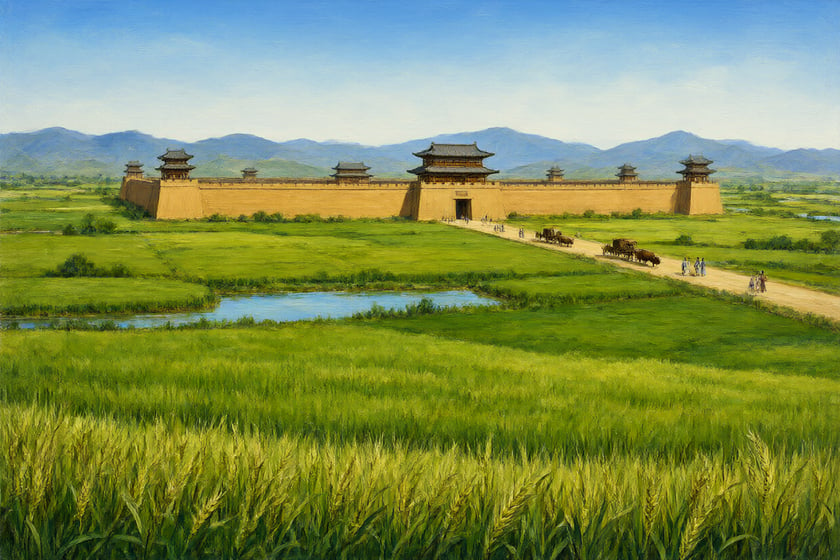
Nanyang Commandery was a commandery in the northern part of Jing Province during the Eastern Han dynasty, with its seat at Wan. Its territory roughly corresponded to the Nanyang Basin in what is now southwestern Henan Province and a corner of northern Hubei Province. The commandery seat stood in present-day Nanyang City. Nanyang had a population of as many as several million households and people. Among the warlords of the late Han, Yuan Shu and Zhang Xiu each used it in turn as a base. Cao Cao, Liu Biao, and Guan Yu also fought repeatedly over the area. Before entering public service, Zhuge Liang said that he had “worked the fields in Nanyang”.
History
During Emperor Ling’s reign, Liu Yan once served as Administrator of Nanyang. In the first year of Chuping (190), when forces from east of the passes rose to campaign against Dong Zhuo, Yuan Shu stationed his forces in Nanyang. Sun Jian, the Administrator of Changsha, advanced north to Nanyang with tens of thousands of troops. Zhang Zi, the Nanyang Administrator, refused to provide them with provisions. After hosting a banquet, Sun Jian had him executed at the army gate, terrifying the commandery. Yuan Shu then seized control of Nanyang, indulging in extravagance and excess and imposing harsh levies, to the people’s misery. When Liu Biao first arrived in Jing Province, Yuan Shu “had all the people of Nanyang under his command”. In the fourth year of Chuping (193), Yuan Shu advanced north to Chenliu, where Cao Cao and Yuan Shao joined forces to defeat him decisively. He fled to Jiujiang with the remnants of his troops.
Later, Zhang Ji entered Nanyang from the Guanzhong region. During a famine, he resorted to plundering and was killed by people from Rang County. His nephew Zhang Xiu took over his troops and stationed them in Nanyang. Jia Xu also came to join him and urged Zhang Xiu to make an alliance with Liu Biao. In the second year of Jian’an (197), after Cao Cao campaigned south against Zhang Xiu and then returned north from Wuyin, several counties in Nanyang and Zhangling rebelled and again submitted to Zhang Xiu. Cao Cao sent Cao Hong to attack them, but the campaign ended in defeat. That winter, Cao Cao personally led an expedition to Wan. Later, while Cao Cao and Yuan Shao were locked in a standoff at Guandu, Zhang Xiu followed Jia Xu’s advice and led his forces in submission to Cao Cao.
After Nanyang came under Cao Cao’s control, Yang Jun became its Administrator. He promoted moral instruction and established schools, earning the praise of officials and commoners alike. Burdened by corvée labor, the people of the commandery rose in revolt: Hou Yin seized the Administrator, Dongli Bao, and allied with Guan Yu. In the first month of the twenty-fourth year of Jian’an (219), Cao Ren sacked Wan and executed Hou Yin. That same year, Guan Yu besieged Xiangyang in the north, and Cao Cao personally sent troops to Nanyang to provide aid. The newly appointed Administrator, Tian Yu, released more than five hundred followers of Hou Yin. The bandits promptly disbanded, and peace returned to the commandery. In the first year of Yankang (220), five thousand households from five counties, including Yin County in Nanyang, submitted to Sun Quan. After Cao Pi became emperor, Yang Jun again served as Nanyang Administrator. Wang Guan also held the post.
People
- Born in Nanyang: He Jin, the Grand General, was from Nanyang and was Empress Dowager He’s half-brother. The renowned scholar He Yong once said that Xun Yu possessed “the talent to assist a king”. Xu You once plotted with Wang Fen to depose Emperor Ling. Many people from Nanyang joined Liu Bei: Huang Zhong killed Xiahou Yuan at Mount Dingjun; Li Yan served Liu Biao and then Liu Zhang before surrendering to Liu Bei; and Chen Zhen, Lü Yi, Wang Lian, Xu Ci, Zong Yu, Du Qi, and Huang Zhu all later held office in Shu. Those who served Wei included Liu Yi, Han Ji, Zhou Tai, and He Yan, a close associate of Cao Shuang. Lady Wang, the birth mother of Sun Xiu, was also from Nanyang. According to the Wu Shu, Gan Ning was originally from Nanyang, though his family had lived as guests in Ba Commandery for generations.
- Sojourners: After Dong Zhuo moved the capital, Hua Xin fled to Nanyang to escape the turmoil, but Yuan Shu, who was stationed in Rang County, detained him. Wang Xiu traveled to Nanyang as a young man to pursue his studies. After Shen Dan of Shangyong surrendered to Wei, he was resettled in Nanyang.
Differences in Historical and Literary Accounts
Both works record that Zhuge Liang worked the fields in Nanyang. In Romance of the Three Kingdoms, Xu Shu says that Zhuge Liang lived at a place called Wolong Ridge, and that he therefore called himself “Master Wolong”. In the Biography of Zhuge Liang in the Records of the Three Kingdoms, Xu Shu also calls Zhuge Liang “Wolong,” but makes no mention of Wolong Ridge. Pei Songzhi’s commentary cites the Han-Jin Chunqiu, which says that Zhuge Liang’s home was in Deng County, Nanyang, twenty li west of Xiangyang city, at a place known as Longzhong.
Today
The seat of Nanyang Commandery, Wan, is in present-day Nanyang City, Henan Province. West of the city stands the Wuhou Shrine at Wolong Hill, a historic site commemorating the place where Zhuge Liang worked the fields. Ancient Longzhong in Xiangyang, Hubei, also claims to be the place where Zhuge Liang worked the fields, and the dispute between the two locations has a long history.