Overview
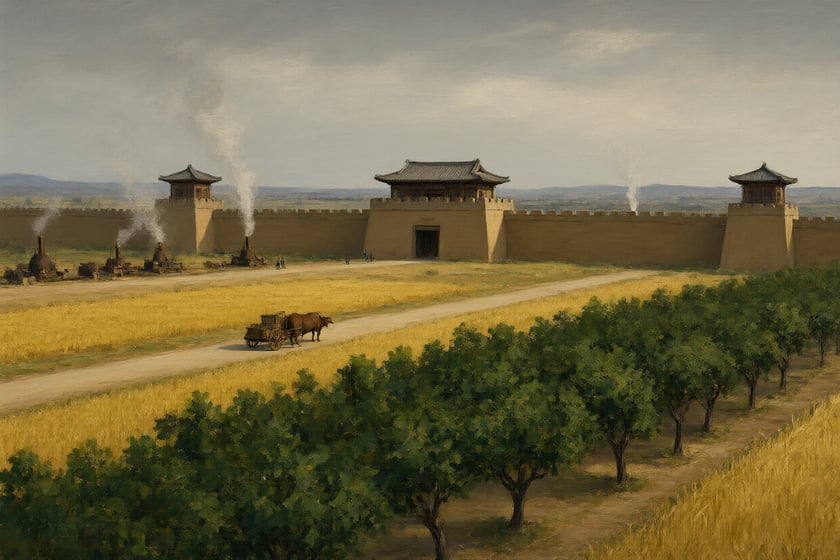
Wan, also known as Wancheng or Wan County, was the seat of Nanyang Commandery in Jing Province during the Eastern Han. Its site lies in present-day Wancheng District, Nanyang, Henan Province, and the Nanyang Administrator was stationed there. Located on a key route south from the Central Plains toward Jing and Xiang, Wan was first occupied by the Yellow Turban Army in the late Han, then garrisoned by Zhang Xiu. Cao Cao suffered one of his most famous defeats there. After Wei was founded, it served for a long time as a base from which the court managed affairs in Jing and Yu Provinces.
History
In the first year of Zhongping (184), the Yellow Turban Army in the Runan and Yingchuan region, pressed by government forces, retreated to Wancheng and held it. Zhu Jun led troops to attack the city, and Sun Jian personally took charge of one sector, scaling the walls first. The rest of the army followed, and the Yellow Turban forces were decisively defeated.
Zhang Ji was killed by a stray arrow while attacking Rang. His kinsman Zhang Xiu took command of his troops and garrisoned Wancheng, joining forces with Liu Biao of Jing Province. In the first month of spring in the second year of Jian’an (197), Cao Cao arrived at Wan. Zhang Xiu surrendered with all his forces, but soon changed his mind and attacked Cao Cao’s camp. Cao Cao was defeated and hit by a stray arrow; his eldest son, Cao Ang, and his nephew, Cao Anmin, were killed. Pei Songzhi’s commentary, citing the Shiyu, says that Cao Ang gave his horse to Cao Cao, allowing him to escape. Dian Wei fought to the death at the camp gate, sustaining dozens of wounds before he died. Cao Cao withdrew to Wuyin, while Zhang Xiu fled to Rang County and joined Liu Biao. In the eleventh month of that winter, Cao Cao again campaigned south and reached Wan. Pei Songzhi’s commentary, citing the Book of Wei, says that by the Yu River he offered sacrifices to the fallen soldiers, weeping and shedding tears.
In the tenth month of winter in the twenty-third year of Jian’an (218), Hou Yin, the defending commander at Wancheng, took the Nanyang Administrator Dongli Bao hostage because the people of Nanyang were suffering under corvée labor. He rebelled with officials and commoners and made contact with Guan Yu. Later, after being persuaded by Zong Ziqing, a meritorious officer of Nanyang, he released the administrator. Cao Cao ordered Cao Ren, stationed at Fancheng, to turn back and surround Wan. The city fell in the first month of the following year; Cao Ren massacred its inhabitants and, together with Pang De, killed Hou Yin and Wei Kai.
After Cao Pi took the throne as King of Wei, he summoned Cao Ren back to garrison Wancheng. In the third year of Huangchu (222), Wei forces launched the Three-Pronged Campaign against Wu. While Cao Zhen and others besieged Jiangling, Cao Pi personally went to Wancheng in the eleventh month to take command and provide support. On this same visit to Wan, Cao Pi flew into a rage at the city’s sluggish market and had Yang Jun, the Nanyang Administrator, arrested. Yang Jun took his own life. Pei Songzhi’s commentary, citing the Weilüe, says this was because the magistrate of Wan County had misunderstood the imperial decree and closed the market gates. In the first month of the fourth year of Huangchu (223), Cao Pi had a terrace built at Wancheng for his southern tour; in the third month, he returned from Wan to Luoyang.
Thereafter, Sima Yi served as commander overseeing Jing and Yu Provinces and garrisoned Wancheng. From there, he led troops to attack Meng Da. During the Zhengshi era, Wang Chang, appointed General Who Conquers the South and commander of military affairs in Jing and Yu Provinces, judged that Wancheng lay more than three hundred li from Xiangyang and that aid would be difficult to provide in an emergency. He submitted a memorial proposing that the command headquarters be moved to Xinye.
Figures
- Wen Ping: A native of Wan, he was originally a senior general under Liu Biao. After Jing Province surrendered to Cao Cao, he became Administrator of Jiangxia and guarded the border region adjoining Eastern Wu.
- Xie Jing: A native of Wan, he governed the commandery with distinction. Officials and commoners called him a good administrator, second only to Gu Shao.
- Dian Wei: Cao Cao’s personal champion, he died fighting during the Wancheng incident. Cao Cao sent men to recover his body, mourned him in person, and had him buried at Xiangyi.
- Yang Jun: The Nanyang Administrator, he was renowned for recognizing and promoting talent. When Cao Cao considered naming an heir, Yang Jun praised Cao Zhi, earning Cao Pi’s lasting resentment. He was later arrested and died at Wan, and people of the time all lamented that he had been wronged.
Differences Between Historical Record and Fiction
The Records of the Three Kingdoms states that the Yellow Turban forces retreated to Wancheng and were defeated by Zhu Jun and Sun Jian. The Romance of the Three Kingdoms, by contrast, says that the city was held by remnants of the Yellow Turban forces led by Zhao Hong, Han Zhong, and Sun Zhong. It also places Liu Bei, Guan Yu, and Zhang Fei among the besieging forces, and has Liu Bei propose lifting the siege on the eastern and southern sides to lure Han Zhong out of the city.
After the defeat at Wancheng, the novel depicts Cao Cao holding a memorial service and saying, “The loss of my eldest son and beloved nephew does not grieve me deeply; it is Dian Wei alone whom I mourn with cries and tears”. The following year, while marching past the Yu River, he first sacrifices to Dian Wei, then to Cao Anmin and Cao Ang. The Records of the Three Kingdoms only says that Cao Cao shed tears upon hearing of Dian Wei’s death and went in person to mourn him, and that he offered sacrifices to the fallen soldiers by the Yu River.
The novel also depicts Sima Yi living in seclusion at Wancheng after being dismissed from office, then, upon his reinstatement, assembling the troops there to attack Meng Da. The account cited in Pei Songzhi’s commentary to the Records of the Three Kingdoms, from the Shiyu, instead says that Sima Yi attacked Meng Da while garrisoning Wancheng.
Today
The site of ancient Wan is in present-day Wancheng District, Nanyang, Henan Province. The district’s name derives from the ancient name Wancheng.