Overview
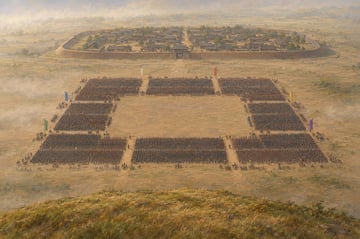
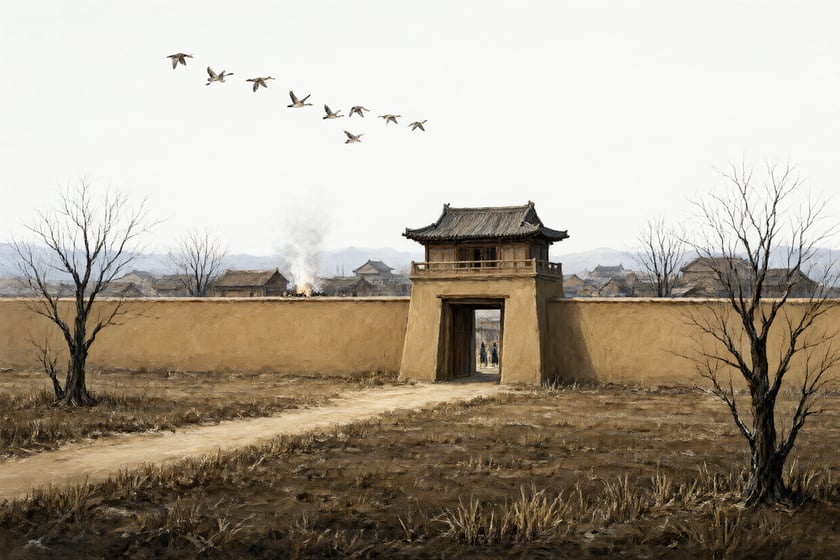
Xinye was a county under Nanyang Commandery in Jing Province during the Eastern Han, located in present-day Xinye County, Nanyang City, Henan Province. The Records of the Three Kingdoms calls Lai Min and Deng Zhi “men of Xinye in Yiyang,” indicating that the county was later reassigned to Yiyang Commandery. While under Liu Biao’s protection, Liu Bei was stationed here. The events that led to The Three Visits (to the Thatched Cottage)—Xu Shu recommending Zhuge Liang—took place while Liu Bei was based in Xinye. After the area came under Wei, Xinye also became the seat of the regional command overseeing Jing and Yu provinces.
History
After Cao Cao defeated Yuan Shao, he personally led a southern campaign against Liu Bei. Liu Bei sent Mi Zhu and Sun Qian to establish contact with Liu Biao; Liu Biao went out to the outskirts to welcome them, treated Liu Bei with the honors due a distinguished guest, assigned him additional troops, and had him garrison Xinye. More and more local men of influence in Jing Province rallied to Liu Bei, prompting Liu Biao to grow suspicious and secretly take precautions against him. On one occasion, at Liu Biao’s command, Liu Bei defended Bowang against Xiahou Dun and Yu Jin. He burned his own camp to feign a retreat, then used an ambush to defeat the pursuing forces. While stationed in Xinye, Xu Shu came to see Liu Bei, praised Zhuge Liang as a “Sleeping Dragon,” and urged Liu Bei to visit him in person. Liu Bei made three visits before finally meeting him.
In the eighth month of Jian’an 13 (208), Liu Biao died. Liu Bei had already moved his camp to Fancheng. In the ninth month, Cao Cao’s main force arrived at Xinye; Liu Cong surrendered the whole province, and Liu Bei fled south to Xiakou. Xinye then passed into the hands of the Cao clan.
After Cao Pi took the throne as King of Wei, Man Chong was appointed General Who Subdues the Waves for his distinguished service in the campaign against Wu at Jiangling, and was stationed at Xinye. During the Zhengshi era, Wang Chang, General Who Conquers the South and commander of military affairs in Jing and Yu, judged that the former base at Wancheng lay more than 300 li from Xiangyang, making it difficult to send aid in an emergency. He submitted a memorial proposing that the headquarters be moved to Xinye. There he trained a naval force and greatly expanded military farming, filling the granaries with grain.
Figures
- Lai Min: A native of Xinye and son of Lai Yan, an official who served as Grand Commandant under the Eastern Han. At the end of the Han, he fled the turmoil in Jing Province with his elder sister and her husband, Huang Wan. He later followed his sister to Shu, where he became a guest of Liu Zhang. An expert on the Zuo Tradition and textual interpretation, he held posts in Shu Han including Commandant of the Palace Library and Household Officer to the Heir Apparent. He was repeatedly demoted for careless remarks and died at the age of 97.
- Deng Zhi: A native of Xinye and descendant of Deng Yu, an official who served as Minister over the Masses in the Eastern Han. He entered Shu at the end of the Han. After Liu Bei secured Yi Province, he was promoted from Director of the Pi Post Station to Magistrate of Pi, and later served as Administrator of Guanghan and Palace Attendant.
- Man Chong: A Wei general who urged Cao Ren to hold out and await reinforcements when Guan Yu besieged Fancheng. After being stationed at Xinye, he joined the southern campaign and saw through Wu’s nighttime fire attack at Jing Lake, launching a counterattack that routed the enemy.
Differences in Historical and Literary Accounts
In Romance of the Three Kingdoms, Liu Biao says that Xinye is a “dependent town of Xiangyang,” well supplied with money and grain, and sends Liu Bei there to be stationed. In reality, Xinye belonged to Nanyang Commandery during the Han. The novel also says that in the spring of Jian’an 12 (207), Lady Gan gave birth to Liu Shan at the Xinye county office, while a white crane called from the roof at night. The Biography of Empress Gan in the Records of the Three Kingdoms says only that Lady Gan gave birth to the later ruler while accompanying Liu Bei in Jing Province.
In the novel, Xu Shu, using the alias Shan Fu (the Pei Songzhi annotation quotes the Weilüe as saying that Xu Shu’s original name was Fu), assists Liu Bei and sees through the Eight Gates Golden Lock Formation laid by Cao Ren outside Xinye. As Xu Shu departs, he turns back on horseback to recommend Zhuge Liang. The Records of the Three Kingdoms merely records that Xu Shu recommended Zhuge Liang to Liu Bei at Xinye; it does not mention the formation being broken.
The novel’s most famous Xinye episode is the “Burning of Xinye”: Liu Bei abandons the town and leads the people away, while Cao Ren and Cao Hong enter the empty town and rest their horses; that night, flames break out in the town. The Records of the Three Kingdoms does not record this episode. In the book, Liu Bei uses fire to defeat the enemy at Bowang, where he burns his own camp.
Today
The former site of Xinye is present-day Xinye County, Nanyang City, Henan Province, and the county name remains in use today.