


Strategic Background
Viewed from the perspective of military history, this battle, which appears only in Chapter 36 of Romance of the Three Kingdoms, must be understood within the broader context of “Liu Bei residing under Liu Biao in Jing Province and seeking strategic initiative.” Since the sixth year of Jian’an (201), Liu Bei had been stationed at Xinye under Liu Biao’s protection. In name, he served as a northern shield for Liu Biao; in reality, his position was deeply awkward: his forces were limited, his territory small, and he was constantly under threat from Cao Wei’s Nanyang–Fancheng defensive line. Although Liu Bei won a minor victory over Xiahou Dun at Bowang Slope, it immediately drew a reprisal from Cao’s forces—Cao Ren’s night crossing of the river to raze Xinye was a continuation of that pressure. The novel introduces Xu Shu (using the alias Shan Fu) at this critical juncture to set the stage for Zhuge Liang’s subsequent emergence: only by first showing the difference between Liu Bei’s camp “with a military adviser” and “without one” can the novel’s later narrative framework—that “with one of Wolong and Fengchu, one can bring peace to the realm”—hold together.
Deployment of the Opposing Forces
On Cao’s side, Cao Ren personally led the main force, with Li Dian as his deputy, crossing south over the river from north of Fancheng. To demonstrate his threat, the novel records that he “crossed the river by night, intending to raze Xinye”. Although the number of Cao Ren’s troops is not specified, as Cao Cao’s northern vanguard in the campaign to pacify Jing Province, he must have had at least several thousand elite soldiers. His formation was the so-called “Eight-Gate Golden Lock Formation,” a battle array organized around the eight gates of Rest, Life, Injury, Obstruction, Scenery, Death, Alarm, and Opening. It should be noted that the Records of the Three Kingdoms contains no account of this formation being used in battle. The “Eight Gates” are closer to a composite of military treatise lore, geomantic directions, and fictional invention. The novel uses the formation to portray Xu Shu as a wise man who can “read formations.” Liu Bei’s forces were far weaker and depended on Xu Shu’s command in the field. Zhao Yun was appointed as the principal commander to lead elite cavalry in a charge through the formation, while Guan Yu and Zhang Fei provided support on the flanks.
Key Decision Points
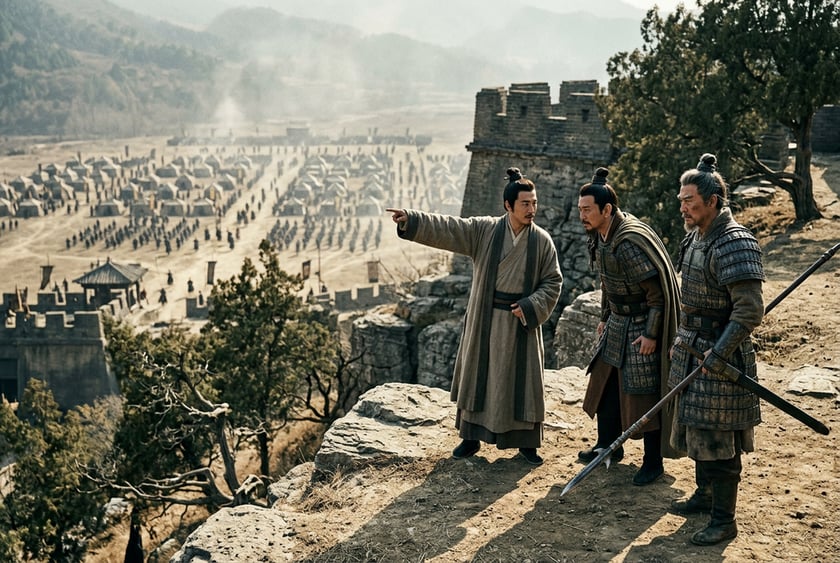
The first decision point came after Xu Shu climbed to a high vantage point to inspect the formation and concluded, “Though the Eight Gates are laid out neatly, there is no one directing the center.” He observed that while the formation looked convincing, its central command was inadequate and could be exploited. Whether this assessment was sound is beside the point; what matters is that the novel uses it to establish a core narrative pattern: a wise man can determine victory or defeat simply by “reading the formation.” The second decision point was Xu Shu’s choice of a diagonal route through the formation, entering by the Gate of Life in the southeast and breaking out through the Gate of Scenery in the west, while avoiding the “unfavorable gates” of Injury, Alarm, and Death. The third decision point came before Cao Ren’s nighttime raid on the camp. Li Dian warned him, “Liu Bei must be prepared,” but Cao Ren rejected the advice, saying, “If we are this suspicious, how can we wage war?”. This is a typical Romance of the Three Kingdoms episode of “a headstrong commander and a clear-sighted deputy,” providing a plausible reason for Cao’s defeat.
Outcome and Aftermath
Cao Ren was defeated in the initial battle and again in his nighttime raid on the camp, forcing him to retreat to Fancheng to regroup. In the chain of the novel’s plot, the significance of this victory far exceeds that of the battle itself: it gives Liu Bei his first confidence in the possibility of “waging war through wisdom.” Then, through Cao Ren’s subsequent inquiries into Xu Shu’s identity, the story introduces Cao Cao and Cheng Yu’s scheme to lure Xu Shu’s mother to Xu. Xu Shu eventually heads north for his mother’s sake and recommends Zhuge Liang before departing, thereby setting in motion the story of “Xu Shu Recommends Zhuge Liang.” In other words, the defeat of the Eight-Gate Golden Lock Formation serves as a narrative prelude to “Zhuge Liang’s emergence” and clears the way for the characters in the later Three Visits (to the Thatched Cottage). From the standpoint of military realism, however, this battle has no corresponding account in the Records of the Three Kingdoms biography of the Former Lord or related biographies, and should be regarded as a novelist’s invention.
Counterfactual Analysis
If this battle is treated as entirely fictional, the counterfactual becomes a question of narrative: if the novel did not have Xu Shu demonstrate his military talent during the Xinye period, the dramatic tension surrounding Zhuge Liang’s emergence would be greatly diminished. Readers would not feel the sense of an equivalent exchange in “losing Xu Shu and gaining Zhuge Liang.” In other words, the narrative function of defeating the Eight-Gate Golden Lock Formation is irreplaceable. If, instead, the episode is seen as a fictionalized account with a historical core—such as a small-scale southern advance by Cao’s forces in the Bowang–Xinye direction that met with a setback—the real counterfactual is this: suppose Cao Ren had not been defeated in this southern advance and had taken Xinye directly. Liu Bei would likely have been forced to retreat south earlier and seek refuge with Liu Qi or Liu Biao, throwing the entire timetable for his meeting with Zhuge Liang into disarray and delaying the strategic consolidation before Chibi. From this perspective, the fictional battle in the novel fills the narrative gap of the “strategic breathing space” most missing from Liu Bei’s journey between Xinye and Chibi.