Records
Cao forces won
Vol. 32「先主棄妻子,與諸葛亮、張飛、趙雲等數十騎走,曹公大獲其人眾輜重」
208 CE (Jian'an 13) · Changban
In the autumn of 208 (the thirteenth year of Jian'an), Cao Cao pacified Jingzhou after Liu Cong surrendered the entire province, and Liu Bei began withdrawing southward from Fancheng intending to hold Jiangling with its stores of military supplies. Fearing that Liu Bei would seize Jiangling's provisions and arms, Cao Cao "abandoned his baggage train and marched light to Xiangyang," and on learning that Liu Bei had already passed, immediately dispatched five thousand elite cavalry who covered over three hundred li in a single day and night in pursuit, catching up with Liu Bei at Dangyangchangban. Liu Bei abandoned his wives, children, and baggage and fled obliquely toward Hanjin with Zhuge Liang, Zhang Fei, Zhao Yun, and a few dozen riders; Lady Gan Furen and the infant Adou escaped only because Zhao Yun personally escorted them to safety. Zhang Fei, under Liu Bei's orders, led twenty horsemen to cover the rear; planting himself at the bridge at Changban, he tore up the planking, glared across the water with spear leveled, and bellowed "I am Zhang Yide — come forward and fight to the death!," and none in Cao's army dared advance. When Cao's forces pressed on, the troops of Wen Pin and Cao Chun swept through Changban, capturing a large quantity of people and supplies. Liu Bei linked up with Guan Yu's naval force at Hanjin, crossed the Mian River, and combined with Liu Biao's eldest son Liu Qi to advance to Xiakou. This engagement drove home the urgency of a Sun-Liu alliance and set the stage for the decisive Battle of Chibi later that same year.
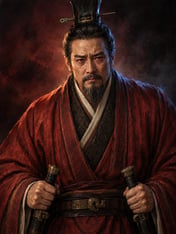 Liu BeiLivedCommanderTalk to me
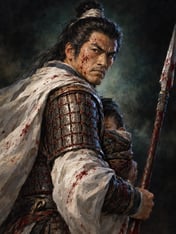 Zhao YunLivedWarriorTalk to me
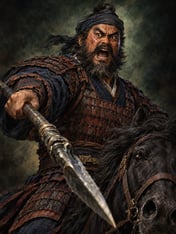 Zhang FeiWarriorTalk to me
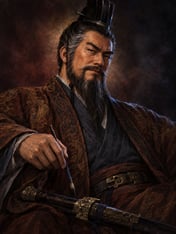 Cao CaoLivedCommanderTalk to me
Who won, as each book tells it; commanders as the text names them.
Scene
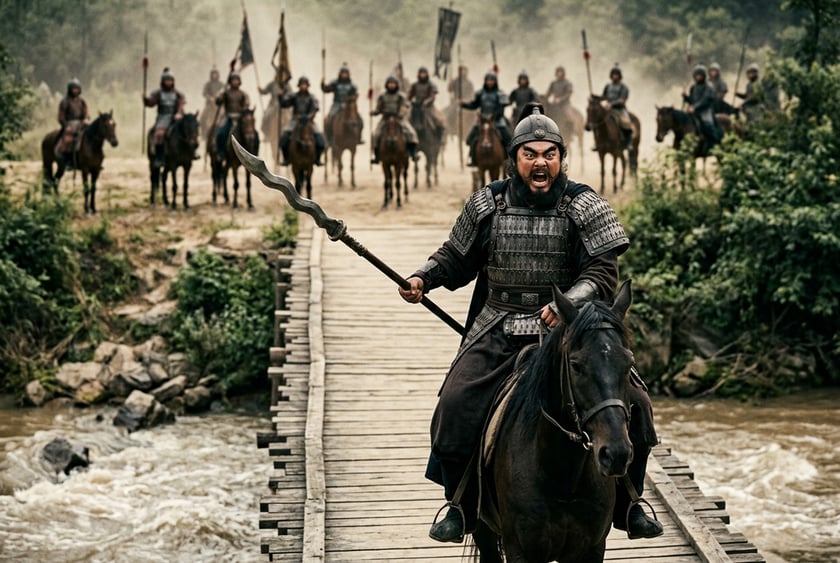
Zhang Fei glares, holding his eight-span serpent spear as he rides on Changban Bridge. The river rushes beneath him, while Cao Cao’s cavalry hesitates in the distance behind him.
Featured people: Zhang Fei
Continue
Replay the Battle of Changban phase by phase on real terrain: troop strengths, movements and turning points at a glance, each marked as coming from the Records of the Three Kingdoms or the Romance.
2014 people in common
2083 people in common
2073 people in common
2103 people in common
2133 people in common
2133 people in common
2143 people in common
2013 people in common
The true nature of the Battle of Changban was a decisive pursuit before the climactic battle at Chibi, not a standalone engagement. In the seventh month of 208, Cao Cao launched Cao Cao's Southern Campaign Against Jing Province. In the eighth month, Liu Biao died of illness; in the ninth, Liu Cong surrendered the entire province. Cao Cao thus gained nearly all of northern Jing Province without a fight, but Jiangling still held “military supplies”—that is, large quantities of provisions and equipment. If Liu Bei reached Jiangling first, he would still have been able to organize a prolonged resistance, relying on Jing Province’s navy, ships, and stores of grain and weapons. Cao Cao keenly recognized how narrow this window of opportunity was, so he “abandoned his baggage and advanced lightly to Xiangyang. Hearing that the former lord had already passed, Cao Cao led five thousand elite cavalry in a forced pursuit, covering more than three hundred li in a day and a night”. This was a classic high-risk maneuver that traded speed for strategic advantage, betting on breaking Liu Bei’s core forces before he could reach Jiangling. Wen Ping, a Jing Province defector, accompanied Cao Chun at the head of the vanguard; his intimate knowledge of the terrain made him part of the command structure directing the pursuit.
On Cao Cao’s side, Cao Chun commanded around five thousand Tiger and Leopard Cavalry, while Wen Ping led Jing Province’s surrendered troops to guide the way. The main army under Cao Ren, Xiahou Dun, Xiahou Yuan, Yue Jin, Zhang Liao, Zhang He, Xu Chu, and others followed close behind. The pursuit was thus arranged in two echelons: a cavalry vanguard followed by the main force. Liu Bei’s side was on the verge of collapse. Because he was retreating south with more than a hundred thousand civilians, his army could cover only a little over ten li a day, and its organization was already half-paralyzed. When Cao Cao’s army caught up that night, Liu Bei had only around two thousand elite troops by his side, along with key advisers such as Zhuge Liang, Zhang Fei, Zhao Yun, Mi Zhu, Mi Fang, and Jian Yong. With such a disparity in strength, a pitched battle was out of the question. Liu Bei’s only viable option was to abandon his baggage and save himself. The histories state plainly: “The former lord abandoned his wife and children and fled with Zhuge Liang, Zhang Fei, Zhao Yun, and several dozen cavalrymen”.
The battle had three key decision points. The first was Liu Bei’s decision to retreat with the people. Tens of thousands of residents from Xinye and Fancheng willingly followed him. Jian Yong cast a divination and declared that “tonight will bring great misfortune,” advising Liu Bei to “abandon the people and flee at once.” Liu Bei refused: “The people have followed me here from Xinye. How could I bear to abandon them?”. Tactically, this was a mistake: it directly caused the retreat to slow to a crawl and allowed the elite cavalry to catch up. Politically, however, it was the right choice. It established the image of “Liu Bei taking the people with him,” a crucial part of the narrative that later drew Jing Province’s local scholars to his side. The second was Zhao Yun’s decision to protect Lady Gan and the heir. The histories record succinctly: “When Cao Cao’s army arrived and caught up with the former lord at Dangyang Changban, he was in dire straits and abandoned the empress and the heir. Thanks to Zhao Yun’s protection, they escaped disaster”. This restrained historical account was expanded in the novel into an entire chapter: “Zhao Yun Rescues His Lord on a Single Horse” (a standalone episode). The third was Zhang Fei’s decision to hold off the pursuers at the bridge. “When the former lord heard that Cao Cao had suddenly arrived, he abandoned his wife and children and fled, ordering Zhang Fei to hold off the rear with twenty cavalrymen. Zhang Fei took up position at the bridge over the river and blocked it. Glaring and brandishing his spear, he cried, ‘I am Zhang Yide! Come and fight me to the death!’ None of the enemy dared approach, and so they escaped”. This was a successful psychological tactic, using the threat of a single warrior in place of a full defensive deployment.
In tactical terms, Liu Bei suffered a crushing defeat: his essential baggage, many of his family members, and the more than one hundred thousand civilians accompanying him were all lost. Only a few dozen cavalrymen broke through to Hanjin. Fortunately, they encountered Guan Yu’s fleet, which came to their aid; joining forces with Liu Qi, they reached Xiakou and stabilized their position. Strategically, however, the defeat at Changban brought about three important turning points. First, Liu Bei was forced to abandon Jiangling as a strategic objective and turn wholeheartedly toward an alliance with Sun Quan. Lu Su happened to be heading north at this time and met Liu Bei at Dangyang. He urged him, “Your best course is to send a trusted confidant to form an alliance in the east,” after which Zhuge Liang went to Wu as an envoy. Second, Liu Qi’s more than ten thousand troops from Jiangxia became the legitimate military foundation of the Sun-Liu alliance. Third, although Cao Cao captured the population and baggage, his elite cavalry had galloped more than three hundred li without their baggage and were already at the end of their strength. This foreshadowed the Cao army’s vulnerability at Chibi to “unfamiliar water and soil, compounded by epidemic disease.” In the novel’s dramatization, Zhang Fei’s stand at the bridge is heightened to the extreme: “Zhang Yide of Yan is here! Who dares fight me to the death?” His mighty shout frightens off Cao Cao’s million-strong army, while Xiahou Jie’s heart and gall are shattered and he falls from his horse. This image no longer belongs to military history alone; it has become part of the shared memory of folk opera, New Year prints, and Peking opera.
If Liu Bei had not brought the civilians south and had instead made a forced march with only his cavalry, could he have reached Jiangling first? Judging by marching speed, Liu Bei’s main force, numbering around ten thousand plus its retainers, could have covered fifty li a day without the civilians. The distance from Fancheng to Jiangling was about three hundred li, requiring six days. Cao Cao’s main force would need about three days to get from Fancheng to Xiangyang, then another four days to reach Jiangling. Liu Bei would therefore have had a lead of perhaps one or two days and, in theory, could have reached Jiangling first. If that had happened, the Battle of Changban would not have taken place. Cao Cao would have faced a Liu Bei entrenched at Jiangling with tens of thousands of naval troops and able to coordinate directly with Sun Quan; the strategic initiative at Chibi might have belonged to the Sun-Liu side from the outset. But the price would have been abandoning the people—a choice fundamentally at odds with Liu Bei’s political narrative and one he could not, in practice, have made. Another counterfactual: if Zhang Fei had failed to deter Cao Cao’s troops at the bridge, Liu Bei himself would very likely have been captured at Changban that night. Had that happened, the later history of the Three Kingdoms would never have unfolded. That is the true significance of “taking the head of a top general amid a million troops”: the novel exaggerated Zhang Fei’s image, but the histories had already acknowledged, in the briefest of strokes, the strategic weight of that lone warrior’s show of force.