Background
Iron was a basic material for warfare in the late Han. Swords, armor, arrowheads, and farm tools all depended on a steady capacity for iron production. Since the mid-Western Han, the state had held a monopoly on salt and iron. Although the Eastern Han relaxed this policy for a time, once warlords carved up the realm in the late Han, whoever controlled ironworking workshops and skilled craftsmen possessed the ability to sustain military campaigns and restore agricultural production. Cao Cao, who promoted garrison farming and reorganized military equipment in the north, had an enormous demand for ironware.
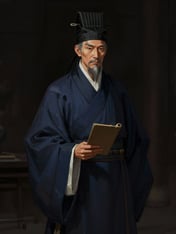
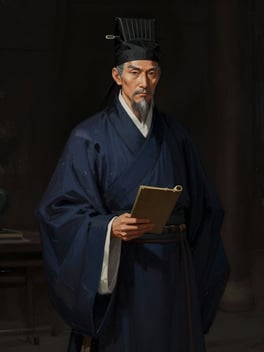
It was against this backdrop that Han Ji entered Cao Cao’s administration. According to the “Biography of Han Ji” in the Records of the Three Kingdoms, after Cao Cao pacified Jing Province in 208, he recruited Han Ji to serve as an aide in the Chancellor’s Office. Han Ji later became Administrator of Leling, then was transferred to the post of Supervisor of Ironworks, with responsibility for state-run iron production. His transfer from a commandery post to a specialized technical position shows that the Cao Cao regime had come to regard iron production as an important task requiring dedicated oversight, rather than merely an adjunct to local administration.
Events
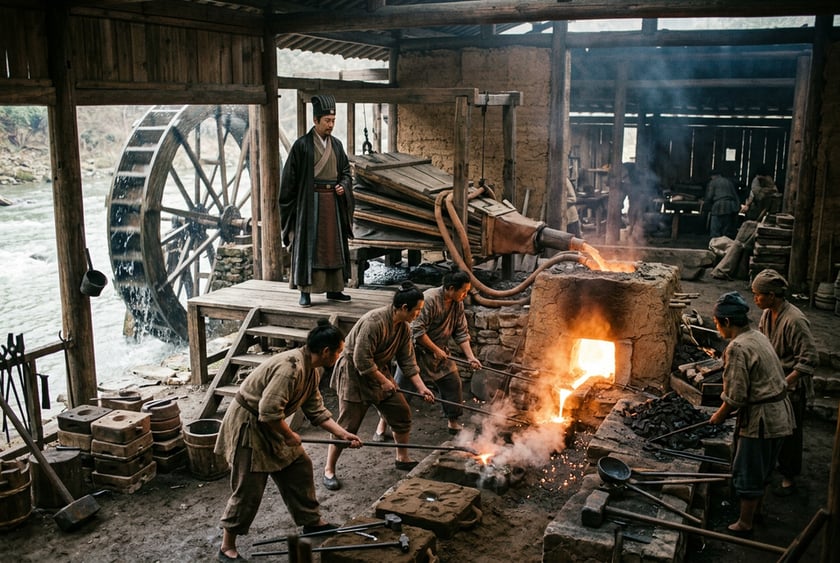
The crucial stage in iron production was blowing air into the furnace. If the temperature was too low, the ore could not melt fully, resulting in low-quality iron and poor output. When Han Ji took office, the furnaces used horse-powered bellows, with horses pulling the bellows. Each smelting run required one hundred horses; switching to human-powered bellows would instead require a large labor force. In wartime, horses were important military assets, while manpower was also in short supply because of conscription and garrison farming. Both methods came at a high cost.
Han Ji’s solution was to use the current of a large river to drive the bellows—a water-powered bellows system. According to the “Biography of Du Shi” in the Book of the Later Han, Du Shi had already built water-powered bellows in Nanyang in the early Eastern Han. Han Ji’s contribution was not to invent the principle, but to apply it to Cao Wei’s state-run iron production and demonstrate its value with quantifiable results: by his calculation, the returns were three times what they had been before. These “returns” presumably reflected several factors, including increased output and savings in horses and labor, but the Records of the Three Kingdoms gives no more precise figures.
It is worth noting that the Records of the Three Kingdoms does not state where the ironworks overseen by Han Ji were located, nor does it describe the specific design of the water-powered bellows. We know only that they were built to draw on river water, which means the choice of smelting site had to take account of ore sources, fuel, and water power. Siting the works was itself a technical decision.
Results
Han Ji served as Supervisor of Ironworks for seven years, during which the state’s tools and equipment were replenished. The court issued an edict praising him and promoted him on the spot to Commandant of Metals, a rank just below the Nine Ministers. This was a high reward for an official in charge of iron production: through improvements in production, he attained a rank close to that of the highest ministers.
Han Ji’s official career continued to rise thereafter. After Cao Pi took the throne, he enfeoffed Han Ji as Marquis of Yicheng Village. In the seventh year of Huangchu (226), Han Ji was promoted to Grand Master of Ceremonies and advanced to Marquis of Nanxiang Village, with an estate of two hundred households. The Grand Master of Ceremonies oversaw rites at the ancestral temples, a role wholly unrelated to iron production. This shows that Han Ji was regarded in Cao Wei’s bureaucracy as a capable and trustworthy official, and that his technical success opened the way to high office.
Impact
The spread of water-powered bellows had practical significance for Cao Wei’s national strength. Among the Three Kingdoms, Wei had the largest population and the broadest territory, but it fought on both its eastern and western fronts for many years, consuming vast quantities of weapons and equipment. The seven years Han Ji oversaw iron production broadly corresponded to the later period of Cao Cao’s unification of the north and the frequent wars with Sun Quan and Liu Bei. A steady supply of ironware was one of the material foundations that enabled Cao Wei to sustain warfare on multiple fronts over the long term.
From the perspective of technological history, this account is important evidence for the use of water power in industrial production in ancient China. It illustrates a practical path to innovation: rather than inventing a new principle from scratch, it applied existing technology to specific production needs and assessed its effectiveness by comparing costs and returns. The court rewarded this improvement with a promotion, which also shows that in an age of frequent warfare, rulers valued increased production efficiency no less than military merit.
Han Ji’s deeds do not appear in Romance of the Three Kingdoms, and he is far less famous in popular memory than celebrated generals or strategists. But if the outcome of a war depends not only on decisions at the front but also on the capacity of the rear, then technical officials like Han Ji were likewise an overlooked force behind the Three Kingdoms’ political landscape.