Overview
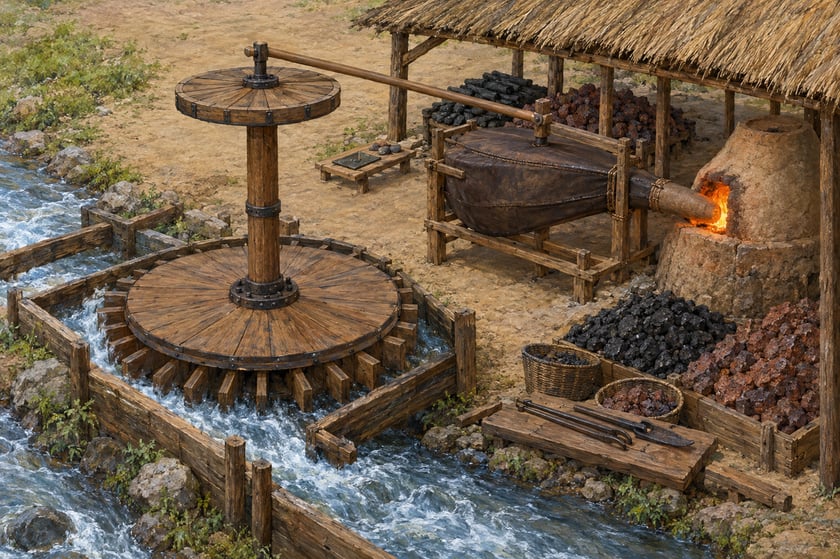
Water-Powered Bellows were devices that harnessed flowing water to blow air onto charcoal during iron smelting. They appear in the Records of the Three Kingdoms: while serving as Supervisor of Smelting, Han Ji “used a perennial stream to make Water-Powered Bellows”. Pei Songzhi's commentary explained that “pai” referred to a device used to blow air onto charcoal.
Origins
According to the Records of the Three Kingdoms, iron smelting had formerly used horse-powered bellows, requiring a hundred horses for each batch of ore smelted; switching to human-powered bellows also consumed manpower. Han Ji therefore used the water of a perennial stream to make Water-Powered Bellows, whose calculated benefits were three times those of the previous methods, as recounted in Han Ji's Introduction of Water-Powered Iron Smelting. During his seven years in office, supplies of implements became plentiful. The court issued an edict praising him and conferred on him the additional title of Commandant of Metals.
Scholarship
According to later research, Water-Powered Bellows were iron-smelting devices that used water power to drive leather bags, blowing air to stoke the fire. They were first made by Du Shi, Administrator of Nanyang, in Jianwu 7 (31) of the Eastern Han.
Later scholars also cited the biography of Du Shi in the Hou Hanshu, which stated that Du Shi “made Water-Powered Bellows and cast agricultural implements.” They required little effort yet achieved much, and the people praised their convenience.