Cao Wei · General Who Promotes Martiality; General Who Subdues the Waves; General of the Van
Man Chong
courtesy name 伯宁 · –242
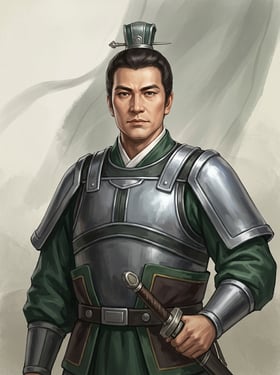
Man Chong was firm and resolute in purpose, brave and resourceful, strict in enforcing the law, and possessed little private wealth. A veteran general of Wei, he served as Grand Administrator of Runan, Inspector of Yu Province, General Who Conquers the East, and Grand Commandant.

Life
In the novel: 12 chapters · In the Records: 7 volumes
Life?–242
196 CE (Jian'an 1)
230 CE (Taihe 4)
- Man Chong's Defense of HuainanHefeiCommander
233 CE (Qinglong 1)
234 CE (Qinglong 2)
Allegiance
- Cao Wei
- Hatched: dated by chapter
- Life event
List all 2 stops
- Luoyang196Xu Huang Joins Cao Cao
- Hefei230–234Man Chong's Defense of Huainan+3 more
On the boards
Compare with someone →Where this person ranks on each board.
Who they were
Character profile
- Character
- Man Chong was firm and resolute in purpose, brave and resourceful, strict in enforcing the law, and possessed little private wealth. A veteran general of Wei, he served as Grand Administrator of Runan, Inspector of Yu Province, General Who Conquers the East, and Grand Commandant.
- Manner of speech
- His manner of speech was sharply antithetical, first demolishing then building up, as in "It cannot be... it is not..." and "I wish... to make...." Decisive in offering strategy, he held that "The men of Wu will surely underestimate us, coming from afar, and will have made no defensive preparations."
- Life
- Man Chong, styled Boning, was a native of Changyi in Shanyang. In his youth he was a commandery Investigator, and served through the three reigns of Cao Cao, Cao Pi, and Cao Rui. He garrisoned Runan, Yu Province, and Yang Province for several decades, achieving notable success in defending against Wu along the Yangtze and Huai. In the second year of Jingchu he was summoned back to court to serve as Grand Commandant, and died in the third year of Zhengshi, with the posthumous title Marquis Jing.
- Anecdotes
- He was once appointed Prefect of Xu, charged with gathering intelligence on Yuan Shao. At the Battle of Fancheng, serving as Cao Ren's adviser, he dissuaded the abandonment of the city with the argument that "a sudden flood cannot last long," causing Cao Ren to hold firm.
Historical Record
Man Chong, courtesy name Boning, was from Changyi in Shanyang. At eighteen, he became a commandery inspector and once took action against powerful local families who were harming the common people. Later, while serving as magistrate of Gaoping County, he investigated Zhang Bao, an inspector guilty of corruption and misgovernment, then resigned and returned home. Cao Cao recruited him as an aide and an official in the Western Bureau, and appointed him magistrate of Xu. When Cao Hong’s retainer broke the law, Man Chong refused to show favoritism on the strength of Cao Hong’s letter. Ordered to handle the case against Yang Biao, he questioned him according to the law. He later explained to Cao Cao that there were no further statements in the case against Yang Biao and that the charges should be clearly established; Cao Cao then released Yang Biao. Pei Songzhi, however, criticized Man Chong’s interrogation of Yang Biao as the work of a harsh official, showing that the historical accounts also preserve differing views of the affair.
When Yuan Shao was at the height of his power, Man Chong became Administrator of Runan. He recruited those willing to submit, captured strongholds, pacified local resistance, and secured households and troops, enabling the people to return to farming. When Guan Yu besieged Fancheng and the waters surged, Cao Ren briefly considered retreating by boat. Man Chong argued that abandoning the city would mean Wei could no longer hold the lands south of the Yellow River, urged him to stand firm, and swore an oath with the troops. After Xu Huang’s relief force arrived, Man Chong fought fiercely, and Guan Yu withdrew. Man Chong later served successively as General Who Inspires Martial Might, General Who Subdues the Waves, and General of the Front, defending Yu Province, Yang Province, and Huainan, before ultimately being promoted to General Who Conquers the East.
Man Chong was long renowned for his ability to counter Wu forces. When Sun Quan announced that he would attack Hefei and then withdrew, Man Chong judged that the retreat was not genuine and opposed calling off the campaign; Sun Quan indeed returned a little over ten days later. When Sun Quan later attacked Hefei Xincheng, Man Chong proposed moving the city to avoid the rising waters and lure the enemy away from the river. His proposal was approved, and an ambush drove off the Wu forces. On another occasion, he led a band of strong men to burn Wu siege equipment and shot Sun Tai dead. In the second year of Jingchu, Man Chong was recalled in his old age and promoted to Grand Commandant. He acquired no property and left no surplus wealth in his household. He died in the third year of Zhengshi and was posthumously named Marquis Jing.
In the Novel
Romance of the Three Kingdoms portrays Man Chong as a capable adviser and commander under Cao Cao, both effective in his duties and skilled at offering counsel. The novel has Liu Ye recommend Man Chong and Lu Qian enter Cao Cao’s service, and later has Man Chong serve as magistrate of Xu. It also depicts him slipping into Xu Huang’s camp at night as an old acquaintance and urging Xu Huang to leave Yang Feng and Han Xian and join Cao Cao. Xu Huang refuses to kill his former lord; Man Chong praises his sense of honor, and the two go over to Cao Cao that very night. This episode emphasizes Man Chong’s ability to judge character and speak persuasively, while also highlighting Xu Huang’s loyalty to his principles. The nighttime visit and persuasion are inventions of the novel and do not appear in the Records of the Three Kingdoms.
The novel also highlights Man Chong’s judgment in a crisis. When Guan Yu besieges Fancheng and floodwaters engulf the city, Man Chong urges Cao Ren not to abandon it, arguing that the mountain floods will eventually recede and that retreat would cost them the lands south of the Yellow River. Cao Ren takes his advice and leads the troops in holding the city. The central account accords with the historical record, but the novel adds scenes of a white horse being brought up to the city wall, an oath to execute anyone who speaks of retreat, and the waters receding after ten days. The novel also has him travel to Wu on Cao Cao’s orders to discuss an alliance against Liu Bei, and later depicts him recommending a nighttime raid on the Wu fleet’s river camp when Cao Rui comes to relieve Hefei, setting fire to its ships and provisions. These episodes expand his portrayal as a diplomat and battlefield strategist, but belong to the novel’s narrative and should not be conflated with the historical accounts.
Key Relationships
Man Chong’s relationship with Cao Cao was both that of subject and ruler and that of law enforcer and patron. Cao Cao appointed him to manage affairs in Xu, and the historical accounts say that Cao Cao praised his decisiveness after he investigated Cao Hong’s retainer. Yet Pei Songzhi also strongly criticized Man Chong’s interrogation of Yang Biao. In the historical record, Man Chong and Xu Huang were comrades in the campaign against Guan Yu. The novel adds a bond of old friendship and a nighttime effort to persuade Xu Huang to switch sides, making Man Chong a key figure in the story of Xu Huang Joins Cao Cao (a detail unique to the novel).
In his dealings with Cao Ren, Man Chong was an important adviser on the decision to hold the city. Both the historical record and the novel describe Guan Yu’s siege of Fancheng, the danger posed by the floods, and Man Chong’s urging Cao Ren to stand firm. The historical account also records that Man Chong sank a white horse and swore an oath with the troops, while the novel further dramatizes the scene by having Cao Ren climb the city wall and swear to hold it. Against Sun Quan and the Wu forces, Man Chong long bore responsibility for the defense of Huainan and excelled at discerning the enemy’s true intentions, holding cities, and laying ambushes. He and Wang Ling, however, fell out while serving together, and Wang Ling’s faction slandered him. After Cao Rui summoned and met him, seeing that he remained vigorous and robust, Cao Rui still allowed him to return to his post.
Signature Scenes
The flood siege of Fancheng. As the city walls were damaged by the floodwaters and troop morale wavered, Man Chong pointed out that the mountain floods would not last and that abandoning the city would cost the state the lands south of the Yellow River. He urged them to hold firm. The historical account says that he sank a white horse and swore an oath to steady the troops; Xu Huang’s relief force arrived soon afterward, Man Chong fought fiercely, and Guan Yu withdrew. The novel recasts the episode with Cao Ren nearly escaping by boat, then climbing the wall and swearing to hold after Man Chong dissuades him; the waters recede ten days later, highlighting Man Chong’s calm in a crisis.
The ambush at Hefei Xincheng. Man Chong believed Sun Quan might come ashore to display his forces, so he secretly positioned six thousand infantry and cavalry. Sun Quan did indeed come ashore, and the ambush sprang out, killing hundreds. The episode shows Man Chong’s skill at anticipating the enemy’s moves and gaining the initiative with concealed forces.
The nighttime visit to Xu Huang’s camp. In the novel, Man Chong disguises himself as a foot soldier and sneaks to Xu Huang’s tent. He urges Xu Huang to join Cao Cao, pointing to Cao Cao’s respect for men of talent and Xu Huang’s subservience to Yang Feng. He ultimately persuades Xu Huang to go over to Cao Cao that very night. This scene of an old friend persuading him to change sides is unique to the novel and is not recorded in the Records of the Three Kingdoms.
Quotes
26 lines in the books · 3 featured
「豈不聞『良禽擇木而棲,賢臣擇主而事』?遇可事之主,而交臂失之,非丈夫也。」
This line is a famous appeal to surrender, embodying Man Chong's ingenuity and his insight into talent.
「山水速疾,冀其不久。聞羽遣別將已在郟下,自許以南,百姓擾擾,羽所以不敢遂進者,恐吾軍掎其後耳。今若遁去,洪河以南,非復國家有也;君宜待之。」
This line displays Man Chong's strategic vision and resolve to hold firm during Guan Yu's Northern Campaign, with far-reaching influence on the course of the war.
「孫子言,兵者,詭道也。故能而示之以弱不能,驕之以利,示之以懾。此爲形實不必相應也。又曰『善動敵者形之』。今賊未至而移城却內,此所謂形而誘之也。引賊遠水,擇利而動,舉得於外,則福生於內矣。」
This line quotes The Art of War, embodying Man Chong's deep mastery of military strategy and his skill in the use of stratagems.
- Family
- Lord & vassal
- Friends
- Enemies
- Other
Who is Man Chong connected to?
Pick someone to see how many steps lie between them and Man Chong.
History vs. novel
7 points · 2 novel-only
| History | Novel |
|---|---|
| Xu Huang Joins Cao CaoNovel only | |
| — | Man Chong claimed to know Xu Huang. One night, disguised as a junior soldier, he infiltrated Xu Huang’s camp and urged him to join Cao Cao, arguing that a wise ruler chooses the worthy. Xu Huang ultimately followed him and went over to Cao Cao ch. 14 |
| Xu Magistrate Interrogates Yang BiaoNovel embellishes | |
Man Chong examined Yang Biao under the law. After finding no other charges against him, he urged Cao Cao to pardon him, stressing that unclear charges would damage public confidence vol. 26 | Cao Cao secretly ordered Man Chong to try Yang Biao, then imprisoned him on the charge of colluding with Yuan Shu; the novel does not mention Man Chong pleading for Yang Biao ch. 20 |
| Holding FanchengNovel embellishes | |
When Guan Yu flooded Fancheng and its walls collapsed, Man Chong urged Cao Ren not to abandon the city, explaining that Guan Yu feared the Wei army would cut off his retreat. Cao Ren took his advice, and Man Chong swore an oath with the soldiers to hold the city vol. 26 | The novel describes Cao Ren as preparing to flee by boat under cover of night. Man Chong urged him to hold the city, and the novel depicts Cao Ren riding a white horse to the walls to swear an oath, while soldiers and civilians guarded the city day and night. The floodwaters receded within ten days ch. 74 |
| Repelling Wu at Hefei XinchengNovel embellishes | |
Man Chong foresaw that Sun Quan would land and show off his troops. He hid six thousand foot and mounted soldiers and launched a surprise attack, killing hundreds. The following year, he recruited strong men to set fire to Wu’s siege equipment and shot Sun Tai dead, prompting the Wu army to withdraw vol. 26 | The novel depicts Man Chong accompanying Cao Rui as he led troops to relieve Hefei, and advising a night attack on the Wu army’s river camp. Zhang Qiu and Man Chong set fires along separate routes, destroying ships and military supplies and routing the Wu army ch. 103 |
| Mission to JiangdongNovel only | |
| — | Cao Cao sent Man Chong on a mission to Jiangdong with a letter urging Sun Quan to join forces with Cao Wei to seize Jing Province. Afterward, Sun Quan received him with the honors due a guest and escorted him back to his lodging ch. 73 |
| Appointment in XuSources disagree | |
According to the historical record, after Cao Cao was appointed General-in-Chief, he recruited Man Chong as an aide in the Western Secretariat and subsequently appointed him magistrate of Xu vol. 26 | The novel records that when Cao Cao made appointments, he named Man Chong magistrate of Xu, but does not mention his earlier appointment as an aide in the Western Secretariat ch. 14 |
| Garrisoning RunanNovel embellishes | |
Yuan Shao’s former retainers and protégés held troops and defended themselves in Runan. After Man Chong was appointed administrator, he recruited five hundred men, captured more than twenty strongholds, and pacified the region vol. 26 | The novel says that Cao Cao once sent Xiahou Dun and Man Chong to garrison Runan against Liu Biao, but does not describe how Man Chong pacified the region ch. 31 |
- Xu Huang Joins Cao CaoNovel only
- Novel
Man Chong claimed to know Xu Huang. One night, disguised as a junior soldier, he infiltrated Xu Huang’s camp and urged him to join Cao Cao, arguing that a wise ruler chooses the worthy. Xu Huang ultimately followed him and went over to Cao Cao
ch. 14
- Xu Magistrate Interrogates Yang BiaoNovel embellishes
- History
Man Chong examined Yang Biao under the law. After finding no other charges against him, he urged Cao Cao to pardon him, stressing that unclear charges would damage public confidence
vol. 26
- Novel
Cao Cao secretly ordered Man Chong to try Yang Biao, then imprisoned him on the charge of colluding with Yuan Shu; the novel does not mention Man Chong pleading for Yang Biao
ch. 20
- Holding FanchengNovel embellishes
- History
When Guan Yu flooded Fancheng and its walls collapsed, Man Chong urged Cao Ren not to abandon the city, explaining that Guan Yu feared the Wei army would cut off his retreat. Cao Ren took his advice, and Man Chong swore an oath with the soldiers to hold the city
vol. 26
- Novel
The novel describes Cao Ren as preparing to flee by boat under cover of night. Man Chong urged him to hold the city, and the novel depicts Cao Ren riding a white horse to the walls to swear an oath, while soldiers and civilians guarded the city day and night. The floodwaters receded within ten days
ch. 74
- Repelling Wu at Hefei XinchengNovel embellishes
- History
Man Chong foresaw that Sun Quan would land and show off his troops. He hid six thousand foot and mounted soldiers and launched a surprise attack, killing hundreds. The following year, he recruited strong men to set fire to Wu’s siege equipment and shot Sun Tai dead, prompting the Wu army to withdraw
vol. 26
- Novel
The novel depicts Man Chong accompanying Cao Rui as he led troops to relieve Hefei, and advising a night attack on the Wu army’s river camp. Zhang Qiu and Man Chong set fires along separate routes, destroying ships and military supplies and routing the Wu army
ch. 103
- Mission to JiangdongNovel only
- Novel
Cao Cao sent Man Chong on a mission to Jiangdong with a letter urging Sun Quan to join forces with Cao Wei to seize Jing Province. Afterward, Sun Quan received him with the honors due a guest and escorted him back to his lodging
ch. 73
- Appointment in XuSources disagree
- History
According to the historical record, after Cao Cao was appointed General-in-Chief, he recruited Man Chong as an aide in the Western Secretariat and subsequently appointed him magistrate of Xu
vol. 26
- Novel
The novel records that when Cao Cao made appointments, he named Man Chong magistrate of Xu, but does not mention his earlier appointment as an aide in the Western Secretariat
ch. 14
- Garrisoning RunanNovel embellishes
- History
Yuan Shao’s former retainers and protégés held troops and defended themselves in Runan. After Man Chong was appointed administrator, he recruited five hundred men, captured more than twenty strongholds, and pacified the region
vol. 26
- Novel
The novel says that Cao Cao once sent Xiahou Dun and Man Chong to garrison Runan against Liu Biao, but does not describe how Man Chong pacified the region
ch. 31
Combat
On the field
Duels, kills and executions as the texts tell them, counted separately for the Records and the Romance.
- RecordsJuan 26ExecutionZhang BaoWon「率吏卒出收之,詰責所犯,即日考竟」
- RecordsJuan 26Struck downSun TaiWon「燒賊攻具,射殺權弟子孫泰」
Battles in command
Battles this person commanded in, with the outcome as each text tells it.
- Records
- 1W 0L 0D 0 undecided
- Romance
- 1W 0L 0D 0 undecided
- Records234Man Chong Burns the Siege Equipment and Shoots Sun TaiWonvs Wu forcesJuan 26「燒賊攻具,射殺權弟子孫泰。賊於是引退」
- Romance234Man Chong Burns the Siege Equipment and Shoots Sun TaiWonvs Wu troopsCh. 103「燒毀戰船、糧草、器具不計其數。諸葛瑾率敗兵逃走沔口。魏兵大勝而回」
Stratagems
Plans this person devised or saw through, as the texts tell them.
- Records
- 4 carried out · 4 worked · 1 turned down · 3 seen through
- Romance
- 2 carried out · 2 worked · 0 turned down · 0 seen through
- RecordsLure the EnemyLureTurned downagainst banditsJuan 3「寵欲拔新城守,致賊壽春,帝不聽」
- RecordsLure and Kill the Rebel ChiefLureWorkedagainst Yuan Shao's disciples and retainers in RunanJuan 26「誘其未降渠帥,於坐上殺十餘人,一時皆平」
- RecordsAnnounce a Hunting ExpeditionFeintSaw throughagainst WeiJuan 26「寵度其必襲西陽而爲之備,權聞之,退還」
- RecordsFeign Retreat and Exploit the OpeningFeintSaw throughagainst WeiJuan 26「此必欲僞退以罷吾兵,而倒還乘虛,掩不備也,表不罷兵」
- RecordsFeign SurrenderFalse surrenderSaw throughagainst Yang ProvinceJuan 26「布夜掩擊,督將迸走,死傷過半」
- RecordsLure the EnemyLureWorkedagainst banditsJuan 26「今賊未至而移城却內,此所謂形而誘之也」
All stratagems (10)
Loading…
Events
Events (11)
Battles and events the texts place this person in, by date.
Battles
Other events
- 196Xu Huang Joins Cao CaoAdvisor
- 196Cao Cao Escorts the Emperor and Moves the Capital to Xu
- 219Flooding of the Seven Armies
- 230Man Chong's Defense of HuainanCommander
- 233Man Chong Relocates and Builds the New Hefei CityInstigator
- 234Battle of Hefei (234)Commander
Places
- Was at
- Yan ProvinceRecords
- FanchengRecords
- XinyeRecords
- DangyangRecords
- YangzhouRecords
- Governed
- XuchangRecords
- Yu ProvinceRecords
- RunanRecords
Continue
Battle of Hefei (234)
Relationship timeline10 entries ▸
History · vol. 3
- Sun Quan§23
Fights
Man Chong, General Who Attacks the East, advanced to resist him
History · vol. 26
- Cao Ren§6
Advised
Guan Yu besieged Xiangyang; Chong assisted Cao Ren, General Who Conquers the South, who was stationed at Fancheng to resist him
- Guan Yu§6
Enemy
was stationed at Fancheng to resist Guan Yu; sacrificed a white horse in an oath, and Guan Yu then withdrew
- Sun Quan§8
Enemy
Recruited strong men to break pine branches into torches, douse them with sesame oil, and burn the enemy’s siege equipment; shot and killed Sun Tai, Sun Quan’s nephew
Novel · ch. 14
Novel · ch. 20
- Cao Cao§6
Witnessed
was ordered to investigate Yang Biao
Novel · ch. 21
- Cao Cao§15
Lord
was ordered to gather intelligence and report back
All 10
Loading…
Inner monologues · AI-generated3 monologues ▸
- When I first entered office, I was no more than a local official. The realm was in turmoil, and worthy men each chose so
- I am Man Chong, courtesy name Boning. Since my youth, my thoughts have been on border affairs rather than family wealth.
- I am Man Chong, courtesy name Boning. Whenever I think back to the beginning of my service as an official, I realize tha