Overview
Hefei was a city in Huainan at the end of the Han dynasty. Its old city stood northwest of present-day Hefei, Anhui Province, between the Huai and Yangtze rivers, with Chaohu Lake and the Yangtze to the south and Shouchun to the north. At the end of the Han, Liu Fu served as Inspector of Yang Province and established the provincial headquarters there, building walls and opening屯田. Thereafter, Hefei became a major frontier stronghold where Cao Wei defended against Eastern Wu in the southeast. Sun Quan attacked it repeatedly from Jian’an 13 (208), but never managed to capture it. In the middle of the Three Kingdoms period, the Wei general Man Chong built Hefei Xincheng west of the old city. In Jian’an 20 (215), Sun Quan failed to take Hefei; while withdrawing, he was nearly captured on the north bank of a ferry outside the city.
History
After being appointed Inspector of Yang Province, Liu Fu arrived alone in the deserted city of Hefei and established the provincial headquarters. He won over local forces such as Lei Xu, and within a few years tens of thousands of refugees crossed the river to join him. He founded schools, greatly expanded military farms, repaired irrigation reservoirs such as Shaobei to water the rice fields, and raised the city walls. He also stockpiled timber and stone, prepared tens of millions of thatch mats, and stored several thousand hu of fish oil for the city’s defense.
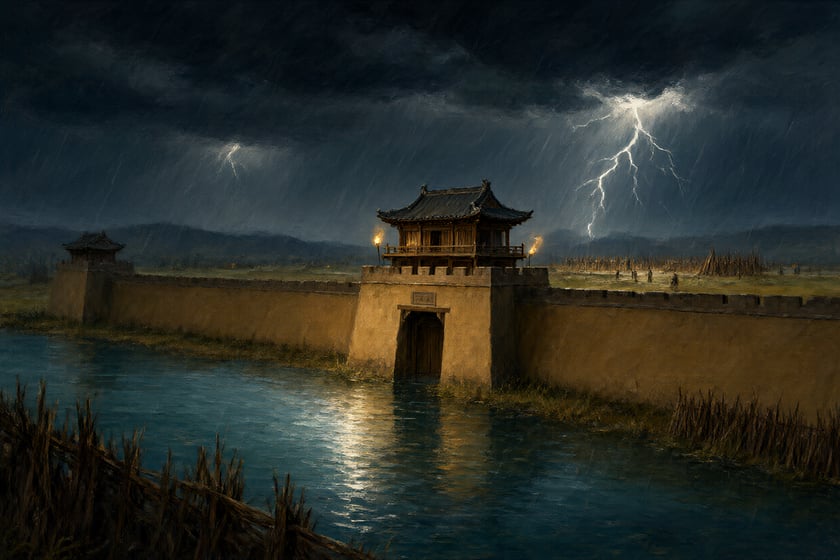
Liu Fu died in Jian’an 13 (208). That same year, Sun Quan led an army of 100,000 to besiege Hefei for more than a hundred days. After days of heavy rain, the city walls were on the verge of collapse. The defenders covered them with thatch mats and rain capes, then lit fish oil at night to illuminate the area outside the walls. Sun Quan eventually withdrew, and the people and officials of Yang Province remembered Liu Fu all the more fondly. Cao Cao’s main force was in Jing Province at the time, and he sent only Zhang Xi with a thousand cavalry to the city’s aid. Jiang Ji, an assistant official in Yang Province, falsely claimed to have received a letter from Zhang Xi saying that 40,000 infantry and cavalry had reached Yulou. The Wu army intercepted the message, and Sun Quan, believing it to be true, burned his camp and retreated. In the seventh month of Jian’an 14 (209), Cao Cao led a naval force from the Wo River into the Huai, proceeded along the Fei River, and entered Hefei. He appointed senior officials to the commanderies and counties of Yang Province, opened military farms at Shaobei, and returned to Qiao County in the twelfth month. Later, fearing that Sun Quan would raid the commanderies and counties along the river, Cao Cao ordered them evacuated inland. As a result, more than 100,000 households from Lujiang, Jiujiang, and other areas fled east across the Yangtze in panic, leaving the north bank largely deserted. Only Wan remained south of Hefei.
After returning from his campaign against Sun Quan, Cao Cao left Zhang Liao, Yue Jin, and Li Dian with more than 7,000 troops stationed at Hefei. Later, when he campaigned west against Zhang Lu, he gave Xue Ti, the chief of the guards, a sealed order marked, “Open only when the enemy arrives”. In the eighth month of Jian’an 20 (215), Sun Quan led 100,000 men to besiege Hefei. The officers opened the sealed order, which instructed Zhang Liao and Li Dian to go out and fight, while Yue Jin was to defend the city. Zhang Liao recruited 800 volunteers willing to fight to the death overnight. At dawn the next day, he personally donned armor and wielded a halberd as he charged into the Wu ranks, fighting his way to Sun Quan’s position. Sun Quan retreated to a high mound to defend himself, and the Wu army’s morale was badly shaken. Sun Quan besieged the city for more than ten days without taking it. During the withdrawal, Zhang Liao launched a surprise attack on him, Ling Tong, Gan Ning, and others on the north bank of a ferry. Ling Tong and the others fought desperately to protect Sun Quan, who escaped by riding his horse over the Jin Bridge, whose planks had been broken.
In Jian’an 24 (219), Sun Quan attacked Hefei again, and all the provinces under Cao Cao sent troops to garrison it. Sun Quan subsequently declared himself a vassal of Cao Cao, who withdrew the garrison from Hefei as a gesture of good faith. After Cao Pi assumed the title of King of Wei, he sent Zhang Liao back to garrison Hefei, citing Sun Quan’s renewed rebellion. Sun Quan submitted a letter in his own defense, asking why troops had been sent again. The Grand Marshal Cao Ren also once took command of various armies at Wujiang before returning to garrison Hefei. He died in the fourth year of Huangchu (223).
In the first year of Qinglong (233), Man Chong submitted a memorial stating that the old city of Hefei lay close to rivers and lakes to the south and too far from Shouchun to the north. The Wu army could use the waterways to besiege it, while Wei forces would find it difficult to provide relief. He asked to build a new city at a defensible site thirty li to the west, and Emperor Ming of Wei approved. That same year, Sun Quan planned to besiege the new city, but because it was far from the water, he did not dare leave his ships for twenty days. When his forces went ashore to display their strength, they were defeated by Man Chong’s ambush troops. In the second year of Qinglong (234), Sun Quan claimed to have 100,000 men as he attacked Hefei Xincheng. Man Chong recruited strong men to set fire to the Wu army’s siege equipment with the wind at their backs, destroying it and killing Sun Quan’s nephew Sun Tai with an arrow. The Wu army withdrew. By the end of the Three Kingdoms period, Hefei belonged to Jin. In the third year of Baoding (268), Sun Hao sent Ding Feng and Zhuge Jing to attack Hefei. Ding Feng sent a letter to sow discord between the Jin general Shi Bao and the court, resulting in Shi Bao’s recall.
People
- Liu Fu: The founder of Hefei’s provincial headquarters. The reservoirs he built were still in use in Chen Shou’s time.
- Defending generals: Zhang Liao was the central figure in the Battle of Hefei. Emperor Wen of Wei later issued an edict praising him: “In the Battle of Hefei, Zhang Liao and Dian, with 800 infantry, defeated 100,000 bandits,” and increased the fiefs of Zhang Liao and Li Dian. Li Dian had long been at odds with Zhang Liao and Yue Jin, but before the great battle he declared resolutely that he would not let private grievances outweigh public duty. Yue Jin defended Hefei alongside the two men, while the chief of the guards, Xue Ti, was entrusted with Cao Cao’s sealed order.
- Killed in battle here: Chen Wu, a lieutenant general of Eastern Wu, was a favorite of Sun Quan. He fought bravely and died when accompanying Sun Quan in the attack on Hefei in Jian’an 20; Sun Quan personally attended his burial.
- Hefei magistrate: Gu Yong became magistrate of Hefei at just twenty years of age. He later served as Minister over the Masters of Writing in Eastern Wu.
Differences from the historical record
In Romance of the Three Kingdoms, after the Battle of Red Cliffs, Sun Quan attacks He Fei (written as “合淝” in the novel). Taishi Ci arranges with an accomplice inside the city to launch a night raid, but falls into Zhang Liao’s ambush. Struck by several arrows, he dies of his wounds after returning to camp. According to the “Biography of Taishi Ci” in the Records of the Three Kingdoms, Taishi Ci died in Jian’an 11 (206), before the Battle of Red Cliffs, and did not take part in the Battle of Hefei. The novel also says that in the second year of Qinglong, when Eastern Wu launched attacks along three routes, the Wei ruler Cao Rui personally led a large army to garrison He Fei. The “Biography of Emperor Ming” in the Records of the Three Kingdoms, however, records that Emperor Ming was still several hundred li away on his eastern campaign when Sun Quan had already withdrawn; Emperor Ming then proceeded to Shouchun.
Today
The old city of Hefei from the Han and Wei periods stood northwest of present-day Hefei, Anhui Province. Xiaoyao Ford Park in the city takes its name from Xiaoyao Ford, where Sun Quan escaped danger. The ruins of Hefei Xincheng are in present-day Luyang District, Hefei, and have been turned into a Three Kingdoms archaeological park.