Chen Wu
courtesy name 子烈 · c. 177–215
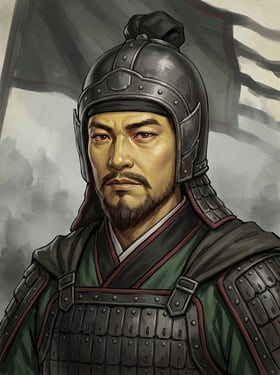
Chen Wu stood seven chi seven cun tall; or, seven chi tall, with a sallow face and red eyes, of strange and singular appearance.

Life
In the novel: 8 chapters · In the Records: 1 volume
Life177–215
196 CE (Jian'an 1)
215 CE (Jian'an 20)
- Battle of Xiaoyao FordXiaoyao FordKilled in action
216 CE (Jian'an 21)
- Battle of Ruxu (217)RuxukouKilled in action
Appearances
By chapter (9)
Outlined chapters have spoken lines; tap one to read them.
Novel
- 15
- 49
- 50
- 51
- 55
- 61
- 67
- 68
Records
- 55
- Life event
- Death
List all 5 stops
- Lujiang177Birthplace
- Jing County196Taishi Ci Joins Sun Ce
- Xiaoyao Ford215Battle of Xiaoyao Ford
- Ruxukou216Battle of Ruxu (217)
- Hefei215Died here
On the boards
Compare with someone →Where this person ranks on each board.
Who they were
Character profile
- Appearance
- Chen Wu stood seven chi seven cun tall; or, seven chi tall, with a sallow face and red eyes, of strange and singular appearance.
- Character
- Chen Wu was benevolent, generous, and fond of giving.
- Life
- Chen Wu was a man of Songzi in Lujiang, and at the age of eighteen he crossed the Yangzi with Sun Ce.
- Anecdotes
- Chen Wu was a veteran general of Sun Wu, having served as Separate Division Major, Commander of the Five Colonels, and General of the Vanguard. He once commanded the fourth squadron of three hundred warships together with twenty fire-ships in the front line. Chen Wu died in battle at Hefei, slain by Pang De.
Historical Record
Chen Wu, courtesy name Zilie, was from Songzi in Lujiang. When Sun Ce was at Shouchun, Chen Wu went to pay his respects. He was eighteen years old and stood seven chi and seven cun tall. He subsequently crossed the Yangtze with Sun Ce on campaign and, for his achievements, was appointed Commandant of a Separate Division. After Sun Ce defeated Liu Xun and acquired many people from Lujiang, he ordered Chen Wu to command the elite among them; they were unstoppable wherever they went. After Sun Quan took charge of military and civil affairs, Chen Wu was reassigned to supervise the Five Battalions. Benevolent and generous, he provided support to people from his home region as well as visitors from afar. Sun Quan was especially close to him and visited his home many times. Chen Wu accumulated numerous military achievements and was promoted to General of the Household. In the twentieth year of Jian’an, he accompanied Sun Quan in the attack on Hefei and died fighting bravely. Sun Quan mourned him deeply and attended his funeral in person. The Jiangbiao Zhuan, cited in Pei’s annotations, also says that Sun Quan ordered his favorite concubine to be buried with Chen Wu and restored the status of two hundred households of his retainers. This account comes from a source cited in Pei’s annotations; Chen Wu’s own biography records his death in battle and Sun Quan’s personal attendance at his funeral.
In the same campaign at Hefei, Zhang Liao launched a sudden attack before the Wu generals could prepare. Chen Wu was killed, while Song Qian and Xu Sheng retreated in defeat. Pan Zhang was at the rear and rode forward to kill two fleeing soldiers, after which the Wu army resumed the fight. This account places Chen Wu’s death amid the surprise attack and the collapse of the formation, but gives no details of how he fought the enemy.
In the Novel
The Romance of the Three Kingdoms portrays Chen Wu as a key vanguard in Sun Ce’s early expansion, and gives him the appearance of “seven chi tall, with a yellow face, red eyes, and a strange countenance.” This differs from the historical account, which records only that he stood seven chi and seven cun tall; the details of his yellow face and red eyes are inventions of the novel. The novel has him meet Zhou Yu as he enters Qu’e. Sun Ce admires his talent, appoints him Commandant, and sends him as the vanguard to attack Xue Li. Chen Wu leads more than ten cavalrymen in a charge into the enemy ranks and takes over fifty heads.
The novel also places him in successive campaigns at Moling and Jing County. Sun Ce feigns death from an arrow wound to draw Xue Li’s army out of the city; as Zhang Ying flees back, Chen Wu kills him with a thrust of his spear. Later, Chen Wu is ordered to scale Jing County’s walls at night and set them ablaze, helping Sun Ce and Zhou Yu lay an ambush and capture Taishi Ci. These events and Chen Wu’s specific military achievements are not recorded in the Records of the Three Kingdoms; they are elaborations of his early career in the novel.
In later chapters, Chen Wu becomes a familiar general in Eastern Wu’s naval and land forces. At the Battle of Red Cliffs, he commands the fourth squadron of warships and joins Zhou Tai in attacking Cao Cao’s forces from the east of Chibi. When Zhou Yu feigns death to lure Cao Ren into a raid on his camp, Chen Wu and Lü Meng emerge from an ambush in the north. The novel also depicts him taking part in an ambush at Ruxukou, accompanying Sun Quan on the campaign against Wan, and patrolling the riverbank under orders. In contrast with the historical account of his death at Hefei, the novel changes the circumstances of his death to a different battle at Ruxu: Chen Wu fights Pang De and is pursued into a forest. His sleeve catches on a branch, allowing Pang De to kill him. After the battle, the Wu army finds his body.
Key Relationships
The most important relationships in Chen Wu’s career were with Sun Ce and Sun Quan. According to the historical record, he crossed the Yangtze with Sun Ce at eighteen and distinguished himself on campaign, gradually taking on command responsibilities. After Sun Quan assumed power, he continued to entrust Chen Wu with supervising the Five Battalions and treated him with particular affection. This shows that Chen Wu earned his standing not only through military achievements but also won his lord’s trust through his benevolence and generosity. The novel goes further, portraying him as a vanguard in Sun Ce’s early siege campaigns, often fighting alongside Zhou Yu, Jiang Qin, and others; these specific comrades and battles are part of the fictional account.
The historical record’s accounts of his comrades and battlefield relationships center on Hefei: Chen Wu is killed in Zhang Liao’s surprise attack, Song Qian and Xu Sheng retreat in defeat, and Pan Zhang kills fleeing soldiers to restore the army’s fighting spirit. In the novel, his opponents include Zhang Ying, whom he kills with a spear, and Pang De, who ultimately kills him. The former episode occurs during the campaign at Moling, while the latter takes place in the novel’s rewritten Battle of Ruxu; both are unique to the novel.
Defining Scenes
The most consequential scene in the historical record is the Battle of Hefei in the twentieth year of Jian’an. Zhang Liao launches a sudden attack, catching the Wu army unprepared, and Chen Wu dies fighting to the last. Sun Quan mourns him and attends his funeral in person. This ending depicts Chen Wu giving his life in battle and reveals the deep bond between Sun Quan and this veteran general.
The novel reinforces his image as a courageous general through two episodes. The first is the pursuit at Moling: Sun Ce feigns death to lure the enemy out of the city, and as Zhang Ying flees, Chen Wu thrusts him through with his spear. The second is the nighttime raid at Jing County: dressed in light clothing and carrying a blade, Chen Wu scales the walls and sets them ablaze, making it possible to ambush and capture Taishi Ci. Both scenes portray Chen Wu as a general willing to enter dangerous territory and undertake vanguard missions, but neither appears in the Records of the Three Kingdoms.
Another dramatic moment in the novel is the naval battle at Chibi, where Chen Wu commands the fourth squadron of warships in an attack from the east, then joins Zhou Tai’s force in a pincer attack on Cao Cao’s army. At the Battle of Ruxukou, he ultimately becomes trapped in a forest and is killed by Pang De. Both episodes are part of the novel’s expansion and rewriting of his military career and should not be conflated with his historical death at Hefei.
Quotes
5 lines in the books · 2 featured
「奉主公之命,請夫人、玄德回。」
This line depicts Chen Wu as a Wu general faithfully carrying out Sun Quan's orders.
「他一萬年也只是兄妹。更兼國太作主;吳侯乃大孝之人,怎敢違逆母言?明日翻過臉來,只是我等不是。不如做個人情。」
This line reflects the complexity of political marriage alliances and the ways of the world at the time.
- Family
- Lord & vassal
- Enemies
- Other
Who is Chen Wu connected to?
Pick someone to see how many steps lie between them and Chen Wu.
History vs. novel
7 points · 5 novel-only
| History | Novel |
|---|---|
| Reinforcing Zhou YuNovel only | |
| — | The novel depicts Chen Wu escorting Zhou Yu into Qu'e and helping Sun Ce seize Liu Yao’s territory; the Records of the Three Kingdoms makes no mention of this. ch. 15 |
| Attacking Xue LiNovel only | |
| — | The novel says Sun Ce appointed Chen Wu as a commandant and made him the vanguard. Chen Wu led a dozen or more cavalrymen in a charge through the enemy ranks, killing over fifty men and forcing Xue Li to shut himself inside the city. ch. 15 |
| Raid on the camp at Nan CommanderyNovel only | |
| — | The novel depicts Cao Ren falling for a trap during a night raid on Zhou Yu’s main camp. Chen Wu and Lü Meng attacked from the north, helping defeat Cao Cao’s troops; the Records of the Three Kingdoms does not record this battle. ch. 51 |
| Pursuing Liu BeiNovel only | |
| — | The novel depicts Chen Wu and Pan Zhang being ordered to pursue Liu Bei and Lady Sun. They later withdraw after Lady Sun rebukes them and Zhao Yun appears at her side. ch. 55 |
| Arrows at RuxuNovel only | |
| — | The novel depicts Chen Wu and other commanders leading archers and crossbowmen out from behind a hill. A hail of arrows forces Cao Cao to retreat; the Records of the Three Kingdoms does not mention Chen Wu’s participation in this battle. ch. 61 |
| Killed in battle at HefeiHistory only | |
Historical accounts record that in the twentieth year of Jian'an, Chen Wu accompanied Sun Quan in an attack on Hefei and died fighting. Sun Quan personally attended his funeral. vol. 55 | — |
| Recorded heightSources disagree | |
Historical accounts record Chen Wu’s height as seven chi and seven cun. vol. 55 | The novel gives Chen Wu’s height as seven chi and adds that he had a yellow face, red eyes, and a strange appearance. ch. 15 |
- Reinforcing Zhou YuNovel only
- Novel
The novel depicts Chen Wu escorting Zhou Yu into Qu'e and helping Sun Ce seize Liu Yao’s territory; the Records of the Three Kingdoms makes no mention of this.
ch. 15
- Attacking Xue LiNovel only
- Novel
The novel says Sun Ce appointed Chen Wu as a commandant and made him the vanguard. Chen Wu led a dozen or more cavalrymen in a charge through the enemy ranks, killing over fifty men and forcing Xue Li to shut himself inside the city.
ch. 15
- Raid on the camp at Nan CommanderyNovel only
- Novel
The novel depicts Cao Ren falling for a trap during a night raid on Zhou Yu’s main camp. Chen Wu and Lü Meng attacked from the north, helping defeat Cao Cao’s troops; the Records of the Three Kingdoms does not record this battle.
ch. 51
- Pursuing Liu BeiNovel only
- Novel
The novel depicts Chen Wu and Pan Zhang being ordered to pursue Liu Bei and Lady Sun. They later withdraw after Lady Sun rebukes them and Zhao Yun appears at her side.
ch. 55
- Arrows at RuxuNovel only
- Novel
The novel depicts Chen Wu and other commanders leading archers and crossbowmen out from behind a hill. A hail of arrows forces Cao Cao to retreat; the Records of the Three Kingdoms does not mention Chen Wu’s participation in this battle.
ch. 61
- Killed in battle at HefeiHistory only
- History
Historical accounts record that in the twentieth year of Jian'an, Chen Wu accompanied Sun Quan in an attack on Hefei and died fighting. Sun Quan personally attended his funeral.
vol. 55
- Recorded heightSources disagree
- History
Historical accounts record Chen Wu’s height as seven chi and seven cun.
vol. 55
- Novel
The novel gives Chen Wu’s height as seven chi and adds that he had a yellow face, red eyes, and a strange appearance.
ch. 15
Combat
On the field
Duels, kills and executions as the texts tell them, counted separately for the Records and the Romance.
- RomanceCh. 15Struck downZhang YingWon「張英撥馬回走,被陳武一槍刺死」
- RomanceCh. 68DuelPang DeLost「為龐德所殺」
Events
Events (8)
Battles and events the texts place this person in, by date.
Battles
- 208Battle of Jiangling
- 208Battle of Red Cliffs
- 213Battle of Ruxukou
- 215Battle of Xiaoyao FordKilled in action
- 216Battle of Ruxu (217)Killed in action
Other events
Places
Continue
The Battle of Xiaoyao Ford in 3D
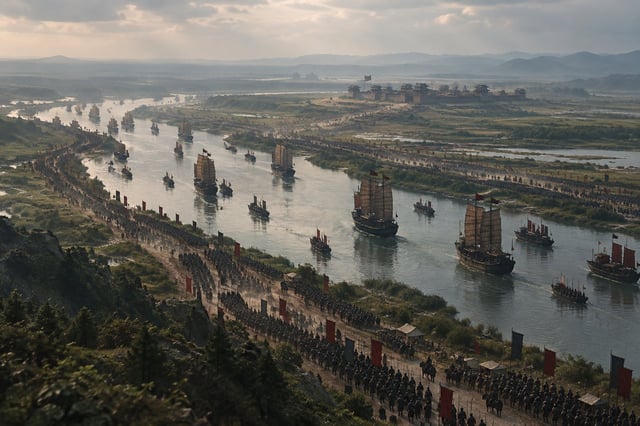
Replay the Battle of Xiaoyao Ford phase by phase on real terrain: troop strengths, movements and turning points at a glance, each marked as coming from the Records of the Three Kingdoms or the Romance.
Relationship timeline5 entries ▸
History · vol. 55
- Sun Ce§36
Lord
When Sun Ce was at Shouchun, Wu went to pay his respects and then accompanied him across the river
Novel · ch. 15
Novel · ch. 51
- Zhou Yu§26
Fights
was ordered to serve as one of the ambush troops and attack from the north
Novel · ch. 61
- Cao Cao§48
Enemy
Came out of ambush with Pan Zhang from the left side of the mountain, leading three thousand archers and crossbowmen in a volley of arrows
Inner monologues · AI-generated1 monologue ▸
- I am Chen Wu, courtesy name Zilie, from Songzi in Lujiang. When I was eighteen, Sun Ce was at Shouchun. I went to see hi