Overview
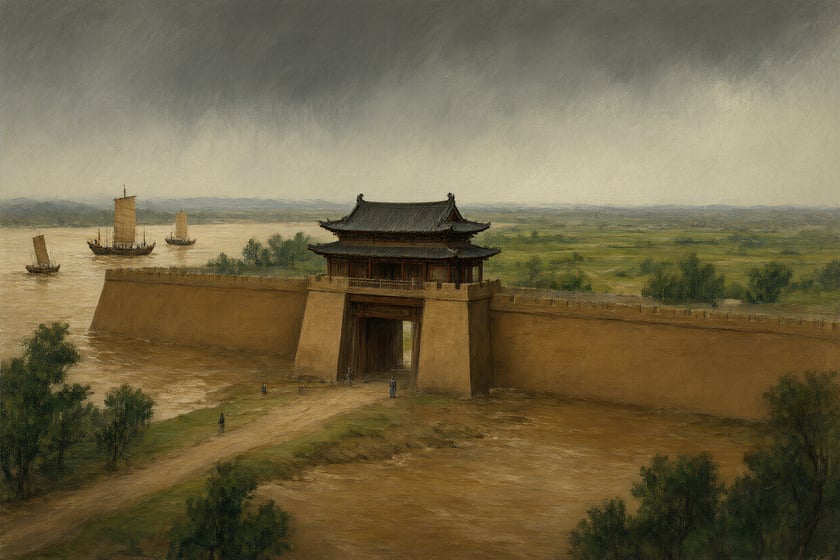
Fancheng was a city in Jing Province during the Eastern Han, on the north bank of the Han River. It was also referred to simply as “Fan” in historical texts, and faced Xiangyang across the river on the southern bank. Its site lies in present-day Fancheng District, Xiangyang, Hubei Province. It commanded a Han River crossing and served in succession as a stronghold from which Liu Biao and Cao Wei defended the northern approaches to Jing Province. In the twenty-fourth year of Jian’an (219), Guan Yu besieged Cao Ren there. The Han River flooded and submerged the seven armies of Yu Jin, while Cao Ren held out in the isolated city until reinforcements lifted the siege.
History
In the third year of Chuping (192), Sun Jian, acting on Yuan Shu’s orders, campaigned against Liu Biao. Liu Biao sent Huang Zu to meet him between Fan and Deng. Sun Jian defeated Huang Zu, crossed the Han River, and besieged Xiangyang. Liu Biao allowed Liu Bei, who had sought refuge with him, to garrison Xinye; Liu Bei later moved his garrison to Fancheng. According to the Weilüe, Zhuge Liang foresaw that Jing Province would come under attack by Cao Cao and once traveled north to Fancheng to seek an audience with Liu Bei. In the thirteenth year of Jian’an (208), Liu Biao died, and his son Liu Cong surrendered to Cao Cao. Liu Bei, who was garrisoned at Fan, had not known of this in advance. He learned of it only when Cao Cao’s army reached Wan, and had no choice but to lead his followers south from Fancheng. That same year, Xu Huang accompanied Cao Cao on his campaign against Jing Province and was separately stationed at Fan.
Fancheng thereafter came under the Cao clan’s control. Cao Ren, holding the acting title of General Who Conquers the South and bearing imperial authority, was stationed at Fan to defend Jing Province. After Hou Yin occupied Wan and rebelled, Cao Ren suppressed the revolt and returned to garrison Fancheng; he was then formally appointed General Who Conquers the South. In the twenty-fourth year of Jian’an (219), Guan Yu attacked Fancheng. In autumn, heavy rain fell for more than ten days, and the Han River surged until the water on the plains below Fancheng reached five or six zhang deep. The seven armies led by Yu Jin, who had come to reinforce the city, were all submerged, and Yu Jin surrendered to Guan Yu. Cao Ren had only a few thousand men to defend the city, and just a few planks of the walls remained above water. Guan Yu approached the city by boat and surrounded it with several lines of troops, cutting it off from all outside contact; provisions were nearly exhausted. The water had soaked through the city walls, causing several sections to collapse. Some urged Cao Ren to escape by boat under cover of night, but Man Chong strongly advised him to hold fast. He sank a white horse and swore an oath with the officers and soldiers. While Guan Yu was besieging Fancheng and Xiangyang, Cao Cao, concerned that Xu lay too close to the front, briefly considered moving Emperor Xian away from Xu. Sima Yi and Jiang Ji dissuaded him and suggested contacting Sun Quan to attack Guan Yu from the rear. Xu Huang’s reinforcements broke through Guan Yu’s siegeworks, finally lifting the siege of Fancheng. Cao Cao praised Xu Huang for “saving Fancheng and Xiangyang”.
In the fifth month of the second year of Zhengshi (241), the Wu general Zhu Ran and others led fifty thousand men in an attack on Fancheng. The siege lasted for more than a month without being lifted. Hu Zhi, Inspector of Jing Province, judged that Fancheng was in a low-lying position and had too few defenders. He hurried there with a light force to provide relief, and only then did the city settle. In the sixth month, Grand Tutor Sima Yi personally led a southern campaign and made a show of being determined to attack. Zhu Ran withdrew under cover of night, and the Wei army pursued him to Sanzhoukou, where it won a major victory.
People
- Liu Bei: While under Liu Biao, he moved his garrison from Xinye to Fancheng; when Cao Cao marched south, he retreated south from there.
- Cao Ren: He was stationed at Fan for many years to defend Jing Province and commanded the defense when Guan Yu besieged the city.
- Man Chong: Then serving as Administrator of Runan, he helped Cao Ren defend Fan and was enfeoffed as Marquis of Anchangting after the battle.
- Pang De: After suppressing Hou Yin’s revolt, he was stationed south at Fancheng. He often rode a white horse, and Guan Yu’s army called him the “White Horse General.” He once shot Guan Yu in the forehead. When the Han River flooded, he fought fiercely on the embankment north of Fancheng until his arrows ran out. Captured by Guan Yu, he stood without kneeling, cursed Guan Yu, and was executed.
- Li Xu: Li Tong’s son, he rendered meritorious service while stationed at Fancheng and was appointed Gentleman of the Household Who Pacifies the Barbarians during Emperor Wen of Wei’s reign.
Differences in Historical and Fictional Accounts
In Romance of the Three Kingdoms, after Huang Zu was defeated by Sun Jian, he abandons Fancheng and retreats to Dengcheng. The Records of the Three Kingdoms says only that Sun Jian defeated Huang Zu between Fan and Deng. In the novel, while Liu Bei is at Xinye, he uses Shan Fu’s strategy to seize Fancheng, where Cao Ren is stationed. The county magistrate Liu Mi comes out to welcome him, and Liu Bei later adopts Liu Mi’s nephew Kou Feng as his son at Liu Mi’s home, renaming him Liu Feng. The seizure of Fancheng is not recorded in the Records of the Three Kingdoms. The “Biography of Liu Feng” in the Records of the Three Kingdoms says only that Liu Feng was the son of the Kou family of Luohou and the nephew of the Lady Liu of Changsha, and that Liu Bei adopted him after arriving in Jing Province. The novel also says that Liu Bei moved all the people of Xinye to Fancheng to escape Cao Cao, and that Cao Cao subsequently stationed troops at Fancheng and summoned Liu Cong to cross the river to meet him. By contrast, the “Annals of Emperor Wu” in the Records of the Three Kingdoms says that Liu Cong had already surrendered when Cao Cao reached Xinye. As for Guan Yu’s Scraping the Bone to Cure the Poison, the Records of the Three Kingdoms says the arrow poison was from an old stray arrow that had pierced his left arm, but does not state when or where he was shot. Romance of the Three Kingdoms instead says that Guan Yu was shot in the right arm by Cao Ren’s archers while attacking Fancheng’s north gate.
Today
The site of Fancheng lies in present-day Fancheng District, Xiangyang, Hubei Province, on the north bank of the Han River, facing the ancient city of Xiangyang across the river.