Records
Cao forces won
- Commanders
- Guan Yu's armyGuan Yu
Vol. 9「晃從外擊羽,仁得溃圍出,羽退走」
219 CE (Jian'an 24) · Fancheng
In the summer and autumn of the twenty-fourth year of Jian'an (219), after Liu Bei proclaimed himself King of Hanzhong, he appointed Guan Yu as military governor of the nine commanderies of Jing and Xiang. Guan Yu then led his forces north from Jiangling to attack Xiangyang and Fancheng, and Cao Ren withdrew into Fancheng to make a last stand. In the eighth lunar month the Hanshui flooded, and Guan Yu used his naval forces to capture the entire relief army — the seven corps and thirty thousand infantry and cavalry commanded by Left General Yu Jin, whom Cao Cao had dispatched — and executed Pang De, shaking all of central China. Cao Cao sent Xu Huang to relieve the siege and accepted the proposal of Sima Yi and Jiang Ji to grant Sun Quan the lands south of the Yangzi as a fief in exchange for attacking Guan Yu from the rear. Sun Quan conferred secretly with Lv Meng and Lu Xun on a plan to seize Jingzhou: Lu Xun would first replace Lv Meng in command and write submissive letters to lull Guan Yu into complacency. In the intercalary month, Lv Meng crossed the river in disguise; the garrison commander Shi Ren at Gong'an and the Grand Administrator of Nanjun Mi Fang surrendered their cities one after the other. In the eleventh month Lu Xun separately seized Yidu, Zigui, Zhijiang, and Yidao. Xu Huang broke through the siege lines from outside, and Cao Ren sallied out to exploit the situation. Guan Yu retreated west to hold Maicheng, but Liu Feng and Meng Da refused to send reinforcements, citing the recent submission of their mountain commanderies. In the twelfth month, Sun Quan's officers Pan Zhang and Ma Zhong captured and executed Guan Yu along with his son Guan Ping and the commander Zhao Lei at Zhangxiang. From that point on, all of Jingzhou belonged to Eastern Wu.
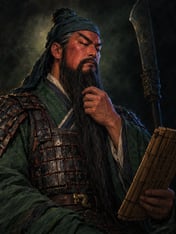 Guan YuCommanderTalk to me
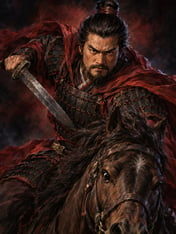 Cao RenCommanderTalk to me
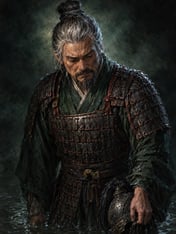 Yu JinKilled in actionTalk to me
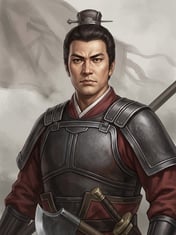 Xu HuangCommanderTalk to me
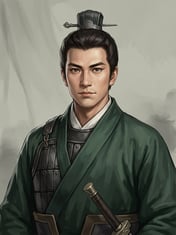 Lü MengInstigatorTalk to me
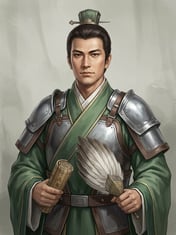 Lu XunInstigatorTalk to me
Who won, as each book tells it; commanders as the text names them.
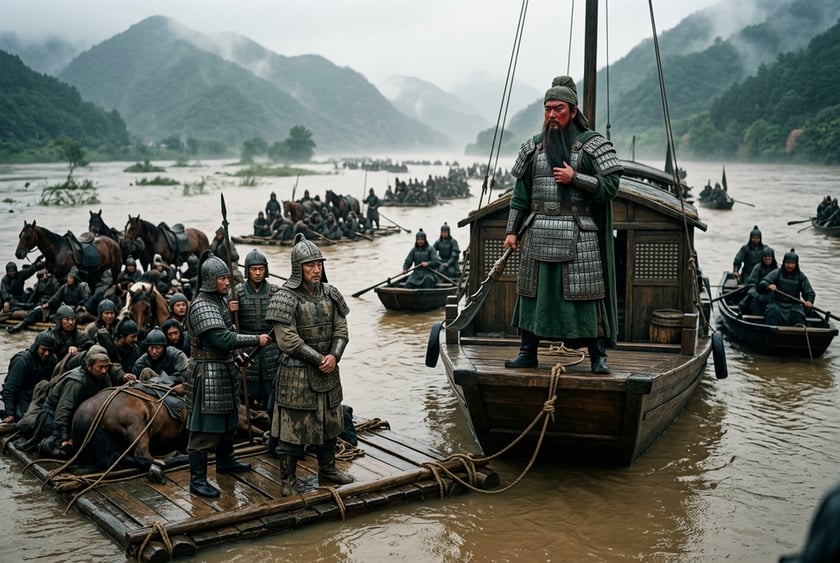
Scene
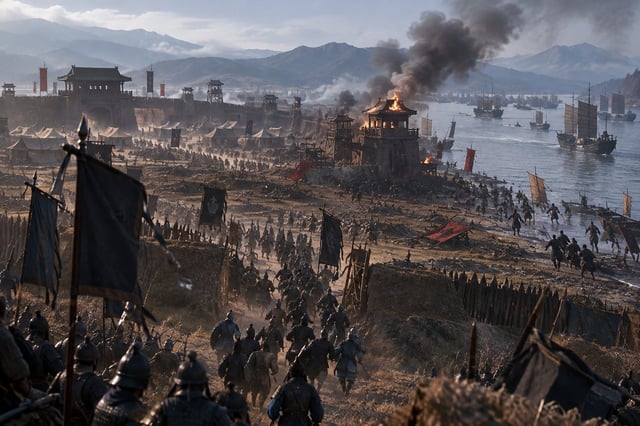
In the eighth month of autumn, the Han River swells, and Guan Yu leads his troops by boat, surrounding and capturing in the flood the thirty thousand Cao Cao infantry and cavalry led by Yu Jin.
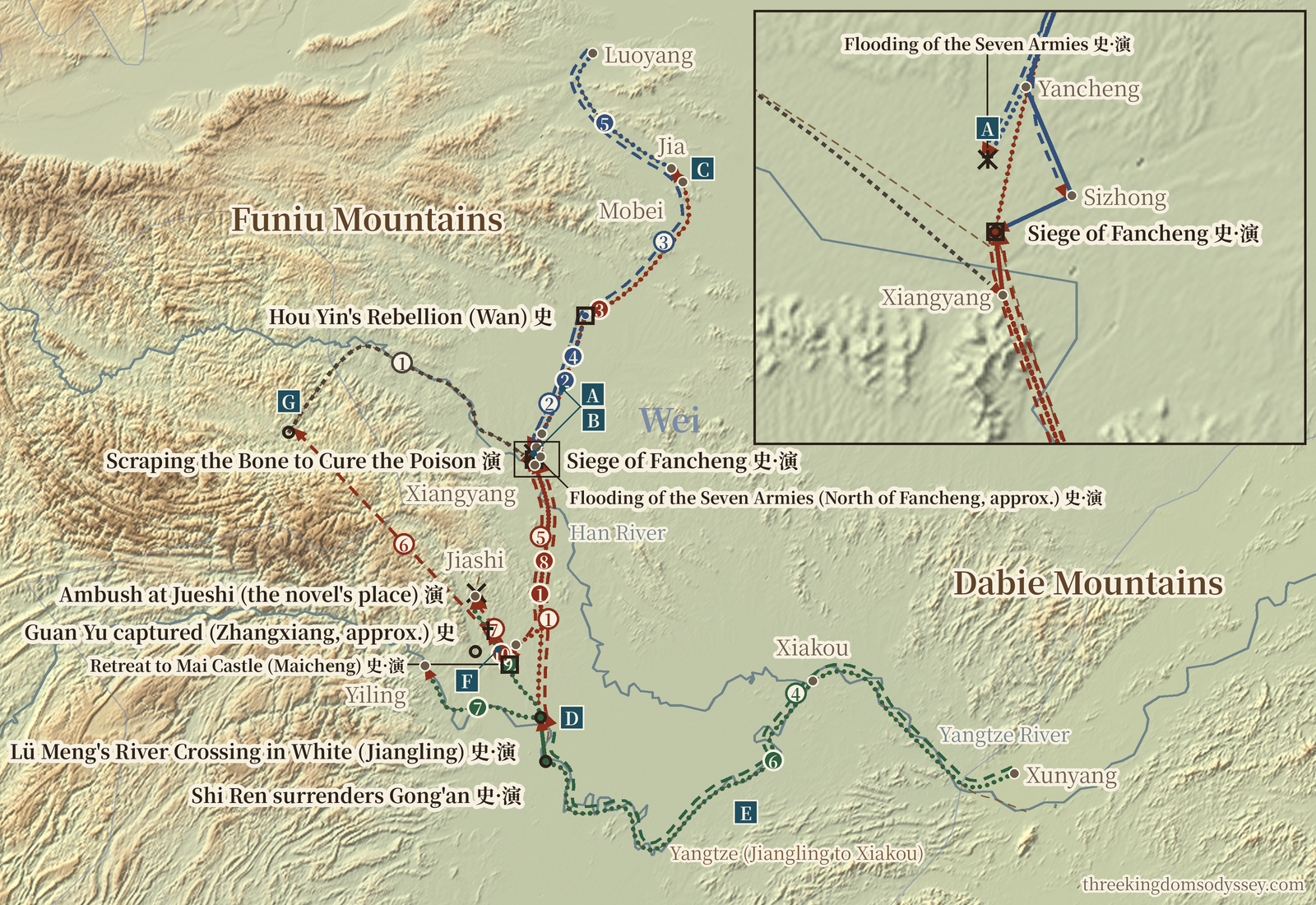
Swipe to see the whole map
In the Sanguozhi Guan Yu besieges both Fancheng and Xiangyang and takes neither; in the novel he first takes Xiangyang, then crosses the river to attack Fancheng.
The books mostly say only where an army set out and arrived: a Records line is solid between the places they name and dotted where it follows a reconstructed road between them; an open ring marks an end the books don't give.
Base map: Natural Earth; terrain: AWS Terrain Tiles (SRTM and others). Roads and marches reconstructed from the sources listed; positions approximate.
Replay the battles on this map in 3D, phase by phase:▶ Guan Yu's Northern Campaign
219
219
219
219
219
219
219
219
Continue
Replay the Guan Yu's Northern Campaign phase by phase on real terrain: troop strengths, movements and turning points at a glance, each marked as coming from the Records of the Three Kingdoms or the Romance.
2084 people in common
2222 people in common
2162 people in common
2152 people in common
2152 people in common
2092 people in common
2072 people in common
2012 people in common
From a modern military-history perspective, Guan Yu's northern campaign (Guanyubeifa) was the highest-risk "single-axis advance" of the early San Guo period. In the twenty-fourth year of Jian'an, Liu Bei had just taken Hanzhong and proclaimed himself King of Hanzhong; the Shuhan regime was entering a phase of strategic offense. The heart of Zhuge Liang's Longzhong Plan was: "when conditions in the realm change, dispatch a senior general to lead the Jingzhou army toward Wan and Luo" — a "wait for an opening, then move on two fronts" concept. In practice, however, Liu Bei did not wait for a genuine shift in the Central Plains (such as internal rebellion within Cao Cao's ranks or the consolidation of the Sun-Liu alliance) before sending Guan Yu north alone, thereby stripping the strategy of its core purpose — simultaneous pressure on two fronts. The timing of Guan Yu's campaign had its reasonable side: Cao Cao had just finished the Hanzhong campaign and his main force was exhausted; Emperor Xian was under Cao Cao's control in Xudou, leaving the southern approaches to Xudou thinly defended; and Hou Yin's rebellion at Wancheng (already suppressed by Cao Ren) had exposed the vulnerability of Caowei's Jing-Yu region. But the fundamental strategic risk was this: the Sun-Liu alliance had in practice already broken down — after the Xiang River demarcation agreement, Sun Quan had never restored genuine trust in Liu Bei; for Eastern Wu, Jingzhou had always been "territory that must be reclaimed," a point that Guan Yu's command clearly failed to appreciate.
Caowei's deployment unfolded in three phases. In the initial phase, General of the South Cao Ren held Fancheng; General of the Left Yu Jin led seven armies as a mobile relief force; and General Who Pacifies Outlaws Xu Huang served as a subsequent reserve. The critical weakness of this defensive posture was that Yu Jin's forces were encamped in low-lying ground, entirely unprepared for the catastrophic flood that can result from the Hanshui's summer rise — a once-in-a-century event for which Cao Cao had made no contingency plan, a clear intelligence failure regarding local topography. In the second phase, after Yu Jin's entire force was annihilated, Cao Cao considered "moving the capital to avoid" Guan Yu but was talked out of it by Sima Yi and Jiang Ji; he then shifted to a diplomatic solution — offering Sun Quan a promise of territories south of the Yangtze to activate the fault line between the Sun and Liu camps. In the third phase, Xu Huang led the main relief force in a counterattack, coordinating with Cao Ren in a simultaneous inner-outer squeeze that finally broke the siege.
On Guan Yu's side, the deployment appeared organized: Wang Fu advised building beacon towers along the river and replacing Pan Jun as governor of Jingzhou with Zhao Lei, but Guan Yu accepted only the beacon-tower proposal and refused to replace Pan Jun — revealing the blind spot in his personnel judgment. The principle of "never reversing a posting made by Liu Bei" was a source of political stability in peacetime but of rigidity in wartime. The front line consisted of Liao Hua, Guan Ping, and Guan Yu himself as the mobile strike force, backed by naval supremacy — a reasonable arrangement before the Hanshui flood, since the navy could simultaneously threaten Fancheng and Xiangyang while cutting off north-south communication between Cao Cao's forces.
Eastern Wu's deployment was the most strategically imaginative of all. Lv Meng feigned illness to withdraw from the front line and recommended Lu Xun as his replacement, leading Guan Yu to believe the eastern flank was secure, whereupon he voluntarily stripped troops from Jingzhou's defenses to reinforce the front — the most lethal lure of the entire campaign. After taking command, Lu Xun sent a letter couched in deliberately humble and deferential language, further lulling Guan Yu. At the moment when Guan Yu was bogged down at the front and his rear was hollow, Lv Meng crossed the river in civilian (merchant) disguise, Shi Ren and Mi Fang surrendered, and the Yidu commandery was encircled by Lu Xun in a flanking maneuver — a textbook campaign of strategic deception combined with rapid maneuver.
The campaign had four key decision points, each of which altered its course. The first was Guan Yu's casual redeployment of rear-area garrison forces to the front. This decision stemmed from his misjudgment of the Sun Quan axis and from the success of Lu Xun's deceptive letter. The second was Cao Cao's adoption of Sima Yi's reverse gambit of "leaking Sun Quan's letter to make Guan Yu hesitate." Cao Cao had Sun Quan's secret communication about the plan to strike Jingzhou shot into Fancheng and into Guan Yu's camp; the intention was to steady the morale of Fancheng's garrison and to force Guan Yu into a dilemma — retreat and the Fancheng siege would be lifted; stay and Jingzhou might be lost. Guan Yu did indeed "hesitate and could not bring himself to leave", ultimately neither taking Fancheng nor finding the time to return and relieve Jingzhou. The third was Liu Feng and Meng Da's refusal to march out from Shangyong to the rescue. Both cited "the mountain commandery has newly submitted and cannot yet be disturbed," but the real cause was their badly deteriorated relationship with Guan Yu; Meng Da subsequently defected to Caowei after a clash with Liu Feng over the use of ceremonial drums, reflecting a serious coordination failure within the Shuhan camp. The fourth was the swift surrender of Mi Fang and Shi Ren. These two rear-area commanders appointed by Guan Yu bore old grudges over his habitual harshness; when Lv Meng arrived outside the walls, they opened the gates with virtually no resistance — a wholesale backlash against Guan Yu's management style of being strict without warmth.
The immediate outcome of the campaign was Guan Yu's capture and execution at Zhangxiang, the complete transfer of Jingzhou's three commanderies to Eastern Wu, and the total erasure of nearly a decade of Shuhan's investment in Jingzhou. The medium-term reverberations were threefold: first, the Sun-Liu alliance became a dead letter; Liu Bei launched the Battle of Yiling the following year (221), inflicting a fresh blow to Shuhan's national strength; second, after Sun Quan received Jingzhou, Cao Cao memorialized him as General of the Chariot and Cavalry, completely reshaping the triangular relationship among the three powers — the true crystallization of the three-kingdoms standoff came after this battle rather than before; third, Guan Yu's death became the central traumatic event in Shuhan's cultural memory, and Liu Bei's decision to seek revenge effectively determined all of Shuhan's subsequent strategic choices, casting everything from Yiling to Zhuge Liang's northern campaigns under the double emotional shadow of "avenging Guan Yu" and "restoring the Han dynasty." Viewed from Caowei's perspective, this campaign marked the first occasion on which Sima Yi played a critical role in a state-level strategic decision, planting the seed for his eventual ascendancy within Caowei's military and political system.
What would have happened if Guan Yu had pulled back immediately after the flood destroyed Yu Jin's seven armies? The most probable outcome: the Fancheng siege would have been lifted, Jingzhou would not have fallen, and the Liu Bei camp would still have possessed the strategic foundation for a two-pronged advance. But this would have required Guan Yu to relinquish the seemingly within-reach achievement of destroying Cao Ren and taking Fancheng — given his character, that was virtually impossible. A second counterfactual: had Liu Feng and Meng Da marched out from Shangyong to the rescue, they could at least have exerted some constraint on Lv Meng in the Jingzhou theater. But their mutual hostility was structural; Shuhan had failed to resolve the political problems on the Shangyong front before the campaign began — a deeper institutional failure. The more sweeping counterfactual: if Zhuge Liang's Longzhong two-front plan had been strictly observed — meaning that while Guan Yu advanced north, Liu Bei's main force simultaneously pressed out of Hanzhong or the Qinling range to threaten Changan — Caowei would have been unable to concentrate Xu Huang's relief forces eastward, and Sun Quan would have found it difficult to detach his main force to strike Jingzhou. But Liu Bei had just taken Hanzhong and his troops were exhausted and provisions depleted; he could not open a second front. Seen from this angle, the fundamental failure of Guan Yu's northern campaign lay not in tactics but in Shuhan prematurely mistaking a "local offensive" for a "two-front strategic opportunity," abandoning the patience of "waiting until conditions in the realm change."