


Background
“Guan Yu Attends the Meeting Armed with a Single Blade” took place after Liu Bei had gained Yi Province, against the backdrop of conflict between Sun and Liu over Jing Province and its subordinate commanderies and counties. The dispute was not simply a border skirmish, but a conflict within the alliance over territorial ownership, military contributions, and political commitments. Sun Quan’s side regarded the land loaned at the outset as a temporary foothold for Liu Bei; now that Liu Bei had secured Yi Province, they believed he should return part of Jing Province. Liu Bei did not accept this demand, and sent Guan Yu to face off against the Eastern Wu army. The Records of the Three Kingdoms states that Sun Quan sent Lü Meng to seize three commanderies by force; Liu Bei returned from Gong’an and ordered Guan Yu to contest them; and Lu Su was stationed at Yiyang, where he confronted Guan Yu. Thus, the meeting was not an isolated act of heroic daring, but a high-risk political negotiation amid a military stalemate.
The Romance of the Three Kingdoms elaborates the conflict into a story in which Sun Quan flies into a rage, Lu Su proposes luring Guan Yu to a banquet to kill him or seize land while there, and Guan Yu knowingly accepts the invitation despite the danger. Guan Yu also has a naval force stand by, using a red flag as the signal. These details heighten the drama of personal courage and the threat exerted in the moment, but cannot be taken directly as historical fact. The meeting described in the Records of the Three Kingdoms took place with both sides’ armies stationed nearby, and the generals agreed to meet armed with single blades. The text does not say that Guan Yu went to a banquet at Lukou accompanied by only a dozen or so attendants, nor does it mention an ambush of armed men with knives and axes. Any analysis of the episode must therefore distinguish the novel’s narrative from the negotiation and confrontation recorded in the histories.
Main Figures
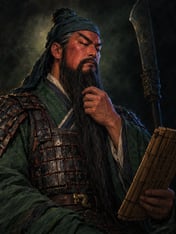
Guan Yu was both a frontline commander and a representative of Liu Bei's faction’s position. In response to Lu Su’s challenge, he did not immediately reduce the territorial dispute to a personal grievance. Instead, he cut off interjections from those present by saying, “This is a matter of state,” and cited their shared history of fighting Cao Cao, including the Battle of Wulin, to ask whether Eastern Wu had contributed without receiving anything in return. The Guan Yu depicted in the historical record did not prevail through martial prowess alone: the talks took place with the troops of both sides as backing, while his words sought to recast the land dispute in terms of alliance contributions and political legitimacy.
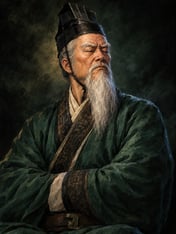
Lu Su organized the negotiations and was also a key figure in defending the order of the alliance on Eastern Wu’s behalf. The Records of the Three Kingdoms states that he advocated attending the meeting in person, believing that the parties should “explain matters to one another,” and that in the conversation he recalled how Sun Quan had sheltered Liu Bei when his position was desperate, before accusing Liu Bei of seeking to extend his control over Jing Province even after gaining Yi Province. The novel, by contrast, depicts Lu Su as a man pressed by Sun Quan to demand land at a banquet, and has Lü Meng take part in the pre-meeting discussion. The two accounts have different emphases: the history focuses on Lu Su’s appeal to principle and the alliance’s past dealings, while the novel highlights the strategic predicament of a man caught between Sun Quan’s pressure and Guan Yu’s threat.
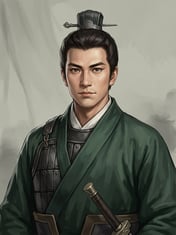
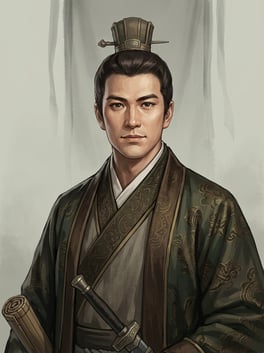
Sun Quan was the decision-maker behind the territorial claims and military action, while Lü Meng is recorded as the commander ordered to lead troops in seizing the three commanderies. The two represented Eastern Wu’s political power and military strength in its effort to secure interests in Jing Province. Zhang Zhao is listed among the figures associated with the episode, but the cited historical passage does not record his taking part in the meeting or in the decision-making, so it cannot be used to attribute any specific words, actions, or influence to him. Similarly, the novel’s account of Lü Meng participating in Lu Su’s pre-meeting discussion does not prove that he attended the negotiations between Guan Yu and Lu Su in the historical record. Distinguishing between “a figure being connected to the conflict” and “evidence proving that the figure was present” is essential to avoiding the mistake of treating a literary scene as political fact.
Key Issues
The first issue was who had the authority to interpret the land arrangements and commitments. Eastern Wu described the land in Jing Province as temporary assistance given when Liu Bei had nowhere to turn. Since Liu Bei had later gained Yi Province, it demanded that he return some territories. Liu Bei’s side, on the other hand, emphasized their shared contribution to the fight against Cao Cao. Citing the Battle of Wulin and asking why they had received “not a single clod of land,” Guan Yu opposed reducing the relationship to a loan. The core of the dispute was not simply where the borders lay, but on what principle the alliance should distribute its gains: the original commitment, actual occupation, or contributions to the common war effort. The sources present competing claims to legitimacy, not a contract text accepted by both sides.
The second issue was how military deterrence could serve the negotiations. The historical account’s statement that “each side stationed its troops a hundred paces away, while only the generals met, each armed with a single blade” shows that neither side disarmed. Instead, they designed the close-range meeting as a controlled risk: the troops present could discourage either party from resorting rashly to force, while the generals’ meeting with single blades kept the negotiations from becoming a full-scale confrontation between armies. Guan Yu’s standing and reputation, Lu Su’s negotiating skill, and the balance of power created by the two armies’ proximity together made the talks possible. The novel concentrates this institutional, collective military restraint in Guan Yu’s personal courage, making the hero easier to remember but the power structure that enabled the negotiations harder to see.
The third issue was the crisis of trust within the alliance. Lu Su attributed the dispute to Liu Bei’s failure to honor his obligations after receiving aid, while Guan Yu stressed the Wu–Shu alliance’s contribution to the fight against Cao Cao and the unfairness of the land distribution. Both sides invoked moral principles to show that they were not simply pursuing their own interests. Because each regarded its own demands as justified, the crisis could not be resolved with a simple “return it” or “refuse.” The meeting gave both parties a chance to state their positions directly, but it also entangled personal safety, troop deployments, and political credibility: any concession could be construed as weakness or a breach of faith.
Political Consequences
The available historical sources show that the negotiations did not produce a comprehensive settlement over the ownership of Jing Province, but the conflict was temporarily halted afterward. The Records of the Three Kingdoms says that Liu Bei “thereupon made the Xiang River the boundary, and the armies were then withdrawn.” This means the parties used the Xiang River as a provisional dividing line, ending the military standoff over the three commanderies at that time. It does not prove that the dispute disappeared completely, nor can it be equated simply with a complete victory for Sun Quan or Liu Bei. More precisely, it was a short-term ceasefire secured by drawing a territorial line while the two sides remained evenly matched and the alliance had not yet fully collapsed. If “the outcome is unclear” means that it is uncertain who won the meeting itself, the Records of the Three Kingdoms gives no explicit verdict; however, it does record the temporary conclusion of the military operations then underway.
Politically, the boundary along the Xiang River turned an abstract dispute within the alliance into a temporarily enforceable territorial arrangement, but did not erase the parties’ differing memories of their commitments. Eastern Wu used military pressure to advance its demand for the return of land, while Liu Bei's faction had Guan Yu hold the border and maintain its own interpretation of events. Lu Su’s direct negotiations prevented the immediate escalation of the conflict, but did not establish rules that both sides could share over the long term. The significance of Guan Yu Attends the Meeting Armed with a Single Blade should therefore not be summed up merely as “Guan Yu was brave.” More importantly, it shows how an alliance lacking a credible mechanism for arbitration relied on military balance, personal prestige, and temporary compromise to maintain order.
Counterfactual Analysis
If Guan Yu had refused to attend the meeting, the novel’s line “They will call me a coward” reflects the pressure of reputation, but the historical sources cannot prove that a refusal would necessarily have led Eastern Wu to attack immediately. A more cautious inference is that, since the two sides were already facing off at Yiyang and Eastern Wu had sent Lü Meng to seize the three commanderies, refusing to negotiate might have prolonged the military standoff and increased the risk of local clashes. At the same time, Guan Yu would have avoided placing himself close to the opposing commanders. Which risk would have been greater depends on troop strength, supplies, and whether both sides were willing to keep the alliance intact; the available passage does not support a definitive judgment.
If the meeting had turned into armed conflict, the outcome would not necessarily have been as predictable as the novel’s account of Guan Yu escaping through his own martial prowess. The historical account shows that both sides had troops stationed nearby, indicating that the meeting’s safety did not depend solely on the blade in Guan Yu’s hand. If the talks had broken down, the state of the battlefield, the speed of reinforcements, and coordination among commanders would all have affected the outcome. The novel has Guan Yu prepare a naval force in advance and use a red flag as a signal, creating the image of a controlled personal crisis. Historical analysis, by contrast, must acknowledge that the sources lack comparable details about the deployments, making it impossible to assert that an ambush, a clash, or Guan Yu’s safe departure was bound to occur.
A deeper counterfactual is this: if Sun Quan and Liu Bei had clearly established, before the acquisition of Yi Province, the duration of Jing Province’s use, the distribution of its benefits, and a means of resolving disputes, Lu Su might not have needed to use military pressure to drive negotiations, and Guan Yu might not have had to rely on his personal prestige to manage a border crisis. This, however, is only a conjecture about institutional conditions, not a historical outcome that the sources can establish. The structural problem revealed by the episode is that the alliance’s early promises of mutual aid did not automatically become enforceable rules for distributing gains after the war. When a common enemy remained but internal interests had changed, vague commitments could easily turn from the basis of cooperation into grounds for dispute.