Overview
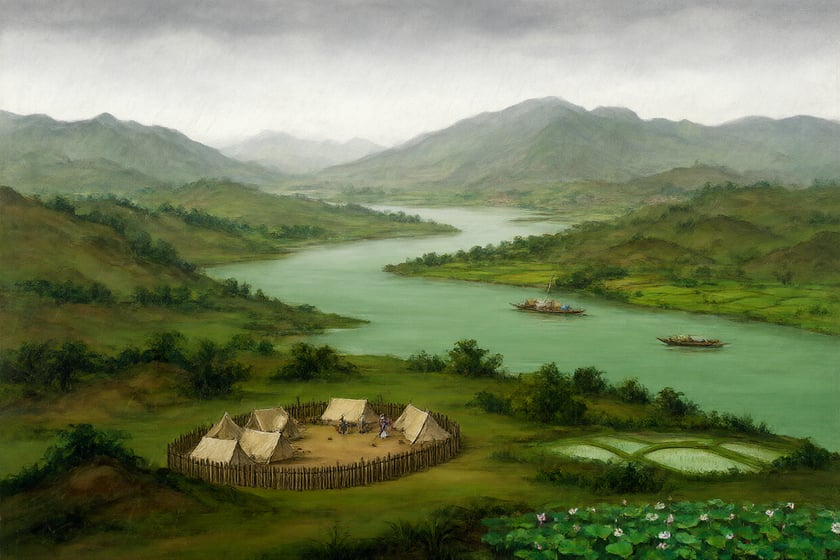
Yiyang was a county under Changsha Commandery in Jing Province during the Eastern Han dynasty. Its former site lies in present-day Yiyang City, Hunan Province, along the lower reaches of the Zi River. In Jian’an 20 (215), Sun Quan and Liu Bei contended for the three commanderies of Changsha, Lingling, and Guiyang. Guan Yu led troops into Yiyang, while Lu Su also stationed himself there to oppose him. The meeting recorded in the Records of the Three Kingdoms, where Lu Su and Guan Yu “met together with single blades,” took place here; the well-known later story Guan Yu Attends the Meeting Armed with a Single Blade originated from it.
History
After the Battle of Red Cliffs, Yiyang was attacked for a time by mountain bandits, whom Sun Quan’s general Huang Gai led troops to suppress.
In Jian’an 20, seeing that Liu Bei had already obtained Yi Province, Sun Quan sent envoys to demand Jing Province. Liu Bei put him off, saying he would return it once he had acquired Liang Province. Enraged, Sun Quan sent Lü Meng to seize the three commanderies of Changsha, Lingling, and Guiyang. Liu Bei led fifty thousand troops down to Gong’an and ordered Guan Yu to enter Yiyang; Guan Yu commanded thirty thousand troops. Sun Quan recalled Lü Meng to assist Lu Su. After inducing Hao Pu, the Administrator of Lingling, to surrender, Lü Meng set out with his army for Yiyang that very day.
Lu Su was stationed at Yiyang, opposing Guan Yu. He invited Guan Yu to meet, and both sides halted their troops a hundred paces apart; only their officers attended, each carrying a single blade. Lu Su reproached Guan Yu to his face: he had originally lent territory to Liu Bei because Liu had been defeated and had come from afar with no resources, but now that he had obtained Yi Province, he not only refused to return the land, but would not even hand over the three commanderies. Someone at the gathering interjected, “Territory belongs only where virtue resides.” Lu Su rebuked him sternly, and Guan Yu also rose with his blade in hand and ordered the man to leave.
Guan Yu selected five thousand elite soldiers from among his men and went to a shallow crossing more than ten li upstream from Yiyang County, declaring that they would ford the river under cover of night. Gan Ning had only three hundred troops at the time. He asked for another five hundred to confront them, saying he guaranteed Guan Yu would not dare enter the water once he heard him cough. Lu Su reinforced him with a thousand troops. Gan Ning hurried there that night, and Guan Yu indeed halted and did not cross, instead building a stockade of brushwood. The shallow crossing was thereafter called “Guan Yu Shoal”.
Before the two sides came to blows, Cao Cao invaded Hanzhong. Fearing he would lose Yi Province, Liu Bei sent an envoy to seek peace. The two sides then divided Jing Province: Changsha, Jiangxia, and Guiyang to the east went to Sun Quan, while Nan Commandery, Lingling, and Wuling to the west went to Liu Bei. The Xiang River was set as the boundary, and the armies withdrew. Changsha Commandery, where Yiyang was located, thus came under Sun Quan’s control.
In the first year of Yankang (220), Sun Quan appointed Lü Dai to replace Bu Zhi, and Bu Zhi led ten thousand volunteers from Jiaozhou north through Changsha. Later, when Liu Bei marched east to attack Wu and the Wuling tribes rose in unrest, Sun Quan ordered Bu Zhi to move his post to Yiyang. After Liu Bei’s defeat, the commanderies of Lingling and Guiyang remained unsettled; Bu Zhi campaigned throughout the region and pacified them all.
People
- Lu Su: Sun Quan’s commander on the Jing Province front. While he and Guan Yu were neighbors, suspicions and border disputes repeatedly arose between them, and Lu Su often sought to ease tensions through friendly gestures.
- Gan Ning: A fierce general of Eastern Wu. For driving Guan Yu back at Yiyang, he was appointed Administrator of Xiling.
- Bu Zhi: After pacifying Lingling and Guiyang, he was promoted in Huangwu 2 (223) to General of the Right and Left Protector of the Army, and his fief was changed to Marquis of Linxiang.
Differences in Historical Dramatization
The Romance of the Three Kingdoms moves the “single-blade meeting” from Yiyang to Lukou: in the novel, Lu Su stations troops at Lukou, hosts a banquet, and invites Guan Yu across the river to attend, with men armed with axes and knives lying in ambush. Despite Guan Ping and Ma Liang’s remonstrances, Guan Yu goes in a small boat with only a dozen or so attendants, saying he will “attend the meeting armed with a single blade”. The meeting in the Records of the Three Kingdoms took place at Yiyang, with the two sides’ troops stationed a hundred paces apart and the officers carrying only single blades; Guan Yu was not the only one to attend.