Eastern Wu · General of Chariots and Cavalry; Governor of Jizhou; Area Commander of Xiling
Bu Zhi
–247
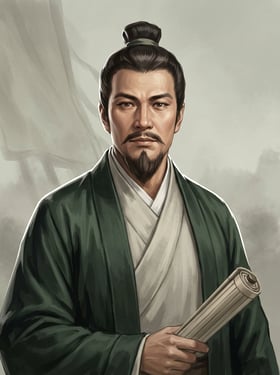
Bu Zhi was magnanimous in temperament and able to win the support of the multitude; joy and anger never showed in his voice or expression, so that all within and without were kept in awe. He was once of equal renown and on friendly terms with Yan Jun, and once joined his name with Zhuge Jin in a memorial.

Life
In the novel: 5 chapters · In the Records: 12 volumes
Life?–247
208 CE (Jian'an 13)
210 CE (Jian'an 15)
- Bu Zhi Pacifies Jiao ProvinceCangwuCommander
230 CE (Taihe 4)
242 CE (Zhengshi 3)
- Sun Quan's Faction
- Eastern Wu· Undated
- Hatched: dated by chapter
- Life event
- Death
List all 3 stops
On the boards
Compare with someone →Where this person ranks on each board.
Who they were
Character profile
- Character
- Bu Zhi was magnanimous in temperament and able to win the support of the multitude; joy and anger never showed in his voice or expression, so that all within and without were kept in awe. He was once of equal renown and on friendly terms with Yan Jun, and once joined his name with Zhuge Jin in a memorial.
- Manner of speech
- Even so he went on instructing and nurturing his disciples, never letting a book out of his hand, his dress and dwelling like those of a scholar.
- Life
- Bu Zhi took refuge in Jiangdong during the turmoil of the age. At first he was single and destitute, and together with Wei Jing of Guangling he grew melons to support himself, toiling with his four limbs by day and reciting the classics by night. When Sun Quan was General Who Chastises Bandits, he summoned Bu Zhi as recorder, and later appointed him chief of Haiyan. In the fifteenth year of Jian'an he went out to serve as Grand Administrator of Poyang, and within the year was transferred to Inspector of Jiaozhou. After Sun Quan assumed the honored title, he appointed Bu Zhi General of Agile Cavalry, concurrently Governor of Jizhou, and in the ninth year of Chiwu he succeeded Lu Xun as Chancellor.
- Anecdotes
- Bu Zhi was a great general of the state of Wu, serving as Chancellor, General of Agile Cavalry, concurrently Governor of Jizhou, and area commander of Xiling; for twenty years at Xiling the neighboring enemies respected his prestige and trustworthiness. He once received a letter that Sun Quan had copied out and shown him; the dress of the wives and concubines within his household was extravagant and ornate, and for this he drew a good deal of criticism.
Historical Record
Bu Zhi, courtesy name Zishan, was from Huaiyin in Linhuai. At the end of the Han dynasty, he fled the turmoil and went to Jiangdong, where he once grew melons with Wei Jing to support themselves. They labored by day and studied the classics at night. Historical accounts describe him as broad-minded, refined, and deep in character, able to endure humiliation and maintain his composure. When Sun Quan was serving as General Who Attacks the Caitiffs, he summoned Bu Zhi to serve as Chief Clerk. Thereafter Bu Zhi held posts including Magistrate of Haiyan, Assistant in the Eastern Bureau, and Administrator of Poyang. In the fifteenth year of Jian’an, he became Inspector of Jiaozhou and General of the Martial Might, and was ordered to travel south. Facing Wu Ju, the Administrator of Cangwu, who harbored rebellious intentions, Bu Zhi first treated him with humility and invited him to a meeting, then had him executed. The brothers Shi Xie thereupon led their followers in accepting orders, and the southern commanderies began to submit to Eastern Wu. Bu Zhi later also pacified and accepted powerful local families in Yi Province, including Yong Kai, and was enfeoffed as Marquis of Guangxin.
In the first year of Yan’kang, Lü Dai replaced Bu Zhi in defending Jiaozhou. Just then, Liu Bei advanced eastward and the Wuling tribes were causing unrest, so Sun Quan ordered Bu Zhi to move his post to Yiyang. After Liu Bei’s defeat, Lingling, Guiyang, and other areas remained unsettled; Bu Zhi traveled between them, campaigning and bringing each place under control. Later, he served as General of the Right and Left Protector of the Army, and was enfeoffed as Marquis of Linxiang. He was then appointed General of Chariots and Cavalry, concurrently Inspector of Jizhou, and placed in command at Xiling. He administered the region for twenty years, earning the respect of neighboring hostile forces for his authority and reputation.
Bu Zhi not only commanded troops but also took part in court affairs and recommending talent. When Crown Prince Sun Deng sought his views on the scholars of Jing Province, Bu Zhi listed eleven men and assessed each in turn. When Lü Yi was in charge of checking documents and impeaching officials, Bu Zhi submitted a memorial advocating reliance on senior ministers such as the Chancellor, the Grand General, and the Minister of Ceremonies. In the seventh year of Chuwu, he and Zhu Ran, among others, submitted a memorial warning that Shu might break its alliance and ally with Wei, but Sun Quan judged that Shu had no such plan. In the ninth year of Chuwu, Bu Zhi succeeded Lu Xun as Chancellor. He continued to instruct his disciples and never put down his books; his clothing and household reflected the bearing of a Confucian scholar. Historical accounts also record that he was magnanimous, won the people’s support, and did not show his anger or delight. He died the following year, and his son Bu Xie succeeded to his post.
In the Novel
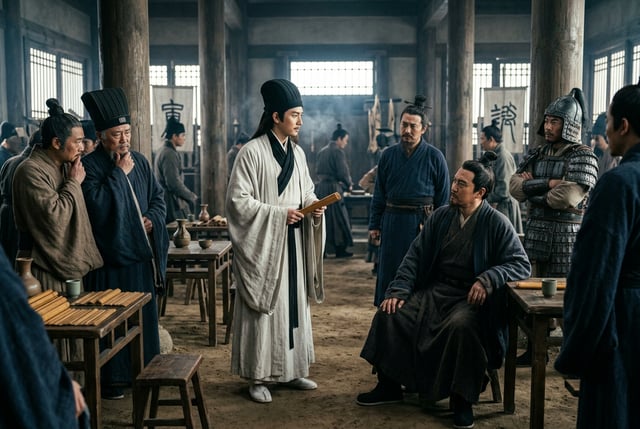
Romance of the Three Kingdoms portrays Bu Zhi as a civil official of Eastern Wu, emphasizing his role in diplomatic debate and military planning. In Chapter 43, “Zhuge Liang's Debate with the Scholars of Jiangdong,” he challenges Kongming, saying that he is lobbying like Su Qin and Zhang Yi. Kongming retorts that the officials of Eastern Wu fear a powerful enemy and seek to surrender, leaving Bu Zhi speechless. The scene depicts him as concerned by Cao Cao’s military strength and bested in debate; Records of the Three Kingdoms does not record this exchange.
The novel also has Bu Zhi join Zhang Zhao and others in advocating peace with Cao Cao. On Sun Quan’s orders, he goes to Cao Cao’s camp to negotiate and offers annual tribute. In the episodes surrounding Guan Yu's Northern Campaign, he proposes using Cao Cao’s forces to draw Guan Yu away, then seizing Jing Province when the opportunity arises. Before the Battle of Xiaoting, with Sun Quan under pressure from the Shu army, Bu Zhi advises returning Zhang Fei’s head and handing over Fan Qiang and Zhang Da to make peace, but this ultimately fails to quell Liu Bei’s desire for revenge. More strikingly, when Sun Quan asks Lu Xun whether he is fit to serve as Grand Commander, the novel has Bu Zhi declare that Lu Xun “has the ability to govern a commandery.” This contrasts with the historical Bu Zhi, who took part in recommending worthy men and served as Chancellor. These specific dialogues and stratagems are inventions of the novel and are not recorded in Records of the Three Kingdoms.
Key Relationships
Bu Zhi and Wei Jing were close in their youth. When they fled the turmoil to Jiangdong, they grew melons together to make a living. When the powerful Jiao Zhengqiang treated them with contempt, Wei Jing was so humiliated and resentful that he could hardly bear it. Bu Zhi, however, urged him not to feel ashamed for being treated according to his poverty and low status, and calmly finished their meager meal, showing his patience and lack of shame about poverty. His relationship with Shi Xie developed through the administration of Jiaozhou: after Wu Ju was executed, the brothers Shi Xie led their followers in accepting Bu Zhi’s authority. Bu Zhi also accepted the forces of Yong Kai and others, expanding Eastern Wu’s influence in the south.
At court, Bu Zhi joined Zhu Ran and others in submitting a memorial on the situation in Shu, and also joined Zhuge Jin in petitioning on behalf of Zhou Yin. Sun Deng regarded him as a senior minister whom he could consult and ask about scholars. The novel additionally depicts him as joining Zhang Zhao and others in advocating surrender and opposing Lu Xun’s appointment. These relationships and statements belong to the novel and are not recorded in Records of the Three Kingdoms.
Signature Scenes
In his youth, Bu Zhi and Wei Jing brought melons to seek an audience with Jiao Zhengqiang. After waiting a long time, they were given a place outside the window and served food on a small dish. Wei Jing felt insulted, but Bu Zhi said that it was only natural for poor and lowly people to be treated as poor and lowly. He then calmly ate his fill and took his leave. This anecdote encapsulates his early bearing: flexible in adversity, he endured hardship without complaint.
Another key scene takes place in Jiaozhou: Bu Zhi feigns humility toward Wu Ju, lures him to a gathering, and then has him executed. His reputation soon grows formidable, and the brothers Shi Xie submit to him. The episode marks a turning point in the situation in the south and shows how skillfully he combined stratagems with pacification and governance. The novel’s “Zhuge Liang's Debate with the Scholars of Jiangdong” offers a starkly different stage: Bu Zhi challenges Kongming’s attempts to persuade them face-to-face, then falls silent after Kongming rebuts him. This scene, unique to the novel, recasts the broad-minded, steady Chancellor of the historical accounts as a civil official who advocates surrender under pressure from Cao Cao.
Quotes
6 lines in the books · 3 featured
「曹操久欲篡漢,所懼者劉備也;今遣使來令吳興兵吞蜀,此嫁禍於吳也。」
This line exposes Cao Cao's scheme to kill with a borrowed knife, showing Bu Zhi's deep insight into the situation.
「今曹仁見屯兵於襄陽、樊城,又無長江之險,旱路可取荊州,如何不取,卻令主公動兵?只此便見其心。主公可遣使去許都見操,令曹仁旱路先起兵取荊州,雲長必掣荊州之兵而取樊城。若雲長一動,主公可遣一將,暗取荊州,一舉可得矣。」
This stratagem displays Bu Zhi's military cunning, providing the key idea for Eastern Wu to seize Jing Province.
「蜀主所恨者:乃呂蒙、潘璋、馬忠、糜芳、傅士仁也。今此數人皆亡,獨有范彊、張達二人,現在東吳。何不擒此二人,並張飛首級,遣使送還,交與荊州,送歸夫人,上表求和,再會前情,共圖滅魏,則蜀兵自退矣。」
This line reflects Bu Zhi's precise grasp of Shu Han's psychology, providing a strategy for reconciliation between Wu and Shu.
- Family
- Friends
- Enemies
- Other
Who is Bu Zhi connected to?
Pick someone to see how many steps lie between them and Bu Zhi.
History vs. novel
8 points · 5 novel-only
| History | Novel |
|---|---|
| Debating Zhuge LiangNovel only | |
| — | On the eve of Chibi, Bu Zhi questioned Zhuge Liang’s attempt to persuade Eastern Wu through his eloquence. After Zhuge Liang’s rebuttal, Bu Zhi fell silent. ch. 43 |
| Urging Zhou Yu to SurrenderNovel only | |
| — | Bu Zhi visited Zhou Yu together with Zhang Zhao, Gu Yong, and Zhang Hong. They advocated urging Sun Quan to surrender to Cao Cao, and believed that Lu Su had been influenced by Zhuge Liang and was stubbornly refusing to see reason. ch. 44 |
| Execution of Wu JuHistory only | |
After Bu Zhi was appointed Inspector of Jiaozhou, he used a conciliatory approach to lure Wu Ju into meeting him, then had him executed, striking fear across the south. The brothers of Shi Xie consequently submitted. vol. 52 | — |
| Pacifying Yong KaiHistory only | |
Yong Kai and other powerful families in Yi Province killed Zheng Ang, the governor appointed by Shu, and then asked to submit to Eastern Wu. Bu Zhi sent envoys to proclaim benevolence, offer comfort, and accept their submission; he was therefore enfeoffed as Marquis of Guangxin. vol. 52 | — |
| Proposing the Seizure of Jing ProvinceNovel only | |
| — | When Guan Yu attacked Fancheng, Bu Zhi advised Sun Quan to use Cao Ren’s deployment of troops to draw Guan Yu away, then secretly seize Jing Province. Sun Quan accepted his plan. ch. 73 |
| Urging Liu Bei to Make PeaceNovel only | |
| — | When Liu Bei campaigned against Wu, Bu Zhi advised returning Zhang Fei’s head, Fan Qiang, and Zhang Da, restoring Jing Province, and sending Lady Sun back, in the hope of making peace and joining forces against Wei. Sun Quan followed the plan and sent Cheng Bing as an envoy. ch. 83 |
| Fearing Shu Would Break the AllianceNovel embellishes | |
Bu Zhi and others submitted a memorial claiming that Shu Han might break its alliance and join Wei, citing shipbuilding, city repairs, and Jiang Wan’s defense of Hanzhong as evidence. Sun Quan, however, believed these were insufficient to prove that Shu would break the alliance. vol. 47 | The Romance does not depict Bu Zhi submitting a memorial expressing suspicion that Shu would break the alliance. Instead, it shows him advocating peace on terms such as restoring Jing Province when Liu Bei campaigned against Wu, illustrating his pragmatic approach. ch. 83 |
| Questioning Lu XunNovel only | |
| — | When Sun Quan appointed Lu Xun supreme commander to resist Liu Bei, Bu Zhi believed Lu Xun had only the ability to govern commanderies and counties and should not be entrusted with an important task; Kan Ze, however, staunchly vouched for Lu Xun. ch. 83 |
- Debating Zhuge LiangNovel only
- Novel
On the eve of Chibi, Bu Zhi questioned Zhuge Liang’s attempt to persuade Eastern Wu through his eloquence. After Zhuge Liang’s rebuttal, Bu Zhi fell silent.
ch. 43
- Urging Zhou Yu to SurrenderNovel only
- Novel
Bu Zhi visited Zhou Yu together with Zhang Zhao, Gu Yong, and Zhang Hong. They advocated urging Sun Quan to surrender to Cao Cao, and believed that Lu Su had been influenced by Zhuge Liang and was stubbornly refusing to see reason.
ch. 44
- Execution of Wu JuHistory only
- History
After Bu Zhi was appointed Inspector of Jiaozhou, he used a conciliatory approach to lure Wu Ju into meeting him, then had him executed, striking fear across the south. The brothers of Shi Xie consequently submitted.
vol. 52
- Pacifying Yong KaiHistory only
- History
Yong Kai and other powerful families in Yi Province killed Zheng Ang, the governor appointed by Shu, and then asked to submit to Eastern Wu. Bu Zhi sent envoys to proclaim benevolence, offer comfort, and accept their submission; he was therefore enfeoffed as Marquis of Guangxin.
vol. 52
- Proposing the Seizure of Jing ProvinceNovel only
- Novel
When Guan Yu attacked Fancheng, Bu Zhi advised Sun Quan to use Cao Ren’s deployment of troops to draw Guan Yu away, then secretly seize Jing Province. Sun Quan accepted his plan.
ch. 73
- Urging Liu Bei to Make PeaceNovel only
- Novel
When Liu Bei campaigned against Wu, Bu Zhi advised returning Zhang Fei’s head, Fan Qiang, and Zhang Da, restoring Jing Province, and sending Lady Sun back, in the hope of making peace and joining forces against Wei. Sun Quan followed the plan and sent Cheng Bing as an envoy.
ch. 83
- Fearing Shu Would Break the AllianceNovel embellishes
- History
Bu Zhi and others submitted a memorial claiming that Shu Han might break its alliance and join Wei, citing shipbuilding, city repairs, and Jiang Wan’s defense of Hanzhong as evidence. Sun Quan, however, believed these were insufficient to prove that Shu would break the alliance.
vol. 47
- Novel
The Romance does not depict Bu Zhi submitting a memorial expressing suspicion that Shu would break the alliance. Instead, it shows him advocating peace on terms such as restoring Jing Province when Liu Bei campaigned against Wu, illustrating his pragmatic approach.
ch. 83
Combat
On the field
Duels, kills and executions as the texts tell them, counted separately for the Records and the Romance.
- RecordsJuan 49ExecutionWu JuWon「而吳巨懷異心,騭斬之」
Stratagems
Plans this person devised or saw through, as the texts tell them.
- Records
- 1 carried out · 1 worked · 0 turned down · 0 seen through
- Romance
- 1 carried out · 0 worked · 0 turned down · 0 seen through
- RecordsLure Ju to a Meeting and Kill HimDeceptionWorkedagainst CangwuJuan 52「騭降意懷誘,請與相見,因斬徇之」
- RomanceOffering a Head to Sue for PeacePersuasionFailedagainst ShuCh. 83「蜀不從講和,誓欲先滅東吳」
Events
Events (7)
Battles and events the texts place this person in, by date.
Battles
Other events
- 208Zhuge Liang's Debate with the Scholars of JiangdongAdvisor
- 210Bu Zhi Pacifies Jiao ProvinceCommander
- 230The Lü Yi Abuse of Power CaseVictim
- 242Struggle of the Two PalacesAdvisor
Places
- Governed
- Jiao ProvinceRecords
Continue
Zhuge Liang's Debate with the Scholars of Jiangdong
Relationship timeline7 entries ▸
History · vol. 49
- Wu Ju§31
Enemy
arrived in Jiaozhou and executed Wu Ju, who harbored disloyal intentions
History · vol. 52
- Wei Jing§60
Friend
was on good terms with Wei Jing of Guangling, who was the same age; both supported themselves by growing melons
- Wu Ju§62
Enemy
Bu Zhi feigned an intention to surrender and lured him, asking to meet; then killed him and displayed his body
- Shi Xie§62
Friend
Shi Xie and his brothers submitted together; the submission of the southern lands began from this time
- Bu Xie§76
Child
His son Xie succeeded Bu Zhi
Novel · ch. 43
- Zhuge Liang§12
Rival
challenged
Novel · ch. 83
- Lu Xun§24
Advised
Thought Lu Xun had the talent to govern a commandery and should not be entrusted with important matters.
Inner monologues · AI-generated3 monologues ▸
- I am Bu Zhi, courtesy name Zishan. Looking back on my life, what occupies my thoughts is not fleeting fame, but how, whi
- In the fifteenth year of Jian’an, Sun Quan appointed me to serve as the Administrator of Poyang. Before a year had passe
- My courtesy name was Zishan. If asked about my early years, these few records before me give no detailed account. I dare