Overview
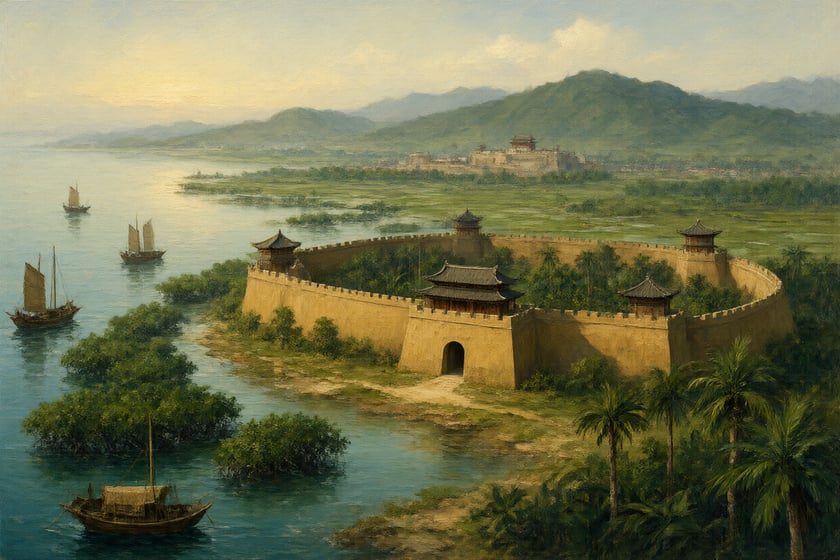
Jiaozhou was one of the thirteen provinces of the Eastern Han. Originally called the Jiaozhi Inspectorate, it was renamed Jiaozhou in the late Eastern Han. Its territory roughly covered present-day northern and central Vietnam and most of Guangdong and Guangxi in China. The provincial seat was first at Longbian in Jiaozhi Commandery (present-day Bac Ninh, Vietnam), then moved in the late Eastern Han to Guangxin in Cangwu Commandery (present-day Wuzhou, Guangxi), and during Bu Zhi’s tenure as inspector was moved again to Panyu in Nanhai Commandery (present-day Guangzhou). An imperial edict described it as “Jiaozhou, a remote region, bordered to the south by rivers and sea”. In the late Han, the family of Shi Xie, Administrator of Jiaozhi, controlled the region. In the fifteenth year of Jian’an (210), it submitted to Sun Quan. Thereafter it remained part of Eastern Wu’s southern territory and served as a place of exile for officials convicted of crimes.
History
The non-Han peoples killed Zhu Fu, Inspector of Jiaozhou, in the late Han, plunging the commanderies and counties into chaos. Shi Xie, Administrator of Jiaozhi, then submitted a memorial recommending that his younger brothers take office: Shi Yi as Administrator of Hepu, Shi Wei as Administrator of Jiuzhen, and Shi Wu as Administrator of Nanhai. The court appointed Zhang Jin as the new inspector, but Zhang Jin was then killed by his subordinate Ou Jing. Liu Biao, Governor of Jing Province, seized the opportunity to appoint Lai Gong, a native of Lingling, as his successor, and also appointed Wu Ju Administrator of Cangwu. On hearing of this, the court sent Shi Xie an imperial seal document, appointing him General Who Pacifies the South and placing him in charge of Jiaozhou’s seven commanderies, while he continued to serve as Administrator of Jiaozhi. Later, Wu Ju and Lai Gong fell out, and Wu Ju raised troops and drove Lai Gong back to Lingling.
In the fifteenth year of Jian’an (210), Sun Quan appointed Bu Zhi Inspector of Jiaozhou. On arriving in office, Bu Zhi found that Shi Xie and his brothers submitted to his authority. Wu Ju, who harbored rebellious intentions, was executed by Bu Zhi, and Jiaozhou thereafter came under the Sun clan’s control. Shi Xie later sent his son as a hostage and persuaded powerful families in Yi Province, including Yong Kai, to align with Eastern Wu from afar. Each year, he sent Sun Quan tribute of spices, fine kudzu cloth, pearls, tortoiseshell, rhinoceros horn, ivory, and various rare fruits. In the first year of Yan’kang (220), Lü Dai succeeded Bu Zhi as Inspector of Jiaozhou. He secured the surrender of Qian Bo, leader of bandits in Gaoliang, put down the non-Han people of Yulin, and captured Wang Jin, who had caused disorder within the borders of Nanhai Commandery. On the Shu Han side, in the first year of Zhangwu (221), Liu Bei appointed Li Hui as the Commander of the Laijiang region, gave him an imperial tally, and had him serve concurrently as Inspector of Jiaozhou from afar, stationed in Pingyi County. It was not until the seventh year of Jianxing (229), when Wu and Shu agreed that Jiaozhou would belong to Wu, that Shu Han relieved Li Hui of his post as inspector.
In the fifth year of Huangwu (226), after serving in the commandery for more than forty years, Shi Xie died at the age of ninety. Because Jiaozhi was far away, Sun Quan divided off the area north of Hepu to establish Guangzhou, appointing Lü Dai as inspector. The area south of Jiaozhi remained Jiaozhou, with Dai Liang as inspector; Chen Shi was also appointed to succeed Shi Xie as Administrator of Jiaozhi. Shi Hui, Shi Xie’s son, declared himself Administrator of Jiaozhi and mobilized troops from his clan to hold the estuary. Dai Liang had no choice but to remain in Hepu. Lü Dai received an imperial order to suppress him and hurried from Guangzhou, traveling day and night. He first sent Shi Kuang, with whom he had old ties, to persuade them. Shi Hui and his five brothers came out to greet him bare-chested. Lü Dai publicly read the imperial edict, listing their crimes, and put them all to death. Guangzhou was then abolished and Jiaozhou’s former administrative system restored. Lü Dai went on to campaign against Jiuzhen, and also sent envoys to proclaim the state’s prestige. The rulers of the foreign lands of Funan, Lin Yi, Tangming, and others all sent envoys with tribute.
In the eleventh year of Chiwū (248), non-Han peoples in Jiaozhi and Jiuzhen captured cities and towns. Sun Quan appointed Lu Yin Inspector of Jiaozhou and Colonel Who Pacifies the South. Lu Yin won them over through kindness and trust: Huang Wu, a leader in Gaoliang, and more than three thousand households, along with over fifty thousand households in the south, successively submitted to him. In the seventh year of Yong’an (264), Eastern Wu once again divided Jiaozhou and established Guangzhou. In the third year of Baoding (268), Sun Hao sent Inspector of Jiaozhou Liu Jun and others to attack Jiaozhi, but they were defeated by the Jin general Mao Jiong and others, and Liu Jun and the others were killed in battle. In the third year of Tianji (279), Guo Ma rebelled in Guangzhou, and Sun Hao ordered Tao Huang, Governor of Jiaozhou, to lead his troops in a coordinated campaign with Wu forces advancing from east and west.
People
Shi Xie, who controlled Jiaozhou: Shi Xie served as Administrator of Jiaozhi for more than forty years. Even amid the realm’s turmoil, he continued to send envoys with tribute to the capital and was enfeoffed as General Who Pacifies the Distant Regions and Marquis of Longdu Ting. After submitting to Wu, he rose to the post of General of the Guards and was enfeoffed as Marquis of Longbian.
Inspectors: Zhang Jin was lax in his conduct and lacked authority, with the result that he was killed by his subordinates. Lu Yin served in Jiaozhou for more than ten years. In a memorial recommending him, Hua He, Assistant Director of the Secretariat, said that since Lu Yin had taken office, storms and miasmas had disappeared from Cangwu and Nanhai, and that he had also stored water so that the people living by the sea could drink fresh water. Yu Si, son of Yu Fan, was appointed Inspector of Jiaozhou and General Who Leads the Army for his part in suppressing Fuyan during the Yong’an era. He died not long afterward.
Scholars who came here to escape turmoil: Jiaozhou lay far from the wars in the Central Plains, and many scholars moved south there in the late Han. Xu Jing traveled ten thousand li by sea from Kuaiji to Jiaozhou and took refuge with Shi Xie. Xu Ci had once studied under Liu Xi and, during the Jian’an era, traveled from Jiaozhou to Shu with Xu Jing. Cheng Bing had studied under Zheng Xuan. While taking refuge from turmoil in Jiaozhou, he discussed the meanings of the classics with Liu Xi. Shi Xie appointed him Chief Clerk, and Sun Quan later summoned him to serve as Grand Tutor to the Heir Apparent. In his youth, Xue Zong also went to Jiaozhou to study under Liu Xi; he later served as Administrator of Hepu and Jiaozhi. Yuan Hui, younger brother of Yuan Ba, was known for his Confucian learning and likewise took refuge in Jiaozhou.
Those exiled here: Yu Fan was outspoken and forthright by nature, and repeatedly angered Sun Quan. He was exiled to Jiaozhou, where he continued teaching tirelessly, often with several hundred disciples. He died after more than ten years in the south, aged seventy. During the Struggle of the Two Palaces, Gu Tan, his younger brother Gu Cheng, and Zhang Xiu were falsely accused over a dispute about merit at Shaobei and exiled together to Jiaozhou. While in exile, Gu Tan devoted himself to writing the New Sayings. Two years after his exile, he died in Jiaozhi at the age of forty-two. Zhang Xiu was later executed after Sun Hong slandered him.