Sun Quan's Faction · Advisor
Lu Ji
courtesy name 公纪 · 188–219
Not to be confused with Lu Ji (陆机, 261–303) — Lu Ji, son of Wu’s Lu Kang, later served Sima Ying, Prince of Chengdu, and was executed after being framed while leading an army against Luoyang.
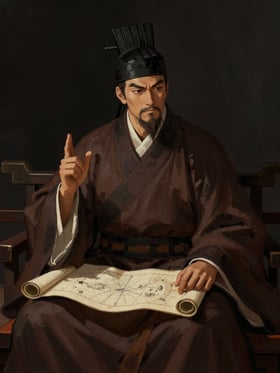
Lu Ji, an Eastern Wu scholar, was famed for offering oranges to his mother; the novel has him lose a debate to Zhuge Liang.

Life
In the novel: 2 chapters · In the Records: 4 volumes
Life188–219
208 CE (Jian'an 13)
Appearances
By chapter (6)
Novel
- 38
- 43
Records
- 37
- 52
- 57
- 58
- Sun Quan's Faction
- Hatched: dated by chapter
- Life event
List all 2 stops
On the boards
Compare with someone →Where this person ranks on each board.
Historical Record
Lu Ji, courtesy name Gongji, was from Wu County, Wu Commandery. His father, Lu Kang, once served as Administrator of Lujiang. When Lu Ji was six, he visited Yuan Shu in Jiujiang. Yuan Shu served oranges to his guests, and Lu Ji secretly tucked three away. As he took his leave, the oranges fell to the ground. Yuan Shu asked why he had done so, and Lu Ji replied that he wanted to take them home for his mother. Yuan Shu was greatly astonished. This childhood story reveals Lu Ji’s filial devotion and shows how his words and actions drew attention from an early age.
When Sun Ce was in Wu, Zhang Zhao, Zhang Hong, Qin Song, and others discussed how the realm remained unsettled and argued that it should be pacified by force. Though young, Lu Ji sat at the end of the table and spoke from afar. Citing the example of Guan Zhong assisting Duke Huan of Qi and setting the realm right through virtue, he also quoted Confucius: “If those far away are not submissive, cultivate civil virtue to draw them near.” He argued that they should not prize military force alone, but should win over distant peoples through moral virtue. Zhang Zhao and the others were all astonished by what they heard. This shows that from an early age Lu Ji drew on Confucian teachings in political debate, advocating civil virtue and moral instruction.
Lu Ji was imposing in appearance, widely learned, and well versed in astronomy, calendrics, and mathematics. He was close to Yu Fan, and Pang Tong, a renowned scholar of Jing Province, was also on friendly terms with him. After Sun Quan took charge, he appointed Lu Ji as an Assistant in the Secretariat of Memorials. Lu Ji’s forthright manner made him the object of others’ resentment. He later became Administrator of Yulin and was additionally appointed General of the Household, receiving command of two thousand troops. Though he took on military duties, and despite his lameness and scholarly inclinations, he did not stop writing. He composed the Diagram of the Armillary Sphere and annotated the Book of Changes and expounded the Book of the Supreme Mystery. His works were passed down to later generations.
Foreseeing his own death, Lu Ji left behind a rhapsody in which he called himself “Lu Ji of Wu Commandery, a devoted servant of the Han.” He recalled studying the Odes and Documents diligently in childhood and the Rites and Changes as an adult, and lamented that illness had beset him while he was serving on a campaign in the south. He also predicted that in sixty years “all carriages would have the same track gauge, and all writing the same script,” regretting that he would not live to see it. Lu Ji died at the age of thirty-two, leaving behind his eldest son, Lu Hong, and second son, Lu Rui.
In the Novel
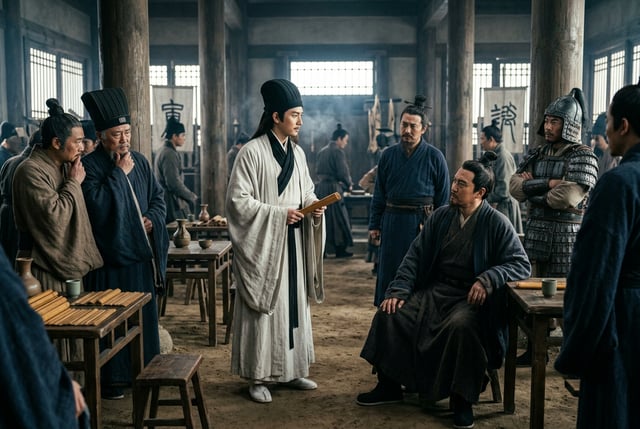
Romance of the Three Kingdoms places Lu Ji among the scholars of Jiangdong whom Sun Quan sought to recruit, alongside Kan Ze, Yan Jun, Xue Zong, and Cheng Bing, portraying Jiangdong as rich in both Wen Wu talent. In the chapter “Zhuge Liang's Debate with the Scholars of Jiangdong,” Lu Ji challenges Liu Bei’s right to oppose Cao Cao, arguing that Liu Bei came from a background of weaving mats and selling straw sandals and that his Han imperial lineage is difficult to verify. Zhuge Liang immediately retorts that although Liu Bei once wove mats and sold straw sandals, he was not ashamed of his origins; Cao Cao, though he claimed descent from Chancellor Cao, seized power and deceived the sovereign. Lu Ji is left speechless.
This scene recasts Lu Ji, who in the historical record upheld civil virtue and was versed in the classics, as a Wu minister whom Zhuge Liang defeats in debate. The Records of the Three Kingdoms records Lu Ji’s early arguments about civil virtue and rule by force, but does not say that he ever held this debate with Zhuge Liang at the Wu court. His attack on Liu Bei’s origins and the outcome in which he is “left speechless” are dramatic inventions of the novel.
Key Relationships
Lu Ji and his father, Lu Kang, both belonged to the Lu clan of Wu Commandery. Lu Kang once served as Administrator of Lujiang. Lu Xun was Lu Kang’s son and was several years older than Lu Ji; while Lu Kang was in office, Lu Xun once looked after Lu Ji’s household. This illustrates the bonds of seniority and mutual care within the same clan.
Lu Ji was on friendly terms with Yu Fan and Pang Tong. When Pang Tong escorted Zhou Yu’s funeral cortege to Wu and was preparing to return west, Lu Ji went with Gu Shao and Quan Cong to meet him. Pang Tong described Lu Ji as “a worn-out horse with the strength to gallop,” and Lu Ji and the others parted after forming ties with him. Gu Shao was Lu Ji’s sister’s son: the historical account says that in his youth, Gu Shao was as renowned as his maternal uncle Lu Ji.
Lu Ji served under Sun Quan, first as an Assistant in the Secretariat of Memorials and later as Administrator of Yulin and General of the Household. This reflects both his career in Wu and the contrast with his stronger inclination toward scholarly writing.
Signature Scenes
Hiding oranges for his mother: At the age of six, Lu Ji secretly tucked away three oranges at Yuan Shu’s table. As he took his leave, they fell to the ground. When Yuan Shu asked about them, Lu Ji admitted that he wanted to take them home for his mother. This brief exchange conveys his childhood filial devotion and became Lu Ji’s most memorable early-life story.
Arguing for civil virtue from the end of the table: When Sun Ce was in Wu, people discussed pacifying the realm by force. Though young and seated at the end of the table, Lu Ji spoke up, citing the classics to argue for cultivating civil virtue and winning over distant peoples. This debate in the historical account shows that Lu Ji was not merely renowned for his learning; he also drew on Confucian thought to challenge contemporary policy.
Confrontation in the debate with the scholars (unique to the novel): The novel has Lu Ji challenge Zhuge Liang over Liu Bei’s origins and lineage. Zhuge Liang counters by citing Liu Bang’s origins as a village headman and Cao Cao’s seizure of power and deception of the sovereign, leaving Lu Ji with nothing to say. This episode turns Lu Ji’s identity as a scholar into that of an opponent in a group debate, differing from the historical account’s emphasis on his filial devotion, advocacy of civil virtue, and writings.
Lines
- 演 ch.43 §14→ Zhuge Liang🗓 Death of Empress Fu
曹操雖挾天子以令諸侯,猶是相國曹參之後。劉豫州雖云中山靖王苗裔,卻無可稽考,眼見只是織蓆販屨之夫耳,何足與曹操抗衡哉!
- Family
- Friends
- Enemies
- Other
Who is Lu Ji connected to?
Pick someone to see how many steps lie between them and Lu Ji.
History vs. novel
6 points · 1 novel-only
| History | Novel |
|---|---|
| Oranges for His MotherNovel embellishes | |
When Lu Ji was six, he met Yuan Shu and hid three oranges in his clothes. As he was taking his leave, they fell out. He explained that he had wanted to take them home for his mother, greatly surprising Yuan Shu. vol. 57 | During Zhuge Liang's Debate with the Scholars of Jiangdong, Zhuge Liang referred to Lu Ji as “the one who hid oranges,” alluding to his past; the novel also incorporated this episode into the debate. ch. 43 |
| A Youth Rebukes Military ForceHistory only | |
While Sun Ce was in Wu, Zhang Zhao, Zhang Hong, and Qin Song discussed pacifying the realm by force. Lu Ji, still young, sat at the end of the席 and argued for cultivating civil virtue and winning people over through moral conduct, astonishing everyone. vol. 57 | — |
| Worthies of JiangdongNovel embellishes | |
The Records of the Three Kingdoms records that after Sun Quan took charge, he appointed Lu Ji as an official in the Secretariat, and later as Administrator of Yulin Commandery and General of the Left. It does not record him taking part in a gathering at which Sun Quan welcomed worthies from all quarters. vol. 57 | The novel depicts Sun Quan welcoming worthies from across the land. Lu Ji arrived in Jiangdong alongside Kan Ze, Yan Jun, Xue Zong, and others, and received a lavish welcome from Sun Quan, serving as a portrait of Jiangdong's flourishing talent. ch. 38 |
| Rebuking Liu BeiNovel only | |
| — | Before the Battle of Red Cliffs, Lu Ji questioned Liu Bei's claim to be descended from Prince Jing of Zhongshan, saying it could not be verified and that he was merely a weaver of mats and seller of shoes. After Zhuge Liang refuted him, Lu Ji was left speechless. ch. 43 |
| Career and IntegrityHistory only | |
Lu Ji's integrity made people wary of him. He first served as an official in the Secretariat, then was posted as Administrator of Yulin Commandery and made General of the Left, with two thousand troops under his command. Though he suffered from a limp, his interests lay in Confucian learning and refinement. vol. 57 | — |
| Astronomy and WritingsHistory only | |
Lu Ji was learned and proficient in astronomy, calendrical science, and mathematics. Though his duties included military affairs, he still wrote the Hun Tian Tu and annotated the Book of Changes and explained the Xuan, and his works were handed down to later generations. vol. 57 | — |
- Oranges for His MotherNovel embellishes
- History
When Lu Ji was six, he met Yuan Shu and hid three oranges in his clothes. As he was taking his leave, they fell out. He explained that he had wanted to take them home for his mother, greatly surprising Yuan Shu.
vol. 57
- Novel
During Zhuge Liang's Debate with the Scholars of Jiangdong, Zhuge Liang referred to Lu Ji as “the one who hid oranges,” alluding to his past; the novel also incorporated this episode into the debate.
ch. 43
- A Youth Rebukes Military ForceHistory only
- History
While Sun Ce was in Wu, Zhang Zhao, Zhang Hong, and Qin Song discussed pacifying the realm by force. Lu Ji, still young, sat at the end of the席 and argued for cultivating civil virtue and winning people over through moral conduct, astonishing everyone.
vol. 57
- Worthies of JiangdongNovel embellishes
- History
The Records of the Three Kingdoms records that after Sun Quan took charge, he appointed Lu Ji as an official in the Secretariat, and later as Administrator of Yulin Commandery and General of the Left. It does not record him taking part in a gathering at which Sun Quan welcomed worthies from all quarters.
vol. 57
- Novel
The novel depicts Sun Quan welcoming worthies from across the land. Lu Ji arrived in Jiangdong alongside Kan Ze, Yan Jun, Xue Zong, and others, and received a lavish welcome from Sun Quan, serving as a portrait of Jiangdong's flourishing talent.
ch. 38
- Rebuking Liu BeiNovel only
- Novel
Before the Battle of Red Cliffs, Lu Ji questioned Liu Bei's claim to be descended from Prince Jing of Zhongshan, saying it could not be verified and that he was merely a weaver of mats and seller of shoes. After Zhuge Liang refuted him, Lu Ji was left speechless.
ch. 43
- Career and IntegrityHistory only
- History
Lu Ji's integrity made people wary of him. He first served as an official in the Secretariat, then was posted as Administrator of Yulin Commandery and made General of the Left, with two thousand troops under his command. Though he suffered from a limp, his interests lay in Confucian learning and refinement.
vol. 57
- Astronomy and WritingsHistory only
- History
Lu Ji was learned and proficient in astronomy, calendrical science, and mathematics. Though his duties included military affairs, he still wrote the Hun Tian Tu and annotated the Book of Changes and explained the Xuan, and his works were handed down to later generations.
vol. 57
Events
Events (2)
Battles and events the texts place this person in, by date.
Other events
Places
- Native of
- Wu CountyRecords
Continue
Zhuge Liang's Debate with the Scholars of Jiangdong
Relationship timeline4 entries ▸
History · vol. 57
- Yuan Shu§21
Witnessed
At six years old, met Yuan Shu in Jiujiang; kept oranges in his clothes to give to his mother, and Shu was greatly impressed
- Yu Fan§22
Friend
Yu Fan had long been renowned for his integrity and was on friendly terms with Ji
- Pang Tong§22
Friend
Pang Tong was a distinguished man of Jing Province, somewhat older in years, and on friendly terms with Ji
Novel · ch. 43
- Zhuge Liang§14
Rival
challenged
Inner monologues · AI-generated1 monologue ▸
- I am Lu Ji, courtesy name Gongji, from Wu County in Wu Commandery. I have now been ordered to take up a post in Yulin, a