In 209, the fourteenth year of Jian'an, Zhou Yu had yet to take Nan Commandery, held by Cao Ren. Gan Ning suggested taking Yiling first, then capturing the city and garrisoning it. Gan Ning had about a thousand men, and Cao Ren sent five or six thousand to encircle and attack them. Zhou Yu adopted Lü Meng’s plan to break the siege and led troops to the rescue, enabling Gan Ning to hold Yiling. This move forced Cao Ren to divide his forces, made Yiling a forward stronghold in the struggle for Nan Commandery, and tied down Cao’s forces, supporting Zhou Yu’s continued efforts to seize the commandery.
The Records of the Three Kingdoms’ biography of Gan Ning records that Cao Ren surrounded Gan Ning, who was defending Yiling, with five or six thousand troops for several days. Gan Ning sent a messenger to report this to Zhou Yu, who adopted Lü Meng’s plan and led the generals to break the siege; Zhou Tai does not appear in this passage. The emphasis is on Lü Meng’s planning and Zhou Yu’s command of the troops.
Romance
Chapter 51 of the novel has Zhou Tai volunteer, take up his blade, and ride into Cao Cao’s army. He breaks through alone to the walls of Yiling, meets Gan Ning, and conveys the news that Zhou Yu’s main army is on its way. This casts Zhou Tai as the central figure in the rescue and downplays Lü Meng’s role in planning it.
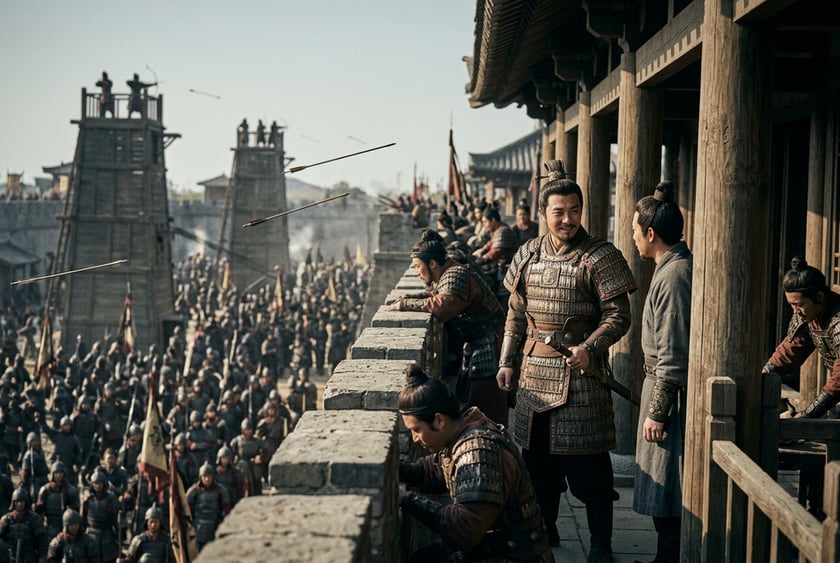
On the walls of Yiling, Gan Ning faces the dense encirclement by Wei troops outside the city, smiling and calmly speaking with the subordinates beside him, while Wei forces below use tall siege towers to shoot arrows into the city.
Gan Ning Holds Yiling took place in the fourteenth year of Jian’an (209), as a flanking operation in the contest for Nan Commandery. Zhou Yu was fighting Cao Ren for control of Nan Commandery, while Yiling lay to its west, where it could tie down Cao’s forces and affect communications between their strongpoints. According to the Records of the Three Kingdoms, Gan Ning proposed that they need not first launch a frontal assault on Nan Commandery, but should instead lead troops directly to seize Yiling. He captured the city soon afterward and then remained there to defend it. This was both a contest for a strongpoint and a complement to Zhou Yu’s operational deployment: with a relatively small force, it altered the spatial configuration of the battlefield and compelled Cao Ren to divide his troops in response.
The Records of the Three Kingdoms gives the size of the garrison in a way that particularly highlights the risks of the operation: Gan Ning originally had several hundred men under his command, and with the troops he had recently acquired, his total strength was only about a thousand. Cao Ren, however, sent five or six thousand men to besiege the city. The forces were vastly unequal, and the defenders were also at a disadvantage in the conditions of the siege: Cao’s troops built high towers and shot arrows into the city, frightening the soldiers there. The account shows that Yiling was not a prize that could be secured simply by seizing it; it was a forward strongpoint that could be held only through sustained defense.
Principal Figures
Gan Ning was the originator of the operation and the central figure in the city’s defense. He proposed to Zhou Yu that they seize Yiling first, then personally led his troops into the city. During the siege, he also sent a messenger to Zhou Yu to report the emergency. The historical account specifically says that, amid the crisis, he “spoke and laughed as if nothing were amiss.” This portrays him as a commander who remained composed in peril, while also showing the practical importance of morale and command authority in defending an isolated strongpoint. It should not, however, be concluded from this that the city was defended by personal courage alone: Gan Ning’s judgment, coordination among the troops, and the arrival of outside reinforcements were all parts of the chain of events.
Zhou Yu’s role was that of the theater commander. Before Nan Commandery had been captured, he accepted Gan Ning’s suggestion to seize Yiling first; after Gan Ning was besieged, Zhou Yu did not treat the isolated city as a secondary front that could be abandoned, but organized the generals to relieve it. Lü Meng took part in the decision-making for the rescue as a strategist: the Records of the Three Kingdoms explicitly links “using Lü Meng’s plan” with Zhou Yu leading troops to break the siege. The key figure on Cao Ren’s side was the commander who decided to besiege the city. The historical account says that he sent troops to surround Gan Ning, but does not specify the individual actions of Cao Hong, Cao Chun, and Niu Jin in this passage.
Romance of the Three Kingdoms gives a more detailed account of Cao’s internal deployments: it says Cao Ren ordered Cao Hong to hold Yiling and secretly sent Cao Chun and Niu Jin to reinforce him. After Gan Ning captured the city, Cao Hong retreated in defeat, and the reinforcements arrived and laid siege to it. The novel also describes Zhou Tai breaking through the encirclement, while Gan Ning prepared to support him from within. These details are useful for analyzing how the novel dramatizes the course of the battle, but they should not be conflated with the more concise historical account in the Records of the Three Kingdoms as if they were equally established facts. In particular, the specific roles of Cao Hong, Cao Chun, and Niu Jin in the attack on and defense of Yiling are supported chiefly by the novel’s narrative.
Key Issues
The first issue is the trade-off between initiative and risk. Gan Ning’s plan depended on capturing the city quickly, and it did indeed compel Cao Ren to commit a large force to the siege. But the garrison was too small, and the city came under sustained pressure, turning the tactical advantage of a surprise attack into the burden of prolonged defense. The operation’s value cannot be measured solely by whether the city was captured; one must also consider whether it tied down Cao’s forces and gave Zhou Yu room to maneuver toward Nan Commandery. The Records of the Three Kingdoms records the siege and relief, but does not quantify the extent to which Cao’s forces were tied down. This can therefore be offered only as a strategic interpretation, not presented as a confirmed result.
The second issue is the relationship between a local strongpoint and the objectives of the theater as a whole. Yiling was not Nan Commandery itself, but it could affect the security of the flank on the Nan Commandery battlefield. Gan Ning’s idea of seizing Yiling first reflects an approach that did not simply reinforce the frontal line chosen by the enemy, but instead sought to take a position that could influence the overall situation. At the same time, the siege shows that a strongpoint’s value is not static: once an isolated force is surrounded, it may shift from being a means of tying down the enemy to becoming a crisis that reinforcements must address. Zhou Yu’s dispatch of troops to relieve the siege shows how local offensives and the movements of the main force were interdependent.
The third issue is how historical accounts and novels shape collective memory. The Records of the Three Kingdoms devotes only a few lines to highlighting Gan Ning’s plan, his defense of the city and his call for help, followed by Lü Meng’s proposal and Zhou Yu’s relief operation. Its focus is on the commanders’ abilities and key turning points in the campaign. Romance of the Three Kingdoms, by contrast, adds dramatic episodes such as Cao’s attempt to lure the enemy, the arrival of reinforcements, and Zhou Tai’s breakout, turning the siege into a continuous heroic narrative. The two texts can suggest questions to one another, but neither can replace the other: details in the novel should not be treated directly as historical evidence, while the brevity of the historical account does not mean that the battle had no more complex course.
Political Consequences
In military and political terms, Gan Ning’s occupation of Yiling gave the Sun–Liu side a strongpoint closer to the area controlled by Cao during the contest for Nan Commandery, and forced Cao Ren to commit five or six thousand troops against a garrison of about a thousand. The operation thus created pressure on the allocation of resources and led Zhou Yu and Lü Meng to take part in the relief effort. However, the surviving material does not provide a complete record of casualties or the duration of the siege, nor does it explain what happened to Yiling afterward. It therefore cannot be used to calculate the specific outcome of the operation or to conclude that it alone determined who gained Nan Commandery.
In terms of command and cooperation within the alliance, the account presents a sequence in which a frontline commander proposed a plan, the commander-in-chief accepted it, and a strategist took part in the rescue effort. It shows that Zhou Yu’s command of the theater did not rely solely on a frontal advance by the main force, but also involved responding to threats and opportunities at flank strongpoints; Gan Ning, in turn, gained room to carry out his mission by making an initiative-taking proposal. Its political significance should not be exaggerated into a turning point in the internal power structure of Eastern Wu, since the cited passage says nothing about appointments, rewards, or institutional changes. The more cautious conclusion is that the operation demonstrated the division of responsibilities and the military’s ability to respond in coordination, while its long-term political impact cannot be established from the materials cited here.
Counterfactual Analysis
If Gan Ning had not proposed seizing Yiling first, Zhou Yu might have been able to keep more troops on the main front at Nan Commandery and avoid having a small force trapped in a siege. But the army might also have lost the flank pressure that compelled Cao Ren to divide his forces. The first possibility is suggested by the defenders’ marked numerical disadvantage; the second by Cao Ren’s actual response of sending troops to besiege the city. Both are conditional speculations: the Records of the Three Kingdoms does not say how Cao Ren would have deployed his forces had Yiling not threatened him, nor can it prove that the main assault on Nan Commandery would necessarily have proceeded more smoothly.
If Zhou Yu had not organized a relief effort in time, Gan Ning’s troops might have suffered greater losses, and Yiling might have fallen back into Cao’s hands. Conversely, if the relief effort had not been constrained by the siege, Zhou Yu might have been able to commit troops elsewhere. However, the Records of the Three Kingdoms records only that Zhou Yu adopted Lü Meng’s plan and led the generals to break the siege; it does not describe the relief operation, casualties, or who ultimately controlled Yiling afterward. The most cautious conclusion, therefore, is that Gan Ning’s bold operation temporarily seized Yiling and provoked a siege by Cao’s forces, followed by a relief effort by Wu’s forces. The operation’s broader campaign results and long-term political consequences should remain uncertain.