Fu Wan
–209
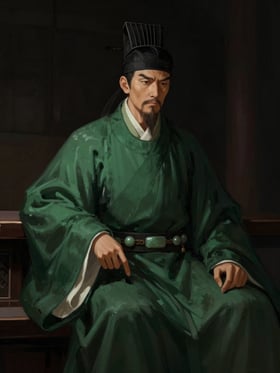
Fu Wan was Empress Fu’s Zhi Fu and a Han imperial relative; history says he died over his daughter’s letter, while the novel says he plotted against Cao.

Life
In the novel: 3 chapters · In the Records: 1 volume
Life?–214
214 CE (Jian'an 19)
- Life event
- Death
On the boards
Compare with someone →Where this person ranks on each board.
Historical Record
Fu Wan was the father of Empress Fu and once served as Commandant of the Encamped Cavalry; the source refers to him as “the former Commandant of the Encamped Cavalry.” During Emperor Xian’s reign, Empress Fu was found guilty because she had corresponded with her father, Fu Wan. The historical record says the letters concerned Emperor Xian’s resentment toward Cao Cao over Dong Cheng’s execution, and their wording was quite vehement. After the correspondence came to light, Empress Fu was deposed and killed, and her brothers were executed as well. The Cao Man zhuan, cited in Pei Songzhi’s commentary, gives further details: Cao Cao sent Hua Xin into the palace to seize Empress Fu. As she was dragged away, she called to Emperor Xian for help; he replied that he did not know how much longer he himself would remain alive. Empress Fu was then killed, and hundreds of Fu Wan’s relatives and clan members died. The Records of the Three Kingdoms does not explain how Fu Wan took part in the correspondence, nor does it record him plotting to attack Cao Cao. What can be confirmed is his relationship as Empress Fu’s father and the suffering inflicted on the Fu family.
In the Novel
Romance of the Three Kingdoms portrays Fu Wan as an imperial father-in-law who understands Cao Cao’s domination of power and is cautious yet resourceful. In Chapter 20, Emperor Xian and Empress Fu are fearful of Cao Cao when Fu Wan enters from outside. He points out that most people at court belong to Cao Cao’s clan or circle, and that he alone has “no authority, making this matter difficult to carry out.” He then suggests concealing a secret edict in the girdle Emperor Xian gives Dong Cheng. He recommends Dong Cheng as someone worthy of trust and devises a way to hide the edict under the guise of a brocade robe and jade girdle, so it will not be easily discovered. The scene emphasizes Fu Wan’s ability to devise covert plans despite his limited power. His proposal and implementation of the Girdle Edict belong to the novel’s narrative; the Records of the Three Kingdoms does not record them.
Chapter 66 also depicts Fu Wan receiving a secret letter from Empress Fu and arguing that they must not act rashly. They should wait for Sun Quan and Liu Bei to raise troops from outside, then enlist loyal and righteous men at court to launch a “pincer attack from within and without.” Here, too, Fu Wan puts caution first: rather than responding hastily, he first assesses Cao Cao’s extensive network of eyes and ears, then arranges for outside support and inside agents. However, Cao Cao discovers Mu Shun carrying the letter. Fu Wan’s residence is surrounded, the three branches of the Fu clan are imprisoned, and Fu Wan, Mu Shun, and more than two hundred other clan members are executed. The novel expands the Fu family’s destruction, which the historical record links to Empress Fu’s letters, into a continuous story in which Fu Wan personally plots against Cao Cao and ultimately fails. The conspiracy, the pincer attack from within and without, and the specific circumstances of their arrest are all inventions of the novel.
Key Relationships
Fu Wan and Empress Fu were father and daughter. The historical record gives Empress Fu’s correspondence with her father as the reason for her conviction, and records the execution of the Fu brothers and the deaths of Fu Wan and many of his clan. But it does not say whether Fu Wan himself wrote any letters or what political actions he took. The novel portrays father and daughter as co-conspirators: Empress Fu first proposes writing to her father to ask him to move against Cao Cao, and Fu Wan then devises a plan to join forces with Sun Quan and Liu Bei, using outside troops to pin down Cao Cao. (Novel-only)
The novel also gives Fu Wan’s relationships with Emperor Xian and Dong Cheng a more active dimension. In Chapter 20, he advises Emperor Xian to rely on Dong Cheng and hide a secret edict in a girdle. After Dong Cheng receives the order, Cao Cao at one point demands to inspect the robe and girdle, nearly causing the plan to fail. (Novel-only) In Chapter 66, Fu Wan also uses Mu Shun to deliver Empress Fu’s letter and arranges for Wu and Shu to provide outside support. When the letter is discovered, he suffers the same fate as his clan. (Novel-only)
Signature Scenes
The scene that best represents the novel’s portrayal of Fu Wan is his proposal of the Girdle Edict when he meets with Emperor Xian. He first explains that his authority is limited and that he cannot act on his own, then turns to Dong Cheng as the target, proposing that the secret edict be concealed under the pretext of presenting a robe and girdle. Fu Wan’s caution in this scene is not timidity; rather, he turns his loyalty into a practical covert plan. However, the Records of the Three Kingdoms does not record this discussion, so it cannot be treated as established fact. (Novel-only)
Another signature scene occurs after Fu Wan receives Empress Fu’s secret letter, when he proposes contacting Sun Quan and Liu Bei so that an uprising outside the court can support action within it. Mu Shun is intercepted while delivering the letter, and Cao Cao discovers it and surrounds Fu Wan’s residence. The Fu clan is then destroyed, bringing the novel’s tragedy to a close with conspiracy, exposure, and punishment linked together. (Novel-only) Chapter 78 of Romance of the Three Kingdoms also has the vengeful spirits of Fu Wan, Empress Fu, Dong Cheng, and others appear in Cao Cao’s bedchamber to demand his life. This further portrays Fu Wan as one of Cao Cao’s victims; the ghost scene is a literary embellishment of his fate, not a historical account. (Novel-only)
Quotes
5 lines in the books · 3 featured
「帝、后休憂;吾舉一人,可除國害。」
This line displays Fu Wan's loyalty to the Han court and his determination to remove the traitor Cao Cao.
「臣有一計,陛下可製衣一領,取玉帶一條,密賜董承;卻於帶襯內縫一密詔以賜之,令到家見詔,可以晝夜畫策;神鬼不覺矣。」
The origin of the 'Girdle Edict' allusion; it was Fu Wan who proposed the plan, reflecting his cunning.
「操賊心腹甚眾,不可遽圖。除非江東孫權、西川孫備,二處起兵於外。操必自往。此時卻求在朝忠義之臣,一同謀之。內外夾攻,庶可有濟。」
This stratagem reflects Fu Wan's analysis of the situation and his strategic vision of allying with Wu to resist Cao Cao.
- Family
- Enemies
- Other
Who is Fu Wan connected to?
Pick someone to see how many steps lie between them and Fu Wan.
Combat
On the field
Duels, kills and executions as the texts tell them, counted separately for the Records and the Romance.
- RomanceCh. 66ExecutionCao CaoLost「當晚將伏完、穆順等宗族二百餘口,皆斬於市」
Stratagems
Plans this person devised or saw through, as the texts tell them.
- Romance
- 2 carried out · 1 worked · 0 turned down · 0 seen through
- RomanceGirdle EdictDeceptionWorkedCh. 20「臣有一計,陛下可製衣一領,取玉帶一條,密賜董承」
- RomanceAttack from Inside and OutsideOtherSeen throughagainst Cao CaoCh. 66「內外夾攻,庶可有濟」
Events
Events (2)
Battles and events the texts place this person in, by date.
Other events
- 200Girdle Edict
- 214Death of Empress FuVictim

Continue
Death of Empress Fu
Relationship timeline3 entries ▸
Novel · ch. 20
- Fu Shou§13
Child
father of Empress Fu
Advised
He went in and advised that Dong Cheng could be entrusted with a plot against Cao Cao; he presented the plan of secretly sewing an imperial edict into a robe and a jade belt
Novel · ch. 66
- Fu Shou§19
Child
In segments 19–20, father of Empress Fu; received his daughter's secret letter plotting to secure support from Wu and Shu
Inner monologues · AI-generated1 monologue ▸
- When Your Majesty earlier asked me with tears in your eyes, speaking of the hunt at Xu Tian, Fu Wan understood at once: