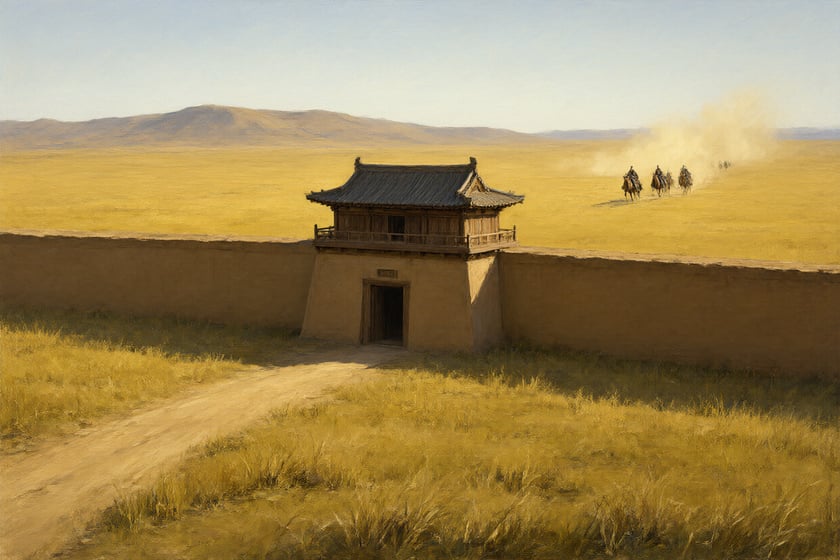
Overview
Liucheng lay beyond the frontier in western Liaoning. Its former site is south of present-day Chaoyang, Liaoning Province, around the Yuantaizi area. In the late Eastern Han, it was a stronghold of Tadun, leader of the Wuhuan in western Liaoning. After Yuan Shang was defeated, he fled to Tadun, hoping to reclaim Jizhou with Wuhuan support. In the twelfth year of Jian’an (207), Cao Cao led a northern campaign against the Wuhuan of the three commanderies, captured Liucheng, and drove Yuan Shang and the others to flee to Liaodong.
History
When Cao Cao campaigned against Yuan Tan, the Wuhuan at Liucheng prepared to send cavalry to aid Yuan Tan. Cao Cao sent Qian Zhao, who had previously been in charge of Wuhuan affairs, to Liucheng. Just then, Qiao Wang was assembling five thousand cavalry, and Han Zhong, an envoy of Gongsun Kang, the Administrator of Liaodong, arrived bearing the seal and ribbons of the chanyu. In front of the assembled people, Qian Zhao persuaded Qiao Wang to submit; Qiao Wang thereupon dismissed the Liaodong envoy and disbanded his troops without sending them out.
The old road from the interior to Liucheng ran from Beiping Commandery through the Lulong Pass to Liucheng. Since the Jianwu era of the Eastern Han, it had been damaged and closed for nearly two hundred years, with only a small path remaining passable. In the summer of the twelfth year of Jian’an (207), Cao Cao’s main army reached Wuzhong. In the seventh month, heavy rains made the coastal roads impassable, and Tian Chou offered to guide the army. The troops passed through Lulong Pass, cutting through mountains and filling valleys for more than five hundred li beyond the pass. They went by Baitan, Pinggang, and the Xianbei court, then turned east toward Liucheng. In the eighth month, Cao Cao’s army encountered Yuan Shang, Yuan Xi, Tadun, and tens of thousands of cavalry at White Wolf Mountain. Cao Cao appointed Zhang Liao as the vanguard and ordered the troops to attack. Tadun was beheaded, and more than 200,000 Hu and Han surrendered. Cao Cao then massacred Liucheng.
In the ninth month, Cao Cao withdrew his army from Liucheng. According to the Cao Man zhuan, cited in Pei Songzhi’s annotations, the return journey was cold and dry: there was no water for two hundred li, and the army ran short of food. They killed several thousand horses for food and dug more than thirty zhang into the ground before finding water. Before long, Gongsun Kang beheaded Yuan Shang and Yuan Xi and sent their heads to Cao Cao. After pacifying Liucheng, Cao Cao distributed captured objects among his ministers. He specially gave Mao Jie a plain folding screen and a plain armrest, praising him for having the bearing of an ancient worthy.
Figures
- Tadun: Leader of the Wuhuan in western Liaoning, known for his resourcefulness. He sheltered Yuan Shang and was killed in battle while fighting Cao Cao’s army.
- Tian Chou: Familiar with the old roads beyond Lulong Pass, he advised Cao Cao and guided the troops with his followers. After the campaign, he was offered the rank of Pavilion Marquis but firmly declined.
- Qian Zhao: Formerly in charge of Wuhuan affairs, he was sent by Cao Cao to Liucheng, where he persuaded Qiao Wang not to aid Yuan Tan.
Differences in Historical and Literary Accounts
Chapter 33 of Romance of the Three Kingdoms says that after Cao Cao entered Liucheng, he immediately made Tian Chou Marquis of Liuting and put him in charge of defending Liucheng. Tian Chou wept and declined, so Cao Cao instead appointed him Gentleman of Discussion. The Records of the Three Kingdoms says that the army returned within the frontier before rewards and appointments were distributed; Tian Chou was made a Pavilion Marquis but firmly declined. According to the “Biography of Tian Chou” in the Records of the Three Kingdoms, Cao Cao later again tried to make him a marquis. Tian Chou wept and refused even at the cost of his life, saying those words about being “a man who had betrayed his duty and fled into hiding,” after which Cao Cao appointed him Gentleman of Discussion. The novel’s account of the two-hundred-li stretch without water on the return journey and the slaughter of horses for food accords with the Cao Man zhuan cited in Pei Songzhi’s annotations.