Language
← The Sima Clan's Seizure of Power

Three Rebellions in Shouchun

251 CE (Jiaping 3) · Shouchun

Between the third year of Jiaping and the third year of Ganlu (251–258), three successive revolts against the Simashi broke out in Shouchun, the strategic stronghold of the Huainan region — collectively known in history as the Shouchunsanpan, the Three Rebellions of Shouchun. The first came in the third year of Jiaping, when Wang Ling conspired with Cao Biao, the Prince of Chu and a grandson of Emperor Cao Fang, to depose the young ruler; Sima Yi personally led a campaign to suppress it, and Wang Ling took his own life. The second unfolded in the second year of Zhengyuan (255), when the General Who Pacifies the East, Guan Qiujian, and Wen Qin raised their forces against Sima Shi; the uprising was crushed, Guan Qiujian was killed by his own routed troops, and Wen Qin fled to Eastern Wu. The third revolt spanned the second and third years of Ganlu (257–258), when the General Who Conquers the East, Zhuge Dan, rose in arms from Shouchun against Sima Zhao, drawing thirty thousand Wu reinforcements into the city; Sima Zhao besieged Shouchun for nearly half a year before Zhuge Dan was killed in combat and the city fell. All three revolts relied on the Huainan regional army as the last military fulcrum of anti-Sima resistance, yet the outcome each time was to bring Shouchun and the entire Huainan military and administrative apparatus more firmly under direct Sima control — making these uprisings the most critical internal suppression campaigns in the process by which the Western Jin replaced Wei.

Part of the The Sima Clan's Seizure of Power campaign▶ Watch the whole campaign's routes on the map
Three Rebellions in Shouchun

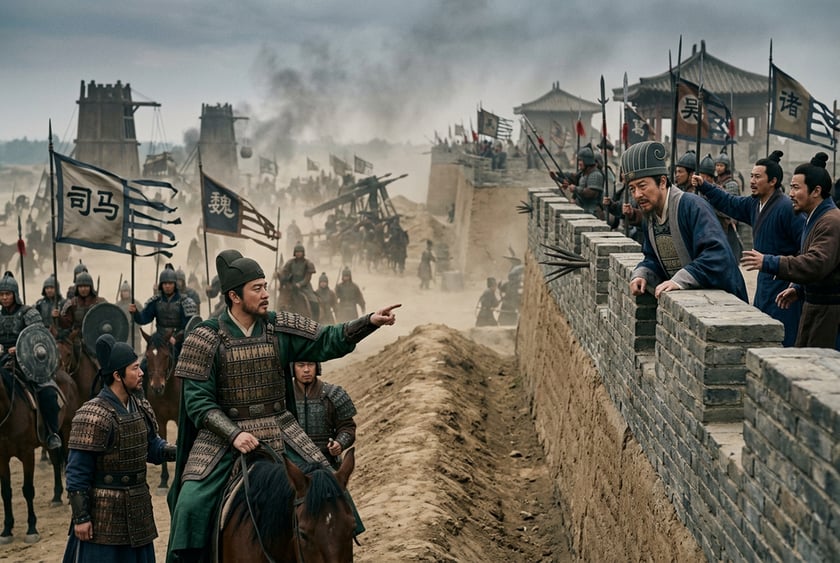
Scene

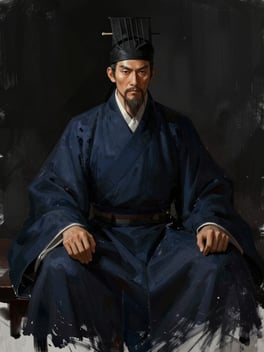
Below Shouchun, Sima Zhao leads a large army in a siege of the city. Zhuge Dan and Wu generals anxiously peer down from the walls, while banners fill the sky and siege engines stand in rows outside.

Featured people: Sima Zhao、Zhuge Dan

Imagine this scene →
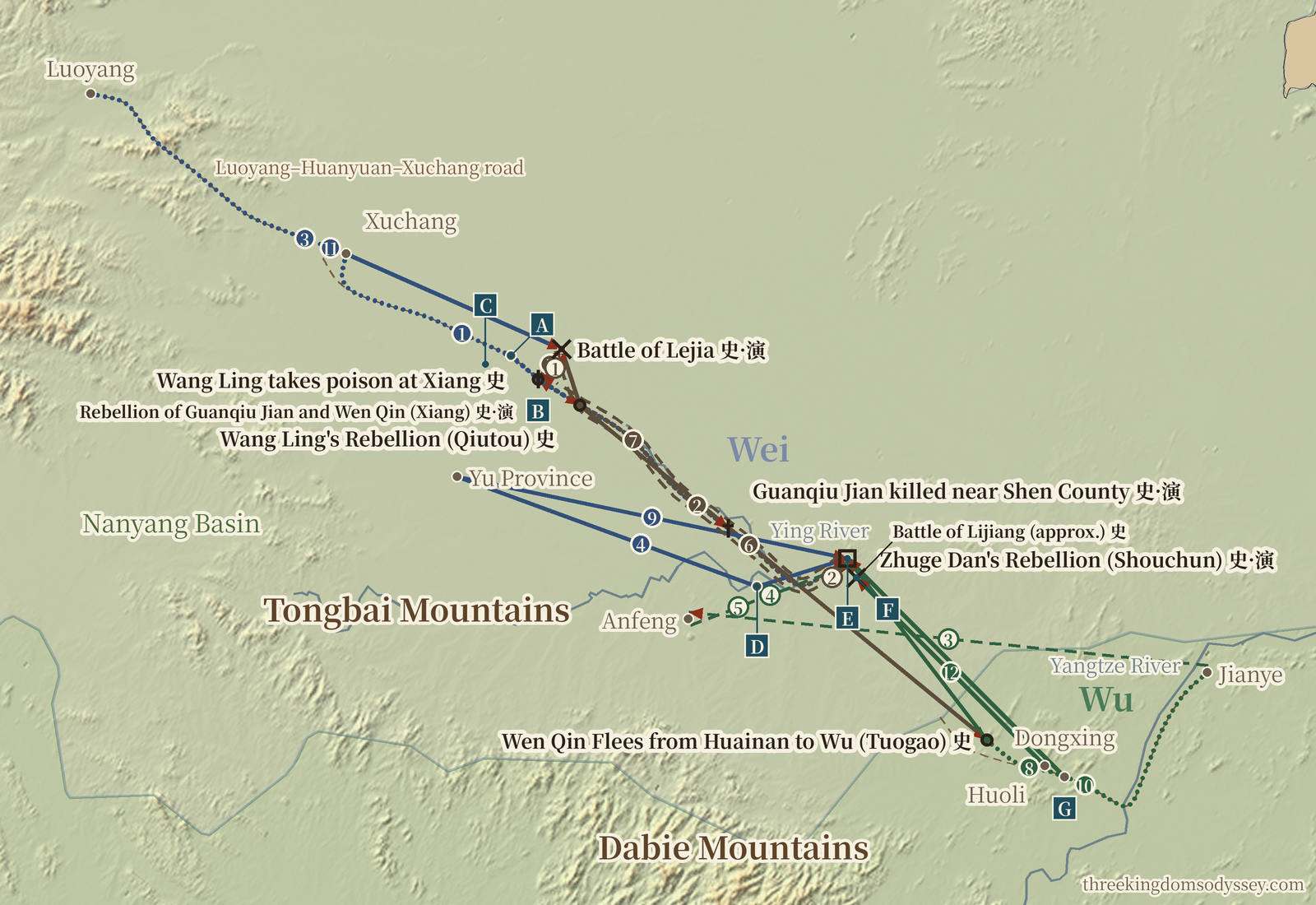
Map of the Three Rebellions in Shouchun, 251

Swipe to see the whole map

Map of the Three Rebellions in Shouchun, 251See the routes on the live map →

In the Records

  1. 1Sima Yi marches on ShouchunRecords of the Three Kingdoms, juan 28
  2. 2Guanqiu Jian and Wen Qin marches on Xiang50,000–60,000Hist.Records of the Three Kingdoms, juan 28Romance of the Three Kingdoms, ch. 110
  3. 3Sima Shi marches on LejiaRecords of the Three Kingdoms, juan 4Records of the Three Kingdoms, juan 28Records of the Three Kingdoms, juan 27Romance of the Three Kingdoms, ch. 110
  4. 4Zhuge Dan marches on ShouchunRecords of the Three Kingdoms, juan 28Romance of the Three Kingdoms, ch. 110
  5. 5Wen Qin marches on LejiaRecords of the Three Kingdoms, juan 28Records of the Three Kingdoms, juan 4
  6. 6Wen Qin falls back to TuogaoRecords of the Three Kingdoms, juan 28Records of the Three Kingdoms, juan 48
  7. 7Guanqiu Jian falls back to Shen CountyRecords of the Three Kingdoms, juan 28Romance of the Three Kingdoms, ch. 110
  8. 8Sun Jun and Lü Ju and Liu Zan marches on Shouchunclaimed 100,000Hist.Records of the Three Kingdoms, juan 48Records of the Three Kingdoms, juan 4Records of the Three Kingdoms, juan 28Romance of the Three Kingdoms, ch. 110
  9. 9Wang Ji besieges ShouchunRecords of the Three Kingdoms, juan 28
  10. 10Wen Qin and Quan Yi and Quan Duan and Tang Zi reinforces Shouchun30,000Hist.Records of the Three Kingdoms, juan 28Records of the Three Kingdoms, juan 48
  11. 11Sima Zhao marches on Qiutou260,000 from the capital and the provincesHist.Records of the Three Kingdoms, juan 28Records of the Three Kingdoms, juan 4Romance of the Three Kingdoms, ch. 111Romance of the Three Kingdoms, ch. 112
  12. 12Zhu Yi and Ding Feng, sent by Sun Chen, marches on Lijiang50,000Hist.Records of the Three Kingdoms, juan 48Records of the Three Kingdoms, juan 64Records of the Three Kingdoms, juan 28

In the Romance

  1. 1Wen Yang marches on Lejia2,500NovelRomance of the Three Kingdoms, ch. 110
  2. 2Wen Qin falls back to XiangRomance of the Three Kingdoms, ch. 110
  3. 3Quan Yi and Quan Duan and Zhu Yi and Tang Zi and Wen Qin marches on Anfeng70,000NovelRomance of the Three Kingdoms, ch. 111Romance of the Three Kingdoms, ch. 112
  4. 4Quan Yi and Quan Duan and Wen Qin reinforces Shouchun10,000NovelRomance of the Three Kingdoms, ch. 112
  5. 5Zhu Yi, sent by Sun Chen, marches on the Shouchun areaRomance of the Three Kingdoms, ch. 112

The novel leaves out Wang Ling's rising. It has Wen Yang raid Lejia alone, Wu troops walk in by an open south gate, and Hu Zun kill Zhuge Dan, where the Sanguozhi's main text tells each differently.

The books mostly say only where an army set out and arrived: a Records line is solid between the places they name and dotted where it follows a reconstructed road between them; an open ring marks an end the books don't give.

Why these routes

  • ASima Yi went 'by the waterway': the Ying runs southeast from Xu past Xiang and Qiutou into the Huai just above Shouchun, and his army came down it on Baichi.Schol.《水经注》卷二十二(颍水)录文淮南三叛之司马懿之死(新浪)Records of the Three Kingdoms, juan 28
  • BFacing Xiang, Sima Shi's armies dug in and refused battle: the Huainan men's families lived north of the Huai, and a rebel army that could neither fight nor go home melted away.Hist.Records of the Three Kingdoms, juan 28
  • CWang Ji raced to Nandun for its great granary, forty days' food; Guanqiu Jian set out from Xiang for it, heard Wang Ji was there first, and turned back.Hist.Records of the Three Kingdoms, juan 27
  • DZhuge Dan crossed the Huai at Anfeng Ford straight for Shouchun while Hu Zun cut the road home through Qiao and Song; when the rebels broke, Shouchun was already his.Hist.Records of the Three Kingdoms, juan 28
  • ESima Zhao would not storm Shouchun, strong, crowded and awaiting Wu relief: he ringed it twice, kept a flying force for the relief, and let hunger do the work.Hist.Records of the Three Kingdoms, juan 28
  • FThe Wu relief had to cross the Lijiang, a stream just south of Shouchun; Shi Bao and Zhou Tai met it at the water, Hu Lie burned its grain at Dulu behind it, and Zhu Yi fell back.Schol.《水经注》卷三十二(肥水),维基文库Records of the Three Kingdoms, juan 28Records of the Three Kingdoms, juan 64
  • GWu went north from the Yangtze up the Ruxu River past Dongxing into Lake Chao; Sun Jun stopped at Tuogao and Sun Chen at Huoli, both by the lake, far from Shouchun.Schol.濡须水(裕溪河,维基百科)Battle of Dongxing (Wikipedia)Records of the Three Kingdoms, juan 48

Base map: Natural Earth; terrain: AWS Terrain Tiles (SRTM and others). Roads and marches reconstructed from the sources listed; positions approximate.


Geography

Three Rebellions in Shouchun
Shouchun251 CE

What happened next

Wang Ling

Continue

Wang Ling

Wang Ling had a lofty and honorable character.

Go to Wang Ling →

Related events

In depth

AI analysis

Origins

The overarching cause of Shouchunsanpan — the Three Rebellions of Shouchun — was the shift of the Simashi from "holding political power" to "acting as ruler in all but name" following the Gaopinglingzhibian. After the coup of Jiaping 1 (249), Sima Yi crushed the Cao Shuang faction in a single stroke and wrested control of the central decision-making of Caowei from the imperial kinship, but this coup settled only the capital region of Luoyang; the regional commanders-in-chief stationed at the frontiers, holding large armies — especially the Huainan Army Group — were not simultaneously suppressed. The Huainan Army Group was the largest and most battle-hardened force on Caowei's Wu border, locked for years in a grinding contest with Sunwu along the Hefei–Shouchun–Ruxu line, and traditionally commanded by Caowei veterans. They had witnessed the extreme handling of Cao Shuang's extermination and understood perfectly well that they themselves would sooner or later be the next targets of purging. The three military uprisings were the consecutive reactive responses of the Huainan commanders-in-chief when faced with the binary choice between "waiting to die or fighting for survival."

Participants

The core forces of the three rebellions differed in composition. The first — Wang Ling's rebellion — followed a "royal kinsmen plus great clans" path: Wang Ling wished to depose the young ruler Cao Fang and enthrone Cao Biao, King of Chu; this was the last gamble of Cao clansmen seeking to recover imperial authority in the manner prevailing before the Gaopinglingzhibian. The second — the rebellion of Guan Qiujian and Wen Qin — followed a "regional commanders-in-chief plus local military power" path: they raised the banner of "purging the court of its evil, eliminating Sima Shi," without the appeal of royal kinsmen, but mobilizing a network of Huainan local military installations and old Wei commanders. The third — Zhugedanzhiluan — escalated to a "regional commander-in-chief plus outside support" path: Zhuge Dan proactively sent his son Zhuge Jing into Sunwu as a hostage and requested Wu intervention, creating a three-party military situation of "internal Caowei rebellion, Wu reinforcements, and Sima main force besieging." The force composition of the three rebellions shows a progressive deterioration from "royal kinsmen — frontier commander — frontier commander plus outside forces," precisely reflecting the Simashi's deepening purge of the Caowei interior layer by layer.

Key Turning Points

Each of the three rebellions had its own key turning point, but all shared a single structural weakness: isolation. The turning point in Wang Ling's first rebellion was Sima Yi's personal campaign — despite his advanced age Sima Yi personally led a large army south; Wang Ling saw the game was up and died by his own hand along the road. The turning point in the second rebellion of Guan Qiujian and Wen Qin was Sima Shi's decision to campaign in person despite his eye disease — he held position and refused battle, wearing down the adversary's morale, then used cavalry to intercept Guan Qiujian's relief forces; Guan Qiujian was killed in the chaos, and Wen Qin escaped alone to Wu. The turning point in Zhuge Dan's rebellion was the Wu relief force becoming trapped inside Shouchun after arriving, with no room to maneuver outside — Sima Zhao deployed Zhong Hui, Wang Ji, and others to besiege Shouchun for half a year; inside the city Jiang Ban and Jiao Yi in turn counseled surrender; and the entire Quan Yi father-and-son group defected after being recruited by a family letter. All three rebellions failed to generate effective political appeal — they lacked a "successor candidate" widely enough recognized to rally support, and could not induce other army groups (Xiahou Ba in the Guanzhong region had already fled to Shuhan; Jingzhou had changed hands multiple times; Hebei had long submitted to the Simashi) to follow.

Suppression and Results

Simashi's handling of the three rebellions became more thorough each time. Wang Ling's rebellion brought retribution only to the core figures; Guan Qiujian's rebellion brought the extermination of whole clans; Zhuge Dan's rebellion culminated in the complete elimination of all "those who dared to fight and had not surrendered" within Shouchun, together with large-scale population relocations — this amounted to pulling out by the roots the "organizational foundation" of the Huainan Army Group. After the three rebellions, the entire Huainan military-political system was brought directly under Simashi control: Shouchun was no longer the stronghold of an independent regional commander but became a forward outpost of the Simashi central forces in the Jianghuai region; the Caowei regional military garrison system as a possible political threat to the Simashi essentially left the stage. Two years after Zhuge Dan's death (260), Sima Zhao dared to engineer the extreme episode of "the Wei Emperor personally leading an expedition against Sima that was repulsed, followed by the assassination of Emperor Cao Mao" — the backdrop being that there were no longer any military forces in the regions capable of responding to an anti-Sima cause.

Historical Reverberations

Shouchunsanpan occupies a dual position in the late San Guo period. From a tactical standpoint it was the last large-scale armed resistance inside Caowei — the combined forces mobilized across the three rebellions reached nearly three hundred thousand, far exceeding any contemporaneous border engagement against Wu or Shuhan; yet all three failed, showing that regional army groups without central political support were incapable of independently resisting a powerful regent. From a strategic standpoint the three rebellions exposed Caowei's "political instability on the Wu border" to Sunwu — Sun Lin personally intervened in support during the third rebellion, representing the largest-scale Wu military operation against Wei, but one that ended up draining the already volatile Wu domestic politics and indirectly accelerating Wu's decline. From a political standpoint, the three rebellions and their suppression completed a "legitimacy dress rehearsal for yet another dynastic replacement following the replacement of Han" — through the military power, personnel networks, and rhetorical resources accumulated in suppressing the three rebellions, the Simashi reduced replacing Wei and founding Jin to a single procedural step. Later historians generally treat "Gaopinglingzhibian — Shouchunsanpan — assassination of Cao Mao — fall of Shuhan — Weijinchandai" as the complete sequence of Western Jin's establishment; within this sequence Shouchunsanpan was the longest, most painful, and most blood-soaked middle passage.