Simashiduoquan — the Sima clan's seizure of power — refers to the roughly twenty-seven-year process by which three successive generations of the Sima family gradually supplanted the Caowei regime, spanning from the regency entrusted to Sima Yi at the death of Emperor Ming (Mingdituogu) in the third year of Jingchu (239), through the Gaopinglingzhibian of the first year of Jiaping (249), to Sima Yan's acceptance of abdication and the founding of Western Jin in the second year of Xianxi (266). The process began when Sima Yi launched the Gaopinglingzhibian in the late period of Cao Shuang's dominance, exterminating the Cao Shuang clique; the middle phase witnessed a succession of rebellions and suppressions: Wang Ling's revolt at Shouchun in the Jiaping years (251), the case of Li Feng and Xiahou Xuan (254), the Wuqiujianwenqinzhiluan (255), Zhuge Dan's uprising at Shouchun (257–258), and the Ganluzhibian (260) — each one further eroding imperial authority under Caowei. In the course of this, Sima Shi deposed Cao Fang (Simashifeicaofang) and installed Cao Mao (254), then replaced the subsequently murdered Cao Mao with Cao Huan (260), reducing the imperial throne to a political instrument subject to arbitrary substitution. After Sima Zhao inherited leadership, he destroyed Shu in the fourth year of Jingyuan (263); the subsequent division of Yizhou between Zhong Hui and Deng Ai was followed by Zhonghuizhiluan, marking the completion of the final wave of military consolidation before the formal displacement of Wei. In the second year of Xianxi, Sima Yan accepted abdication and Caowei came to an end. The essential character of the entire process was a gradual usurpation spanning nearly thirty years — a threefold transformation of military prestige, political institutions, and ritual legitimation — standing in sharp contrast to the swift abdication by which Caopidaihan replaced the Han.
In the biographies of Wang Ling, Guanqiu Jian, Zhuge Dan, Zhong Hui, and others, the Records of the Three Kingdoms records separate events spanning the Gaoping Mausoleum Incident through the abdication. It emphasizes that each coup involved concrete struggles for power, local resistance, and the alignment of elite clans. This was a complex process full of contingency and human maneuvering, not one marked by fatalism.
Romance
The novel packages The Sima Clan's Seizure of Power as a chain of fate—“Sima Yi–Shi–Zhao–Yan”: it begins with Cao Cao's dream of “three horses sharing a trough” as an omen, then proceeds through Cao Rui entrusting Sima Yi with the care of his heir, and on to Gaopingling, deposition and enthronement, regicide, and the abdication to the new dynasty. The overall tone resembles a narrative framework of the “transfer of the Mandate of Heaven,” and it diminishes the political significance of local resistance such as the Three Rebellions in Shouchun.
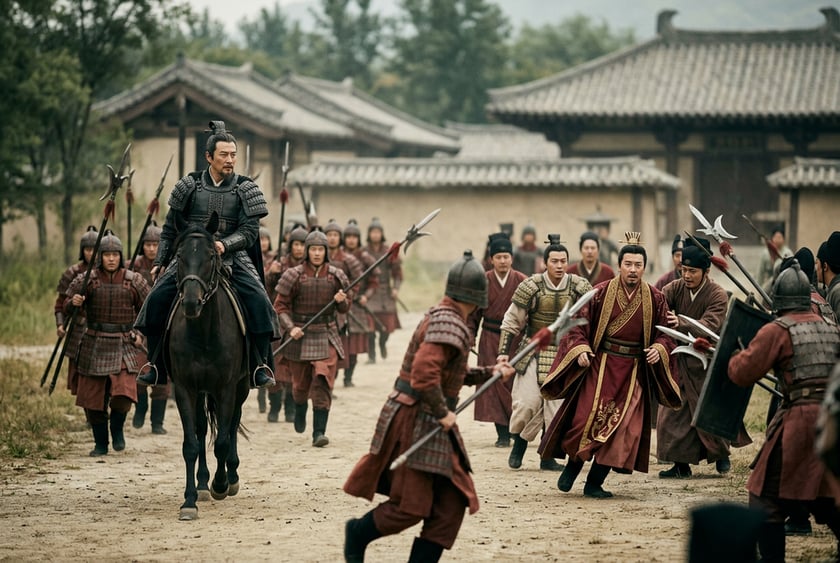
Sima Yi suddenly appears at Gaopingling at the head of his army, catching Cao Shuang and his faction off guard. The soldiers try to resist in confusion, but Sima Yi’s forces soon surround them.
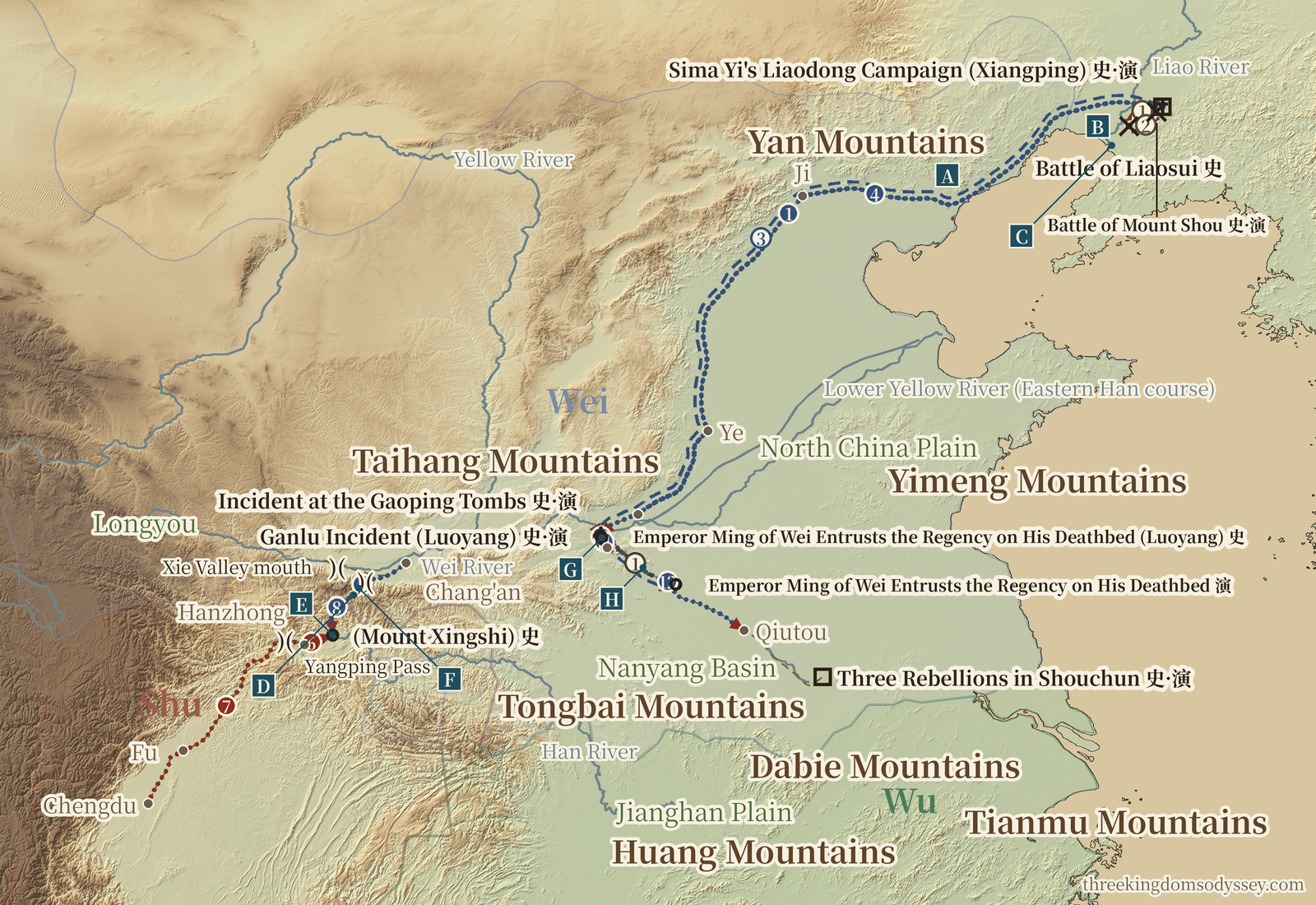
1Sima Yi marches on Xiangping40,000 menHist.Records of the Three Kingdoms, juan 3Records of the Three Kingdoms, juan 8Romance of the Three Kingdoms, ch. 106《晋书·宣帝纪》(维基文库)
2Bei Yan and Yang Zuo, sent by Gongsun Yuan, holds LiaosuiRecords of the Three Kingdoms, juan 8
3Bei Yan falls back to Mount ShouRecords of the Three Kingdoms, juan 8
4Sima Yi marches on LuoyangRecords of the Three Kingdoms, juan 3曹叡(维基百科)
5Cao Shuang and Xiahou Xuan marches on Mount Xingshi60,000–70,000 menHist.Records of the Three Kingdoms, juan 9Records of the Three Kingdoms, juan 33Records of the Three Kingdoms, juan 44
6Wang Ping holds Mount XingshiRecords of the Three Kingdoms, juan 43Records of the Three Kingdoms, juan 44Records of the Three Kingdoms, juan 33
7Fei Yi reinforces Mount XingshiRecords of the Three Kingdoms, juan 33Records of the Three Kingdoms, juan 43Records of the Three Kingdoms, juan 44
8Cao Shuang falls back to the Chang'an areaRecords of the Three Kingdoms, juan 9Records of the Three Kingdoms, juan 4
9Cao Shuang and Cao Fang marches on Gaoping MausoleumRecords of the Three Kingdoms, juan 9Records of the Three Kingdoms, juan 4Romance of the Three Kingdoms, ch. 106
10Sima Yi holds Luo River pontoon bridgeRecords of the Three Kingdoms, juan 9Romance of the Three Kingdoms, ch. 107
11Cao Shuang falls back to LuoyangRecords of the Three Kingdoms, juan 9Romance of the Three Kingdoms, ch. 107
12Sima Yi and Sima Shi and Sima Zhao marches on QiutouRecords of the Three Kingdoms, juan 28Records of the Three Kingdoms, juan 4Romance of the Three Kingdoms, ch. 110Romance of the Three Kingdoms, ch. 111
In the Romance
1Bei Yan and Yang Zuo, sent by Gongsun Yuan, holds Liaosui80,000 troopsNovelRomance of the Three Kingdoms, ch. 106
2Bei Yan and Yang Zuo falls back to Mount ShouRomance of the Three Kingdoms, ch. 106
3Sima Yi marches on XuchangRomance of the Three Kingdoms, ch. 106
Proposed, not taken
1Cao Shuang marches on XuchangRecords of the Three Kingdoms, juan 9Romance of the Three Kingdoms, ch. 107
The novel leaves out the Luo Valley campaign, and it has Cao Rui entrust his heir to Sima Yi at Xuchang; in the Sanguozhi Sima Yi is summoned to the palace from Henei.
The books mostly say only where an army set out and arrived: a Records line is solid between the places they name and dotted where it follows a reconstructed road between them; an open ring marks an end the books don't give.
Why these routes
ALiaodong was reckoned 4,000 li from Luoyang. When ministers called 40,000 men too many, Cao Rui said so long a march must rest on strength, not only on stratagem.Hist.Records of the Three Kingdoms, juan 3
BSima Yi slipped past Bei Yan's 20-li trench line at Liaosui toward Xiangping; fearing for their capital, the defenders left by night and had to fight in the open at Mount Shou.BothRecords of the Three Kingdoms, juan 8Romance of the Three Kingdoms, ch. 106
CThirty days of rain flooded the Liao and stalled the siege, but the high water also let supply boats sail from the river mouth right up to Xiangping's walls.BothRecords of the Three Kingdoms, juan 3Records of the Three Kingdoms, juan 8Romance of the Three Kingdoms, ch. 106
DThe Tangluo trail is the shortest way into Hanzhong but the roughest and driest; Cao Shuang's supply train broke down and his pack animals died.Schol.Battle of Xingshi (Wikipedia)Records of the Three Kingdoms, juan 9
ERather than fall back on the forts of Han and Le, Wang Ping went forward to hold Xingshi: help at Fu was nearly 1,000 li away, and losing the pass would be a disaster.Hist.Records of the Three Kingdoms, juan 43
FThe retreat was worse than the advance: Fei Yi seized the three ridges in the Luo Valley to cut the way home, and Cao Shuang barely fought his way out (after the Zizhi Tongjian).Schol.Battle of Xingshi (Wikipedia)
GThe Gaoping tomb lay in the hills southeast of Luoyang; holding the arsenal and the Luo River bridge put Sima Yi between the emperor's party and the capital.Schol.Incident at the Gaoping Tombs (Wikipedia)《万安山史话》浅说万安山(澎湃)Records of the Three Kingdoms, juan 9
HHuan Fan urged Cao Shuang to take the emperor to Xuchang and raise troops (half a night away, says the novel). Cao Shuang refused that road and gave in.BothRecords of the Three Kingdoms, juan 9Romance of the Three Kingdoms, ch. 107
Base map: Natural Earth; terrain: AWS Terrain Tiles (SRTM and others). Roads and marches reconstructed from the sources listed; positions approximate.
Simashiduoquan is one of the paradigmatic "powerful minister usurpation" episodes in Chinese history, yet compared with Wang Mang's displacement of the Han, Cao Pi's displacement of the Han, or Liu Yu's later displacement of the Jin, it has a distinctive quality: it was completed across generations, at a slow pace, and ultimately through institutional means rather than through a single coup. From the death of Cao Cao to Cao Pi's proclamation of the Wei dynasty took only a few months; from Sima Yi's assumption of real power to Sima Yan's replacement of Wei took twenty-seven years. Understanding the internal logic of that "slowness" is essential to understanding how the medieval gentry-aristocratic political system of China took shape. The background must be traced to the regency of Caoshuangfuzheng. The deathbed edict of Emperor Ming in the third year of Jingchu (239) appointed both Cao Shuang and Sima Yi as co-regents for Cao Fang, but Cao Shuang exploited his status as an imperial clansman to sideline Sima Yi, reducing him to the empty honorary title of Grand Tutor, while promoting He Yan, Deng Yang, Ding Mi, and other "luminaries of the Zhengshi era" to implement a new program. That program appeared on the surface to be "reformist" but was in substance a wholesale displacement of the old guard of officials and jurists by the imperial clan and the "frivolous gentry" faction. Sima Yi feigned illness and withdrew — while covertly linking himself to elders such as Grand Commandant Jiang Ji and Minister over the Masses Gao Rou, as well as commanders of the palace guards, waiting for the right moment. That is the true starting point of Simashiduoquan: not any single coup, but the counter-thrust of a long-suppressed old-gentry coalition against the exclusive power of the imperial clan.
Key Figures
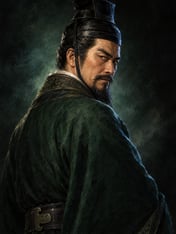
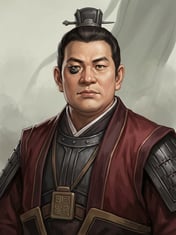
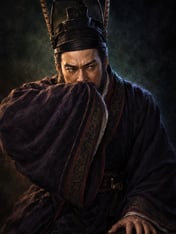
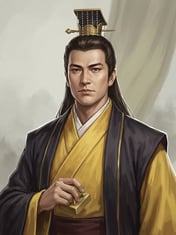
Sima Yi (179–251) was the founder. His core political assets were threefold: senior statesman of four reigns, illustrious military record, and the alliance of the official-jurist gentry class. In the Gaopinglingzhibian (249) he exploited the absence of Cao Shuang and his brothers, who had left the capital to pay respects at the Gaoling mausoleum, to launch his move: he seized the Luoyang palace guards and the city gates, and compelled Cao Shuang to yield — the brilliance of this stroke lay not in the military dimension but in the political: he pounced on the extremely narrow window of "Cao Shuang's absence from the capital" and used the legitimate rhetoric of "the late emperor's dying commission" to override the Caowei imperial clan. Sima Shi (208–255) was the consolidator. Confronted with Wang Ling's revolt (251), the cases of Li Feng and Xiahou Xuan, and Guanqiu Jian's rebellion, he dealt with every crisis by swift and hard-handed action. His deposition of Cao Fang and installation of Cao Mao (254) established the political precedent that "emperors could be replaced," making him the pivotal figure in the Simashi's transition from powerful ministers to de facto sovereigns. Sima Zhao (211–265) was the bridge. He presided over the suppression of Zhuge Dan's Shouchun rebellion (257–258), tolerated Jia Chong's assassination of Cao Mao (260), conquered Shuhan (263), and crushed the Zhonghuizhiluan — each step a dual operation of "accumulating merit" and "clearing obstacles." Sima Yan (236–290) was the finisher. In the second year of Xianxi (266) he accepted the abdication of Cao Huan and founded the Jin dynasty. Across four generations of the family, each member bore a distinct political assignment, with a clear division of labor and an unbroken chain of continuity — a mode of "family enterprise" power transmission that is exceptionally rare in Chinese political history.
Core Issues
The central question of Simashiduoquan was not "whether power could be seized" (military authority had long since been secured) but rather "how to make the seizure appear legitimate." This manifested as three successive transformations. The first was the conversion of military prestige. Sima Yi's defeat of Meng Da, his resistance to Zhuge Liang, and his pacification of Liaodong each served to establish him as an indispensable pillar of the state; Sima Shi's suppression of Wang Ling and Guanqiu Jian, and Sima Zhao's suppression of Zhuge Dan and conquest of Shuhan, all followed the same logic. The cumulative weight of these military exploits made the Simashi a family that "could not in practice be replaced." The second was the conversion of institutional structure. The Simashi exploited the support of the gentry stratum under the nine-rank examination system to shift the power base from "emperor and imperial clan" to "emperor and gentry coalition." The Caowei imperial clan, thoroughly purged in the wake of the Cao Shuang case (Prince of Chu, Cao Biao, was ordered to commit suicide on suspicion of complicity in Wang Ling's plot), lost the capacity to resist the powerful ministers. The third was the conversion through ceremonial legitimation. From the conferral of the Nine Dignities (Sima Shi, 254) to the Jin dukedom (Sima Zhao, 258), the Jin kingship (Sima Zhao, 264), and finally abdication (Sima Yan, 266), each step replicated the standard formula of Wang Mang and Cao Pi. This "following the formula" served to dress "usurpation" as a legitimate and proper political transfer, leaving no opening for outside criticism. The three transformations together constitute the most complete "institutional–military–ceremonial" tripartite project of powerful-minister succession in Chinese history.
Political Consequences
The political consequences of Simashiduoquan operate on three levels. In the short term: the Caowei imperial clan was comprehensively purged within two decades, and Cao family blood withdrew from the political stage; regional resistance (the three Huainan rebellions, Zhong Hui's revolt) was crushed one by one, and central authority was strengthened. In the medium term: the gentry stratum replaced the imperial clan as the actual prop of the regime. Chen Qun's nine-rank examination system had originally been a transitional design, but by the end of Caowei it had solidified into an entrenched system of gentry politics; with the Simashi's replacement of Wei, that stratum formally came into its own, constituting the network of the Eight Dukes of the Western Jin and their matrimonial alliances. The politics dominated by that stratum bore a pronounced "gentry-primacy" character, with imperial authority actually weakened — the institutional consequence of "relying on gentry support to seize power." In the long term: this gentry-centered politics directly nurtured the short-lived Western Jin, the upheaval of the Yongjia era, the southward flight of the aristocratic elite, and the eventual transformation into the gentry-aristocratic system of the Eastern Jin and Southern Dynasties. In this sense, Simashiduoquan was not merely a powerful minister's usurpation but a pivotal event in China's transition from the "Qin–Han system of imperial bureaucracy" to the "medieval system of gentry aristocracy." The structural changes in Caowei's late political order carry more historical weight than the power transfer itself.
Counterfactual Analysis
Counterfactual one: had Cao Shuang successfully resisted the Gaopinglingzhibian (as Huan Fan recommended — "escort the Son of Heaven to Xu Chang and issue orders to all the realm"), Sima Yi might have been executed instead, Caowei's clansmen would have maintained their exclusive power, and the process of gentry-ization of politics would have been delayed — but not fundamentally reversed, since the rise of the gentry stratum under the nine-rank system was a structural trend. Counterfactual two: had Sima Shi failed to depose Cao Fang, or had Cao Mao not been assassinated, the timetable for Simashi's replacement of Wei would have been severely disrupted, and might even have collapsed during some internal succession crisis. The Sima family's smooth completion of its generational handover was itself a low-probability event — for Sima Yi, Sima Shi, Sima Zhao, and Sima Yan all to live long enough and die of natural causes, sustaining that continuity, is extraordinarily difficult to replicate. Counterfactual three: had Zhuge Dan's Shouchun rebellion (257–258) succeeded in linking up with Sunwu reinforcements, a new axis of opposition might have formed along the Huainan–Jiangdong line, fragmenting Caowei and trapping the Simashi in a two-front war; in that situation Shuhan might well have resumed its northern campaigns, and the San Guo balance would have evolved into the complex coalition dynamic of "Simashi versus Zhuge Dan + Wu + Shu," with an outcome impossible to predict. From these counterfactuals it is clear that Simashiduoquan was a process that depended heavily on the stacking of contingencies — failure at any single node would have caused the entire edifice to collapse. Yet it succeeded in reality, and in doing so it pushed China from one era into another. That is why the San Guozhi, the Jin Shu, and the Zizhi Tongjian alike devote to this period a depth of documentation that far exceeds the surface drama — because it was, in fact, the watershed of medieval Chinese history.