Records
No victor stated
- Commanders
- Han forcesZhuge Liang
Vol. 33「大雨道絕,真等皆還」
230 CE (Taihe 4) · Hanzhong
According to chapters ninety-three, ninety-four, ninety-seven, and ninety-nine of the Romance of the San Guo, beginning in the first year of Taihe, Zhuge Liang repeatedly mounted northern expeditions against Qishan; Emperor Ming Cao Rui appointed Cao Zhen as Supreme Commander, with Guo Huai as deputy and Wang Lang as military strategist, leading two hundred thousand troops to meet him. Cao Zhen's campaign, however, went poorly from the start: his vanguard commanders Cao Zun and Zhu Zan were killed in separate engagements by Shu generals Zhao Yun, Wei Yan, Guan Xing, and Zhang Bao. Guo Huai's proposal to ally with the western Qiang tribes to strike Shu from the rear proved equally ineffective. In the fifth year of Taihe (230; placed by the Romance in the eighth year of Jianxing, autumn), Cao Zhen recovered from illness and submitted a memorial requesting permission to lead a combined army with Sima Yi through Hanzhong to attack Shu; after a private conference with Liu Ye, the Wei ruler approved the memorial. The two armies pushed directly into Chencang, but found themselves unable to establish a foothold because Zhuge Liang had burned all the buildings there in advance; Sima Yi read the heavens at night and foresaw heavy rain, advising Cao Zhen to halt and encamp. True to the prediction, rain fell for thirty consecutive days, floodwaters reaching several feet on level ground; the Wei army's equipment was all soaked and countless horses starved, and the soldiers were consumed with complaint, leaving the campaign paralyzed. The expedition ultimately came to nothing as the Shu forces waited in rested readiness and a forged surrender letter from Jiang Wei sowed mutual suspicion within the Wei army. It was Cao Zhen's final large-scale attempt to conquer Shu and foreshadowed his death by illness the following year.
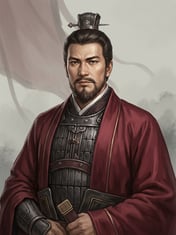 Cao ZhenCommanderTalk to me
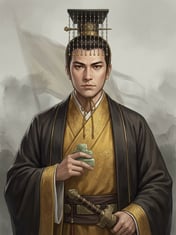 Cao RuiParticipantTalk to me
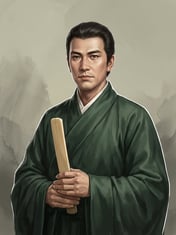 Chen QunAdvisorTalk to me
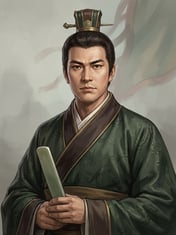 Yang FuAdvisorTalk to me
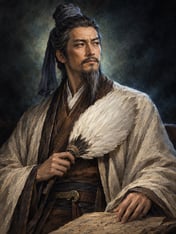 Zhuge LiangLivedCommanderTalk to me
Who won, as each book tells it; commanders as the text names them.
Records
No victor stated
Vol. 33「大雨道絕,真等皆還」
Romance
No victor stated
Ch. 99「二人遂將大軍前隊作後隊,後隊作前隊,徐徐而退」
Scene
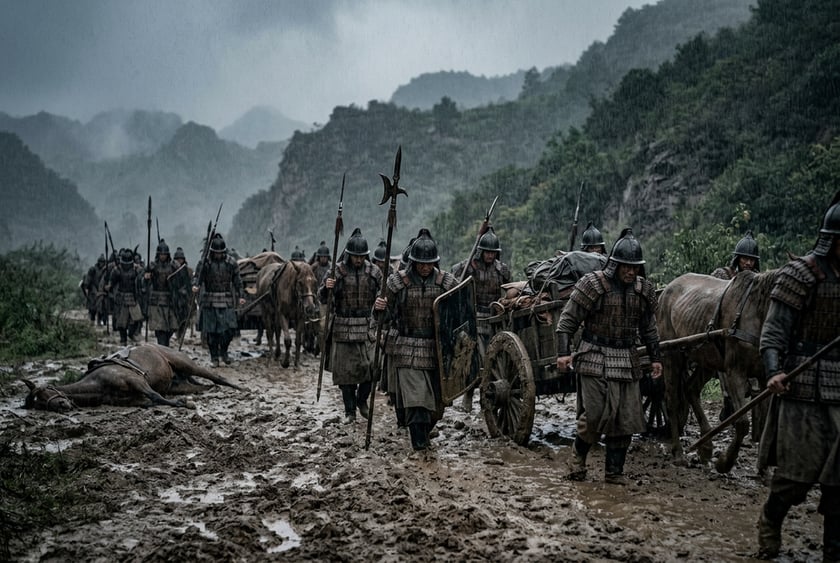
Torrential rain falls as Wei troops struggle through the mud with low morale. Horses collapse from hunger, and equipment is damaged by the damp.
Continue
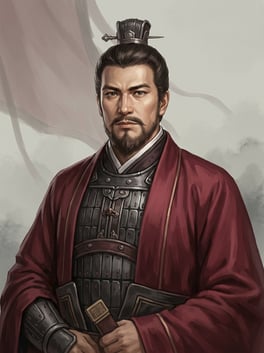
Cao Zhen shared hardships and comforts alike with his officers and men; when the army's rewards fell short he would often distribute his own family wealth among them, and so won the deep devotion of his soldiers. Steady and discerning, he could see through schemes of estrangement, acting with prudent gravity and relying on careful planning. Yet he once caused his vanguard's defeat by failing to vet the men he used, or, eager to win merit and wipe out disgrace, credulously trusted a feigned surrender, and in the end, grown arrogant, complacent, and contemptuous of the enemy, died of shame and rage.
2303 people in common
2283 people in common
2282 people in common
2282 people in common
2282 people in common
2282 people in common
2311 person in common
2281 person in common
The story of Caozhenfashu in the Romance spans chapters 93 through 99, from the first year of Taihe (227) to approximately the fourth and fifth years of Taihe (230–231), compressing into its narrative multiple events originally spread across several years. The underlying strategic situation is: from the sixth year of Jianxing onward, Zhuge Liang mounted successive northern campaigns year after year — targeting Qishan, Chencang, Wudou, and Yinping in succession — forcing Caowei to sustain enormous and prolonged military pressure along its northwestern frontier. In this period the main axis of the Caowei outer court was the "four regents," with the imperial clan representative Cao Zhen holding the western front and Sima Yi holding the southeast, while Wang Lang, Chen Qun, Yang Fu, and others sustained the central government. The Romance channels the entire strategic pressure of the western front onto Cao Zhen alone, making him the representative imperial-clan commander standing against Zhuge Liang.
The Wei side initially fielded an army of two hundred thousand, with Cao Zhen as Grand Commander awarded the staff of authority, Guo Huai as Deputy Commander, Wang Lang as Military Advisor, and Cao Zun and Zhu Zan as vanguard commanders. The main Shu force was personally led by Zhuge Liang, supported by Zhao Yun, Wei Yan, Wang Ping, Ma Dai, Zhang Yi (张嶷), Zhang Yi (张翼), Guan Xing, and Zhang Bao — forming a mid-generation cohort of generals arrayed in multiple intercepting columns. Geographically, the Wei army used Changan as its rear base, advancing westward along the Wei River toward the Qishan direction; the Shu army, relying on Hanzhong, thrust forward into the Longxi plateau and used mountain ambushes to sever the Wei vanguard from the main body. By the second major operation in the fifth year of Taihe, the Wei army was reorganized as Cao Zhen and Sima Yi jointly commanding four hundred thousand troops divided along separate routes heading straight for Jiange and Hanzhong — Caowei's last large-scale active offensive against Shu.
In the first campaign, Cao Zhen acted on Guo Huai's plan of "a night raid on the empty camp," only to run into pre-positioned ambushes; Zhao Yun, Wei Yan, Guan Xing, and Zhang Bao attacked from the rear in four columns, while the two vanguard commanders fell back and clashed with Cao Zhen's own force in mutual confusion, ultimately suffering a crushing defeat and withdrawing. Guo Huai then proposed the strategy of "linking up with the Western Qiang for a pincer from front and rear", but the Shu army lured the pursuers by feigning retreat: Wei Yan and Zhao Yun separately killed Cao Zun and Zhu Zan in battle, while Guan Xing and Zhang Bao encircled Cao Zhen and Guo Huai — the Wei army lost its vanguard commanders and fell back to the Wei River. In the second campaign, Cao Zhen, eager to redeem himself after Sima Yi had stolen his glory in the previous engagement, arrived at Chencang only to find that Zhuge Liang had already burned down all the structures inside the city in advance, denying any foothold. Sima Yi observed the sky at night and predicted heavy rain, advising Cao Zhen to halt at Chencang and build makeshift shelters to hold position — the single most critical judgment of the entire campaign. It saved the Wei army's lives, but also ensured the expedition's failure.
Rain fell at Chencang without cease for thirty days; all Wei equipment was soaked through, no one could sleep, the horses "found no fodder and died in numbers beyond count," and the troops' complaints were unceasing. Emperor Ming at Luoyang erected an altar praying for the skies to clear, to no avail. At the same time, Zhuge Liang used Jiang Wei's forged surrender letter to sow suspicion within the Wei army, further eroding Cao Zhen's will to command. The expedition ultimately returned empty-handed, and Cao Zhen, gravely ill from the campaign's defeat, died at Luoyang the following year (231). The political consequences for Caowei from this campaign were far-reaching: the last proactive offensive in the west by the imperial-clan representative Cao Zhen ended dismally, and from that point Caowei shifted its strategic posture toward Shu to "holding firm and awaiting developments," with Sima Yi personally taking over command of the Longxi front — a chain of personnel changes leading directly to the standoff at Wuzhangyuan in 234 and, a decade later, to Simashi's simultaneous grip on both the palace guard and the western front in the Gaopinglingzhibian.
Had Cao Zhen adopted a more cautious approach in the first campaign — with Guo Huai holding the Yang Pass and not allowing the vanguard to carry out night raids — could he have avoided the cascade of disasters involving lost vanguard commanders and lost Wei River camps? The narrative logic the Romance offers is "whichever option is chosen leads to defeat," because Zhuge Liang holds the advantage in intelligence and mobility at every turn. But stripping away the Romance's dramatic embellishments, the historically documented Caozhenfashu consisted of only one campaign (230), and the reasons for failure were far more straightforward: autumn rains blocked the roads, plank roads were severed, transport could not keep up. This means that even without the dramatic elements — Jiang Wei's false surrender, slain vanguard commanders, Qiang tribal rebellions — this expedition would almost certainly have failed regardless: the natural barrier of the Shu road is a structural problem that any attacking force would struggle to solve. The true significance of Caozhenfashu lies not in the battlefield outcome but in the fact that it conclusively demonstrated the infeasibility of Caowei's "proactive southward advance," pushing the strategic contest between Wei and Shu into its next phase — a long war of attrition fought primarily through defensive counterattack, supplemented by political subversion.